 Ga naar de inhoud






The past, present, and future of Beddeleem
Over the course of 75 years, Beddeleem has gradually grown from a one-person company to a team
of over 200 employees and 350 installers, steadily refining its products and services to match market
demands. Acknowledging the organisation’s forward-thinking and pioneering approach, Beddeleem
was recognised as a Best Managed Company for the third year in a row. For the latest edition of
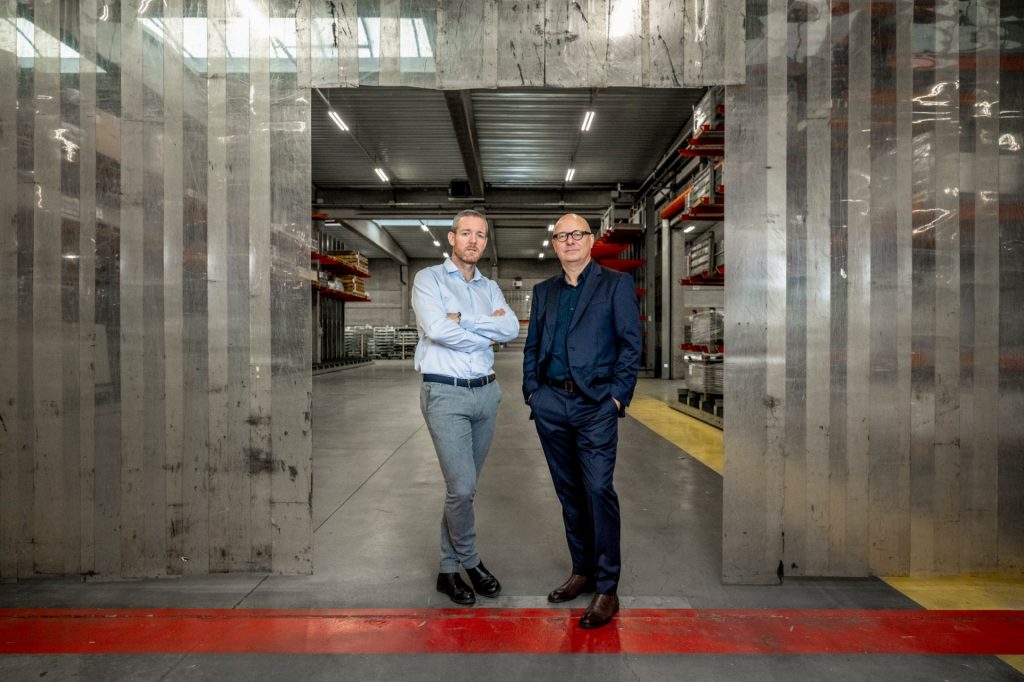
Beddeleem’s inspiration guide, CEOs Koen De Block and Jochen Daneels share their thoughts about
the current market and upcoming trends, as well as the past, present, and future of the company.
The interview
FROM A MODEST PLASTERING COMPANY TO A HOUSEHOLD NAME IN WORKSPACE
INTERIORS INTERVIEW THE PAST, PRESENT, AND FUTURE OF BEDDELEEM
“Beddeleem originally started out in 1950 as a plastering company, specialised in waterproof cellars
and ornamental moulding,” Koen explains. “But the company only experienced true growth once it
started installing suspended ceiling systems, adopted from the USA. Plasterboard walls followed soon
after, which then evolved into the increasingly popular partition walls.”
“In 1989, we asked ourselves the following question: shouldn’t this be a modular and relocatable
system?” Koen inquires. “Why aren’t we developing our own partitions? And what about windows and
doors? We wanted a system that was easy to assemble and disassemble, while steadily growing and
integrating our own production throughout the process.”
But that wasn’t the last of it for Beddeleem: “We had ceilings, we had partitions – what else do you
need in an office?” Koen asks. “Although times have changed, back then, you required a lot of storage
space. Which led to us making cabinets – ones that also worked as partitions. After cabinets,
freestanding furniture followed, and that’s when we realised, we essentially had a one-stop shop on
our hands. In addition to our products, we then started offering a total fit-out service, including the
coordination of more technical elements in specific projects, such as electricity and HVAC systems,
flooring, painting, and more in offices, educational, healthcare, sport and governmental environments.
EMBRACING THE ONE-STOP SHOP MODEL
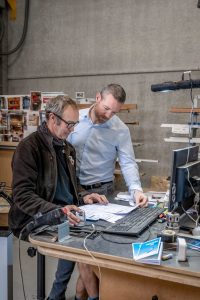
Jochen further elaborates on the one-stop shop model: “By adopting this model, we are able to
unburden clients and provide a great diversity in products and services – something that’s greatly
appreciated. Through a dedicated project manager, clients benefit from the flexibility of working directly
with Beddeleem for custom requests. Our vertical integration also means we have specialists in all areas: fire resistance, acoustics, sustainability…”
“This translates to our manufacturing process,” Koen says. “By investing in the right machinery and the
right departments, along with our automation and digitalisation projects, , all our knowledge remains
in-house in our production site in Belgium. Our capacity is significant, and we are recognised as a
Class 8 (category D, ed.) contractor in Belgium, which is the highest class available and most capable
of taking on complex, large-scale projects.”
“WE PROVIDE FULL CUSTOMISATION AND SPECIFIC CUSTOMER REQUESTS.”
“For those reasons, we can quickly accommodate upcoming trends and follow market evolutions,
allowing us to provide full customisation and specific customer requests,” Koen explains. “And we’re
talking about more than just colours: customers can choose their level of acoustics, fire resistance,
type of materials… Just ask and Beddeleem will deliver on it.” Jochen expands with an example: “The
past few years, we’ve experienced an increase in requests for improved acoustics and curved
partitions. Thanks to our extensive R&D team, we’ve been able to finetune such specific requests.”
REPRESENTING YOUR WORKSPACE CULTURE THROUGH DESIGN
The current market and workspace interior trends have also influenced how Beddeleem tackles
projects: “The direction of today’s market is a little unclear for now. Clients have become more risk-
adverse and won’t start building without guaranteed tenants. On the other hand, there’s a major focuson energy-efficient renovations in older buildings to match European sustainability norms and building
codes,” Jochen observes. “These renovations present interesting opportunities for our products: our
JB COOL climate ceilings are a great example of how clients can easily reduce energy consumption and costs.”
“We’ve seen many evolutions in how people tackle workspaces throughout the years. We’ve gone
from open spaces to closed offices, to New Ways of Working, and finally to ActivityBased Working –
fewer people grouped together, and rooms available for dedicated activities such as meetings,
informal chats, and concentration zones,” Koen mentions. “Conviviality and a central socialisation area
are a big thing in offices nowadays. The trick is mapping out your different divisions and observing the
interactions between them and placing them in a logical way to benefit productivity. That’s when – and where – an architect can work their magic.”
“CONVIVIALITY AND A CENTRAL SOCIALISATION AREA ARE A BIG THING IN WORKSPACES NOWADAYS.”
“The post-COVID return-to-office policy has made people desire a homey, cosy atmosphere in an
office,” Jochen adds. “Our production in square metres has gone down per project, but the quality of
items has gone up. Luxury aesthetics and acoustics are more in demand.”
Jochen underlines the importance of employer branding when it comes to office design: “An office
should be a place people willingly want to visit. When designing an office space, architects should
always respect and understand the culture of a company – you can’t change a company’s culture by
updating the interior, but you can enhance it.”
THE CULTURE AT BEDDELEEM
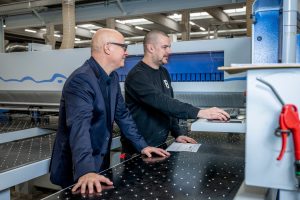
But how is Beddeleem’s culture ingrained within the company? Jochen and Koen explain their
approach as a Best Managed Company and the company’s attitude towards digitalisation, structure, and sustainability.
“We’re not walking around with a manual on how to be a Best Managed Company,” Jochen jokes. “But
the title has held us accountable and has brought structure to how we evaluate and report within Beddeleem.”
Within the company, there’s always been a drive to optimise ways of working, oftentimes as an early
adopter. Koen recalls, “We’ve been ISO-certified with ISO 9001 since 1999. Although this certification
mainly focuses on quality, the true value lies in the organisational model behind it – formalising quality
checks and implementing the company’s know-how in an automated system.”
The digitalisation of Beddeleem happened in a similar manner, according to Koen: “I’ve seen the
company evolve over time from a paper-based system to a digital one. We were a pioneer in
paperless warehouse management, and all our projects are fully documented within this system,
including every last nut and bolt. We’re always looking to optimise these systems and grow alongside
the times.”
A SUSTAINABLE APPROACH
“As for sustainability,” Koen continues, “we achieved our ISO 14001 certification back in 2011 – which
was unheard of at the time for a fit-out company.”
Jochen dives deeper into the subject: “There are many aspects to sustainability, but we’ve approached
it from different angles within Beddeleem. We were the first company in the world to achieve the
Cradle to Cradle Certified® Silver label for our partitions in 2016 – which has been renewed and
upgraded in the meantime. Beddeleem has been producing and installing circular partitions for over 35
years, long before the emergence of a circular economy, reassembling and reusing them repeatedly
within the same buildings and for the same clients. In the last five years, we started receiving more
requests for second-hand partitions. As a result, in 2021, we started the Beddeleem Circular project toassess the quality of our materials for reuse, making our used products available across projects and
clients through our Reuse range.”
“WE HAVE SEVERAL GOALS WE WANT TO ACHIEVE BY 2030.”
“This is only a recent development, but our other sustainability initiatives have been around for much
longer,” Jochen remarks. “We have several goals we want to achieve by 2030, stipulated by our
Taking Climate Action label. As a company, you need to take responsibility for the planet, and we are
always looking to improve. We have 4.200 solar panels for our manufacturing, and our employees are
equipped with electric vehicles – including an electric truck as our latest addition. Our new building will
run on electricity and will be equipped with heating pumps. These investments cost time and money, but over time, you reap the rewards.”
“Along with our sustainability officer, we also have a dedicated employee on our R&D team to focus on
this topic,” Koen adds, “and sustainability remains a significant motivator for our entire ten-person R&D
team. We’re currently researching the acoustic and fire-resistant properties of our rockwool insulation,
and we’ve replaced suppliers that are still using harmful substances in their products. We’ve also
determined that recycled aluminium is more feasible, cheaper, and sustainable to use, and is now
present in our products by up to 70%. Again, these things cost time, money, and effort, but being able
to offer a more sustainable alternative will benefit our company in the long run.”
LOOKING TOWARDS THE FUTURE
Along with the company’s sustainability goals, Beddeleem is also looking towards the future from a
business perspective. Having recently opened a new office in Switzerland, Koen and Jochen talk about future growth.
“We completed a few projects with local distributors in Switzerland in the past, and set up a joint
venture with our Swiss partners in 2024. We’re still very focused on our home markets, but the
opportunity to work together with someone who is very attuned to the local market and who believes in
our products was too interesting to pass up,” Jochen explains. “If a similar opportunity were to arise in another country, we’re open to exploring it.”
“With so much potential in our home markets, we’re not actively looking for further international
expansion,” Koen clarifies. “Our strategy is currently very opportunistic. We’ve been lucky to
experience stable growth that matches our capacity and market demand. Exponential growth wouldn’t
be healthy or sustainable. We just want to keep going in the same way we’ve always done.”


