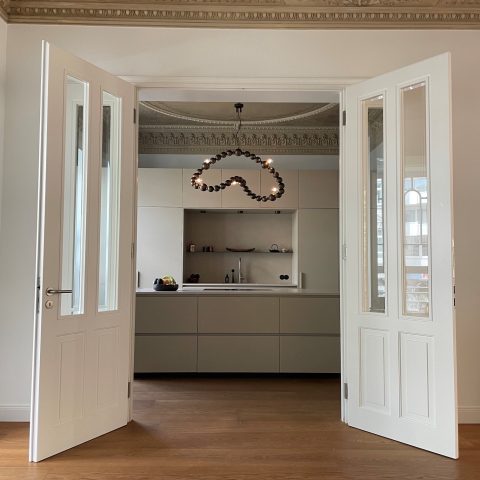









Classic interiors with light sculptures
A high ceiling changes the way a room accepts light. In these classic interiors, the fixtures do more than brighten the space: they sit against moldings, panelled walls, and dark surfaces as clear focal points. The open metal frames, glass globes, and warm bulbs pull attention upward, where the ornamented ceiling gives the composition a fixed frame.
Light sculpture in a classic interior as the central gesture
The strongest images place a light sculpture in a classic interior where a dining table, sofa, or bed sits below it. The scale matters. A suspended form with multiple light points can hold its own in a room with tall proportions and decorative plasterwork, while the open structure keeps the fixture from feeling heavy. In one dining setting, a round table and six chairs sit under a gold-toned frame with colored glass elements. In another view, a chandelier-style piece hangs above a seated area, turning the ceiling into part of the composition.
That role is repeated across the project: the lamp is not background lighting, but the object that organizes the room visually. Dark walls sharpen the outline of the metalwork. White ceiling trim lifts the eye to the upper edge of the space. Warm light, reflected in glass spheres and polished tubes, gives each piece a clear silhouette against the darker surroundings. The result is a modern chandelier for classic interiors that reads as a sculptural presence rather than a standard ceiling fitting.
High ceilings, moldings, and the room around them
Classic rooms often need something that can match their height. Here, the high ceilings do that work themselves through ornament, cornices, and wall panels, but the fixtures add a second layer. A pendant suspended far below the ceiling can draw the upper volume into the room below, especially when the metal structure is open enough for light to pass through. The contrast between plaster details and crisp linear frames is what gives these interiors their tension.
Several images show dark, textured walls with framed panels, then a bright ceiling edge above them. That shift matters. It creates a clear horizontal break, and the lighting hangs in the middle of that visual field. In the bedroom view, the bed, curtains, and paneled walls sit quietly, while the suspended fixture takes over the upper zone. In the living room scenes, the same principle appears through a strong object at the center of a large room, with furniture kept low and visually restrained beneath it.
Open metal forms and glass globe pendants
The fixtures in this series rely on structure. Thin metal rods, curved arms, and ring-like connections define the shape before the bulbs do. In close-up views, the frame becomes almost graphic, with warm points of light scattered through the network. Some designs use glass globe pendant lamp elements, others lean toward cage-like or dome-like outlines, but all of them keep the construction visible. That openness is what lets the piece stay readable in a classic room with moldings and paneled walls.
Color is handled with the same restraint. Black background walls make the light bodies appear sharper, while chrome, gold, and bronze accents reflect small highlights. In one image, a cluster of round glass elements catches the glow and makes the fixture feel denser; in another, a more skeletal version leaves more negative space inside the form. Both approaches support the same idea: lighting for high ceilings needs presence, but it also needs enough air around it to let the room stay legible.
Statement pendant above dining table and other room settings
The statement pendant above the dining table is one of the clearest scenes in the project. A marble-like round table, six chairs, and a dark wall create a controlled setting, and the lamp becomes the main visual counterweight. Its metal frame and glass elements break up the vertical space above the table, giving the dining area a distinct center without enclosing it. The same logic appears in the other rooms, where a sofa, a bed, or a simple rug remains secondary to the fixture above.
Because the images move between dining room, living room, and bedroom scenes, the project reads as a study in how the same lighting language adapts to different classic interiors. A bedroom setting asks for a softer reading, so the large fixture sits near curtains and a upholstered headboard. A living room allows a more theatrical profile, with panelled walls and a strong ceiling line behind it. Each room keeps its own proportions, yet the lighting sculpture remains the element that connects them.
Made to be seen from below
Viewed from underneath, these lamps reveal their construction most clearly. The metal arms, joints, and circular elements form a pattern that changes with each angle. Some pieces look almost like a suspended canopy; others read more like a branching chandelier. Warm bulbs sit deep in the frame, so the light does not flatten the design. It is the spacing between parts, not just the parts themselves, that gives the fixture its presence in the room.
The source text notes that these light sculptures are made by hand, which helps explain the variation between the different forms shown. Even when the shapes share a family resemblance, they do not repeat mechanically. One model uses glass spheres, another focuses on slender rods, and another opens into a dome-like network. That variety suits classic interiors, where ceilings, panels, and wall moldings already provide strong architectural detail. The lamp has to respond to that setting, not disappear into it.
A long-running approach to sculptural lighting
The project text describes more than thirty years of work in light sculptures, including designs for older castles and newly built villas with a classic style. That long span helps explain the confidence of the forms here. They do not depend on ornament alone; they rely on proportion, spacing, and the way light is held inside the frame. The visible collections named in the source material point to a broad body of work, but in the images the shared thread is more important: a sculptural fixture placed where a classic room needs a strong focal point.
What stays with the viewer is not a decorative flourish, but the relation between object and room. A dark wall gives the metal structure definition. A high ceiling allows the pendant to hang as an independent volume. Glass spheres and open frames catch the light differently in each scene, from dining room to bedroom. That is where the project finds its strength: in the way a light sculpture in a classic interior can shift the room’s reading without changing its architecture.
Want to see more of Brand van Egmond – Light Sculptures? View the page of Brand van Egmond – Light Sculptures for even more great projects and company information.




NEW 2026 Jubileum Edition The Best Interior Designers Benelux
Order Now €125


NEW 2026 Jubileum Edition The Best Interior Designers Benelux
Order Now €125


NEW 2026 Jubileum Edition The Best Interior Designers Benelux
Order Now €125


NEW 2026 Jubileum Edition The Best Interior Designers Benelux
Order Now €125