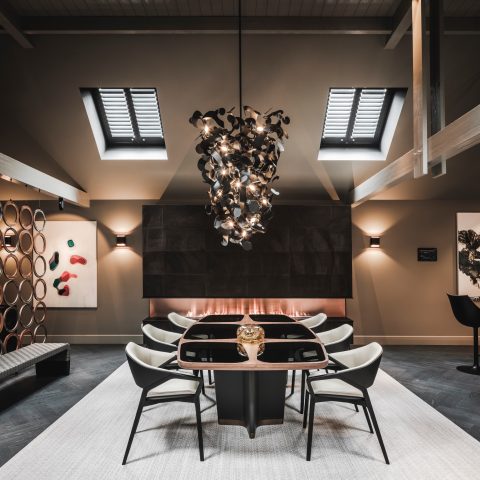








Sculptural pendant lighting in a rustic interior
Glowing glass spheres and dark metal arms set the tone before the room itself does. In these interiors, sculptural pendant lighting takes the lead, hovering above a kitchen island, an oval dining table, or a quiet seating area where wood beams and pale walls act as a backdrop. The pieces read less like fixtures than like objects with their own outline, especially when warm light gathers inside the glass and the metal branches spread outward.
Statement lighting above kitchen and dining tables
The clearest scenes place the lights at the centre of daily space: over a black kitchen block with a double sink, above a long dining table, or in front of a broad window that looks out to greenery. The contrast is strong and easy to read. Dark surfaces hold the lower part of the frame, while the sculptural pendant lighting brings motion overhead through clusters of globes, layered arms, and vertical light elements. In a modern rustic interior, that shift matters more than decoration alone.
Several images show round glass pendants arranged in groups, with gold-toned metal connecting the parts. Others use slimmer rods and open frameworks, which give the lamps a branched or treelike profile. The forms vary, but the effect stays consistent: statement lighting that marks the room without closing it off. Against light walls or a marble-like floor, the metalwork becomes easier to read, and the glass picks up a warm core of light.
Glass and metal lighting with a warm core
Seen close up, the materials do most of the talking. Glass globes, brushed metal rings, bronze-toned stems, and black supports create a steady rhythm of hard and soft surfaces. In one detail, the warm bulb glow sits deep inside several glass spheres; in another, the metal structure is a dense knot of rods and joints. These are not flat decorative shapes. They carry weight, reflection, and shadow, which is why glass and metal lighting works so strongly in rooms with timber, stone, and pale plaster.
The source text describes the light sculptures as characterful, surprising, and slightly sensuous. That description matches the images without needing more explanation. The lamps do not disappear into the ceiling. They interrupt the room with curved lines, hanging points, and a sense of movement. The gold design lighting, in particular, stands out when paired with dark millwork or a shadowed background, where every reflective edge becomes visible.
Branch-like forms and globe pendant lights
Some of the most striking pieces use branching arms that spread outward from a central point. Those forms recall twigs or small canopies, a reference that fits the note about nature as a source of inspiration. Elsewhere, the composition is built from globe pendant lights suspended in clusters, each sphere catching the light differently. The mix of round shapes and linear metal gives the collection a direct presence, especially above a dining table where the lamps can be read from several angles at once.
That variety is useful in a modern rustic interior. A room with beams, stone, or wood paneling can take a more open lamp structure without feeling crowded. In the larger seating view, a silver-toned pendant with multiple globes hangs near a pale sofa and a window wall, while in the dining scenes the lamps sit lower and feel more intimate. The objects stay visible, but the architecture around them remains calm.
Rustic light sculptures in rooms with wood and stone
Wood appears in several places as a counterpoint rather than a theme. A beam ceiling cuts across a dining room, and a lighter timber structure frames another room with a series of hanging fixtures. In these settings, rustic light sculptures are not there to imitate the house. They are placed against it, so the shapes can be read more clearly. Stone and marble surfaces sharpen that effect, especially when the floor reflects a little of the warm light from above.
The images also suggest a careful use of contrast. Light walls meet dark cabinetry. A black kitchen island sits under a gold pendant. A pale sofa sits beneath a metallic cluster of lights. These pairings make sculptural pendant lighting easy to spot in a room, even from a distance. The lamps become the first visual stop, then the eye moves to the table, the window, or the beam above it. That sequence gives the whole interior a strong visual order without overstatement.
What the collections add to the room
The page mentions Galaxy, Linea, Ersa, Sultans of Swing, and Orpheus. The text does not pin each image to one collection, and the photographs do not need that level of matching to work. What matters is the shared language: glass and metal lighting shaped into hanging compositions that feel expressive rather than plain. Whether the form is a globe cluster, a linear strand, or a branch-like chandelier, it is treated as a visible object in the room rather than background light.
That approach is strongest where the lamps hang over a kitchen or dining table. The furniture gives scale, the ceiling height gives room to breathe, and the sculptural pendant lighting supplies the focal point. In a darker close-up, the warm bulbs glow inside the structure like small lanterns. In a wider interior view, the same family of forms reads more softly, but still defines the center of the space. It is this shifting scale that makes the lighting useful across different rooms.
Light, shadow, and the natural reference behind the forms
The nature reference appears not as literal imitation but as a set of cues: branching arms, clustered points of light, and forms that seem to grow outward. That is where the design feels closest to its source. The same quality comes through in the contrast between black metal and glowing glass. One contains the shape; the other releases it. Together they create a clear silhouette against pale walls, wood ceilings, and window light.
Across the kitchen, dining room, and living room scenes, the lamps keep the same role: they anchor the view and make the room easier to read. The modern rustic interior gives them room to stand out, while the handworked look of the metal and the glow inside the glass keep them from feeling rigid. As statement lighting, they do exactly what the project suggests: turn light into an object the room can be built around.
If you want to explore the work behind these light sculptures, see the Brand van Egmond partner profile, browse related interior lighting projects, compare more pieces in the category page sculptural lighting, or view a related project page pendant lighting.
Want to see more of Brand van Egmond – Light sculptures? View the page of Brand van Egmond – Light sculptures for even more great projects and company information.




NEW 2026 Jubileum Edition The Best Interior Designers Benelux
Order Now €125


NEW 2026 Jubileum Edition The Best Interior Designers Benelux
Order Now €125


NEW 2026 Jubileum Edition The Best Interior Designers Benelux
Order Now €125