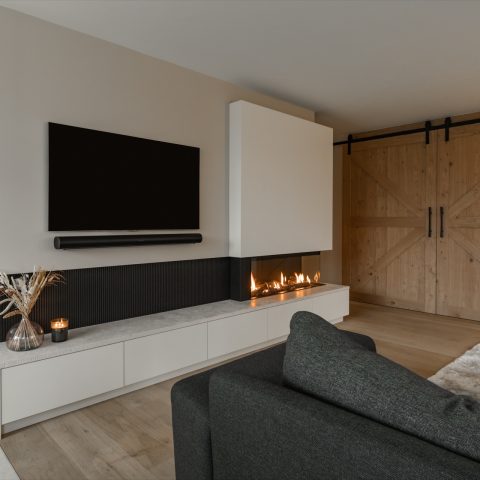








Art Deco steel sliding doors with side panels
Black steel lines cut across the room before the eye reaches the patio beyond. The art deco steel sliding doors with side panels set the rhythm of the space through their flat divisions, figure glass and the specially developed handles. What first reads as a strong graphic frame becomes more nuanced on closer view, especially where the glass is divided into clear panels and the sliding leaves move along both the wall and the fixed side elements.
Geometry in the glass and frame
The most direct reference to art deco sits in the geometry. Repeated rectangles, narrow verticals and crisp intersections give the doors their presence without adding bulk. The slim black steel profiles keep those lines sharp, while the figure glass softens the view just enough to separate the living area from the patio side. In a room with light walls and a pale floor, the darker frame holds the composition in place and makes the glazing read as part of the architecture rather than a loose insert.
These steel sliding doors with side panels are not built around ornament for its own sake. The visual effect comes from proportion and division. Each panel has a clear role in the overall grid, and the fixed side sections extend that pattern so the opening feels wider and more considered. Seen from the living room, the doors form a screen of black lines and glass planes that stays legible even when the sliding leaves overlap.
Special handles and figure glass
The handles are part of that visual discipline. They were specially developed for this project, and their shape follows the restrained language of the frame instead of competing with it. Together with the geometric glass steel doors, they give the set a precise, composed look. The glass itself is not plain and transparent throughout; the figure glass introduces another layer, breaking up direct sightlines and giving the doors a more distinct character when daylight moves across the panes.
That detail matters in a space like this, where the doors are seen not only as a partition but also as a facing element in the room. The handles, the divided glass and the steel bars all sit close to the eye. Nothing is exaggerated. The result depends on exact placement and on the way each line meets the next, which is where art deco steel doors often reveal their strength: in control of structure rather than decoration.
Sliding movement across wall and side panels
The movement of the doors adds another layer to the project. These are soft close sliding doors, so the opening and closing happens without the abruptness that larger panels can sometimes bring. The leaves slide partly over the fixed steel side panels and partly over the wall, which creates a shifting overlap as they move. That offset changes the depth of the composition and keeps the opening visually active even when the doors are closed.
In daily use, that movement is as visible as the frame itself. The doors do not disappear into the background; they travel along a clear route and make the transition between spaces readable. Because the side panels remain fixed, the opening keeps its structure whether the sliding sections are open or shut. In a steel sliding doors living room setting, that matters: the room keeps its definition while still allowing a direct line of sight through the glass.
Quiet motion in a busy opening
The soft open and close function is described as user-friendly and quiet, and that suits the character of the installation. Large steel doors can dominate a room if every action becomes a visual event. Here, the mechanism tempers that effect. The sliding motion stays controlled, so the doors can be used often without drawing attention away from the frame, the glazing pattern or the light passing through the opening.
That restraint also reinforces the material contrast. Steel gives the structure its outline; glass introduces transparency and reflection; the moving panels add a measured change of position. Together they create a clear spatial sequence. The doors can open the room toward the patio or close it off again, but they always keep the same graphic order. The details are not loud, yet they set the tone of the whole composition.
Ultra slim profiles that keep the view open
SteelDoorsHuys describes its work through ultra slim steel profiles, and that is visible here in the narrow black lines that frame the panes. The profile thickness is kept minimal so the glass remains dominant in the composition. Instead of a heavy perimeter, the doors rely on precision and tight detailing. That approach suits the project well, because the geometry needs enough structure to read clearly, but not so much steel that it closes the opening visually.
The result is a set of slim black steel profiles that works as both frame and drawing. The lines trace the divisions across the height and width of the doors, then continue into the fixed side panels. Seen against the lighter interior, the steel profile gives the glass a stronger edge. The opening feels deliberate, and the view toward the patio remains visible through the grid of panes rather than being lost behind a dense frame.
How the living room uses the opening
The living room setting is important because it shows how the steel sliding doors with side panels operate in daily life. The doors sit in a light interior, where the contrast between pale surfaces and dark framing is immediate. That contrast is what makes the openings easy to read from across the room. One glance picks out the sliding leaves, the fixed side elements and the route out toward the terrace or patio, all within one coordinated frame.
At the same time, the doors do not lock the room into a single view. Because the panels overlap the wall and side sections, the composition changes as soon as they move. That movement brings depth to the room without requiring a change in materials elsewhere. The furniture is kept in the background; the steel and glass take the lead. This is where the art deco steel doors become more than a divider: they organize the living space through line, transparency and movement.
A project built around precision, not excess
What stands out most is the discipline of the whole assembly. The geometric glass steel doors, the specially developed handles, the soft close sliding doors and the fixed side panels all work within the same visual language. Nothing tries to stand apart. The steel remains slim, the glass remains readable, and the door movement stays calm. That is why the piece feels resolved without needing extra ornament or a complicated backdrop.
For a project like this, the strength lies in the exacting relationship between parts: the black frame, the figure glass, the overlapping sliding leaves and the wall they run along. Each element is visible, and each one serves a clear spatial role. The opening to the patio becomes part of the living room composition, not an interruption to it. That is the real value of these art deco steel sliding doors with side panels: they turn a practical passage into a precise piece of interior structure.
Want to see more of StalenDeurenHuys? View the page of StalenDeurenHuys for even more great projects and company information.