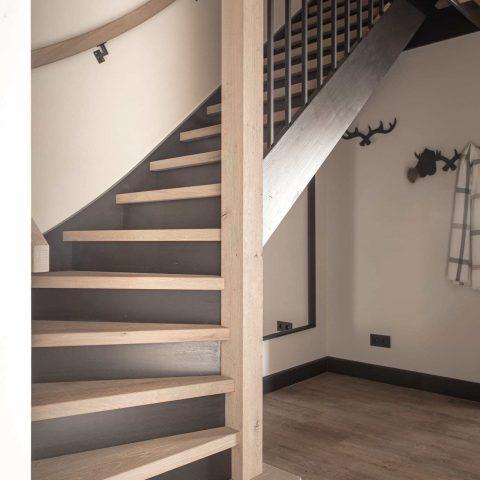







Classic white staircase with runner
The dark runner draws the eye up the steps before the white joinery takes over: spindles, handrail, and newel post all sit against a light entrance hall. The contrast is direct and easy to read. Underfoot, the runner trims the stair treads with a clear edge, while the pale wood floor below keeps the space open and bright. It is a classic white staircase with runner, and the details are visible from the first glance.
A staircase that reads clearly from the hall
Seen in full, the staircase moves through the room with a steady line. The white balustrade follows the rise without interruption, and the vertical spindles give the side view a measured rhythm. Light walls and the pale timber floor frame the stair rather than competing with it. The result is a calm entrance sequence shaped by simple contrasts: white paint, dark textile, and the soft grain of the floorboards.
The classic staircase is not trying to disappear. Its profile is present in the hall, especially where the stair turns and where the railing continues onto the landing. Those transitions matter here. They show how the staircase links the lower floor to the gallery above, using the same white finish to hold the route together from one level to the next.
White spindles and a rounded newel post
At closer range, the staircase detail becomes the main subject. The spindles are slender and evenly spaced, and the newel post has a rounded, turned form that gives the composition a more traditional note. The white paint keeps the carving and profiles legible instead of flattening them. Even in a simple close-up, the staircase detail carries the character of the whole project.
That same white balustrade continues around the stair run and onto the upper edge of the open space. From one angle, the railing looks almost architectural in its repetition; from another, it becomes a sequence of posts and rails that guide the eye. The staircase detail is strongest where the curves and verticals meet, especially around the top of the newel post and the transition into the handrail.
The runner as a visual line
The dark runner on the stairs does more than cover the treads. It draws a straight, dark line through the centre of the white stair flight and gives the steps a sharper reading. Each tread edge remains visible, but the textile softens the surface enough to break the effect of painted timber alone. In the wide shot, that runner acts as a guide. In the close-up, it becomes a textural layer with a clearly defined border.
Because the runner is dark, the white staircase stands out even more strongly. The contrast is simple, but it carries through the whole composition. The stair front, the spindles, and the handrail stay light; the runner anchors the centre. This is where the classic white staircase with runner gains its strongest visual tension, not through ornament, but through the way the materials meet along the step line.
Raised above a pale timber floor
The entrance hall around the stair is equally restrained. A pale wood plank floor runs across the base of the composition, and its lighter tone keeps the hall open. White door and window openings appear in the background, echoing the staircase finish and helping the stair feel integrated into the room. Nothing competes with the stair; instead, the hall gives it space to read in full.
That bright setting also makes the upper gallery and balustrade easier to follow. The horizontal railing at the landing forms a clear edge above the stair run, while the vertical spindles continue the same language around the open void. The white staircase therefore works on more than one level: as a stair, as a rail, and as a room divider inside the entrance hall.
Side view, landing, and the turn of the rail
The side view shows how the staircase settles into the room. The white under-edge of the stair run appears continuous, and the balustrade traces the rise with a steady line. At the landing, the railing shifts direction and frames the opening above. That change in angle is one of the clearest parts of the project, because it reveals the stair as a route rather than a single object.
On the gallery side, the spindles become more repetitive and the rail sits lower in the frame, making the upper level feel lighter. The classic staircase keeps its character in these transitions. Even without extra decoration, the combination of rounded post, slim spindles, and the dark runner on the steps gives the stair a precise profile. It is a white staircase, but not a flat one; the shadows between parts make the detail visible.
From the lower hall to the upper landing, the eye keeps returning to the same elements: white balustrade, dark runner, pale floor, and the rounded newel post. They are simple parts, but together they define the project clearly. In the image set, that clarity matters more than any single decorative gesture. The staircase is best understood through its detail, its line, and the way it holds the entrance hall together visually.
Want to see more of Bronkhorst Machinale Houtbewerking? View the page of Bronkhorst Machinale Houtbewerking for even more great projects and company information.



NEW 2026 Jubileum Edition The Best Interior Designers Benelux
Order Now €125


NEW 2026 Jubileum Edition The Best Interior Designers Benelux
Order Now €125