







Mediterranean Garden with Pool and Rounded Composite Deck
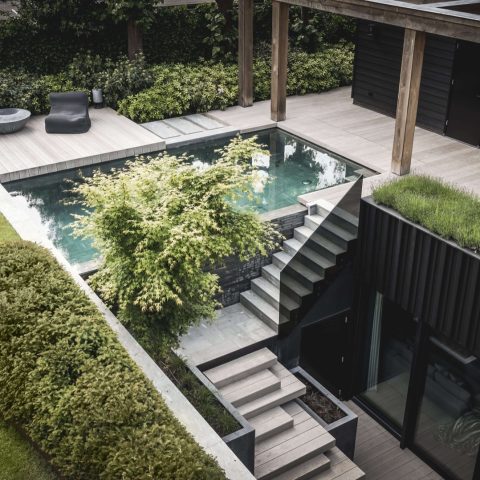
The pool sits in the middle of the garden as a clear, calm shape, with a rounded composite pool deck drawing the eye around its edge. The warm wood tone softens the hard line of the water and gives the terrace a different register from the surrounding stone. Around it, planting beds, lawn, and low borders keep the composition open, while a large umbrella marks the terrace as a place to pause close to the water.
A rounded edge that guides the view
The most noticeable move is the curved finish of the deck beside the pool. Instead of stopping in a straight line, the rounded pool deck wraps the water and creates a gentler transition between swimming area and terrace. That curve is repeated in the nearby stone edging, so the eye moves in small arcs rather than sharp breaks. In a garden with strong horizontal surfaces, that detail gives the pool a more settled presence.
Visible from several angles, the rounded edge also changes how the pool is read in relation to the lawn. The water is framed, not boxed in. The deck follows the contour closely, and the surrounding planting beds sit just beyond it, which keeps the whole setting compact without feeling crowded. The result is a pool zone that opens toward the rest of the garden instead of separating itself from it.
Warm composite against stone and water
The deck is finished in a composite pool deck with a grain-like surface in a warm, coppery tone. That surface sits next to natural stone pool edge elements and stone retaining walls, making the material contrast easy to read. The stone stays visually firm and pale against the darker decking, while the wood tone introduces a quieter note close to the water. Together they keep the terrace from becoming one flat plane.
From the image material, the deck boards, stone borders, and adjacent paving belong to the same outdoor sequence even though each surface behaves differently. The composite finish pulls the terrace toward the pool, while the stone marks the edges and changes height where needed. It is a practical arrangement in visual terms: the materials do not compete, and each one has a distinct role in the garden by the pool.
Planting beds and lawn around the pool garden
Green borders run around the pool and soften the hard geometry of the paving. The planting is not pushed to the edge of the frame; it sits in pockets and bands that break up the surfaces and leave open views across the garden. Lawn fills the broader areas, so the pool garden does not read as a single paved field. That mix of grass, shrubs, and planted beds gives the space its Mediterranean garden character without overloading it with detail.
The planting also works as a visual buffer between terrace and garden. Near the pool, the beds tighten the composition; farther out, the lawn opens it again. This alternation keeps attention on the rounded deck and the water, while still giving the surrounding garden a clear role. The result is a layout where the pool remains central, but the planting prevents it from feeling isolated.
Terrace details close to the water
A large umbrella anchors the terrace area and introduces a vertical element above the low deck and paving. It is a simple addition, but visually it matters because it gives scale to the open surface around the pool. The terrace furniture sits low against the deck, so the umbrella becomes the clearest marker of use in the scene. It also helps define the patio with umbrella as a separate part of the garden without adding walls or heavy structures.
The terrace finish itself is visible as a continuation from the pool deck toward the seating zone. That change of surface is subtle, but it keeps the circulation legible: water, deck, terrace, then planting. Each move is distinct. The garden does not rely on decoration to make that sequence clear; the materials and their edges do the work, especially where the stone borders meet the composite boards.
How the composition holds together
What gives the garden its presence is the relation between the pool, the rounded pool deck, and the planted perimeter. The water shape is held by stone, softened by the composite surface, and set into a framework of lawn and border planting. Because the curve is visible at the edge of the deck, the eye keeps returning to the center. That makes the pool garden easy to read, even with several materials in play.
The project also shows how a few well-placed surfaces can shape the mood of an outdoor room. The natural stone pool edge keeps the outline crisp. The composite pool deck adds warmth close to the water. The lawn and planting borders keep the garden from flattening out. Together they form a Mediterranean pool garden that is defined less by ornament than by the way each material meets the next.
Project notes visible in the images
The images show the rounded deck edge, the stone retaining walls, and the planted edges in one continuous outdoor composition. They also show how the seating area sits back from the pool, leaving the waterline free. That spacing matters. It gives the rounded deck room to read as its own shape and keeps the terrace from feeling pressed against the pool. The surface changes stay legible throughout.
Seen as a whole, the garden is built from clear gestures rather than many separate features. A curved deck, a natural stone pool edge, lawn, and planting beds are enough to set the rhythm. The warm-toned composite boards draw the pool into the terrace, while the surrounding greenery pulls the eye outward again. It is a quiet sequence, but a well-ordered one, and that is what makes the garden by the pool memorable.
Want to see more of Wooddeck? View the page of Wooddeck for even more great projects and company information.