




Black marble-look bathroom accessories with white veining
Black marble-look bathroom accessories with white veining set the tone before anything else in the room. The dark surface draws the eye, while the pale veining breaks across it in fine lines, especially against the light stone wall and the concrete floor seen in the images. It is a restrained palette, but not a quiet one. The contrast does the work: black, white, and grey materials standing close together, with rounded forms softening the harder edges of the setting.
black marble-look bathroom accessories with white veining as the architectural starting point
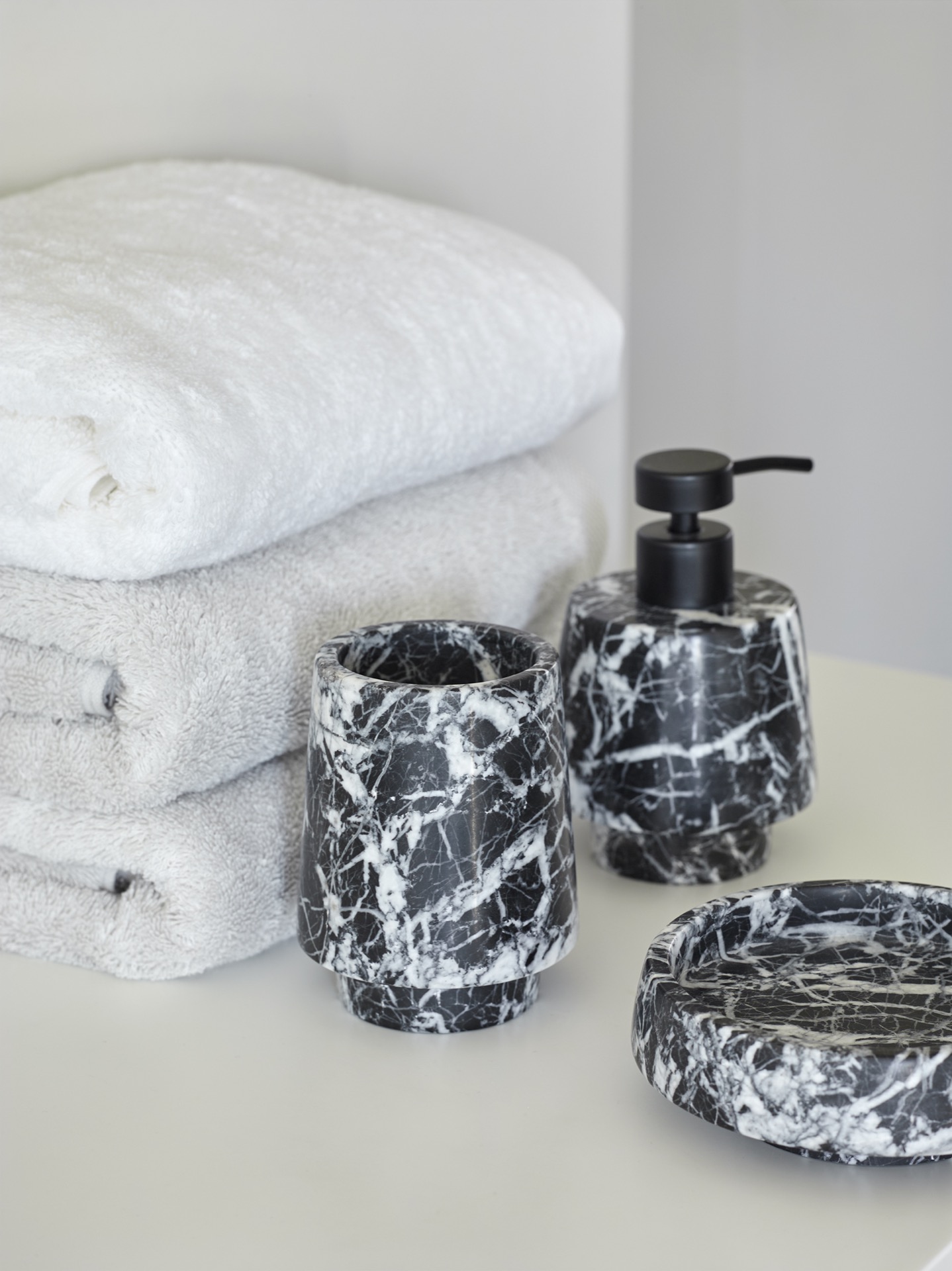
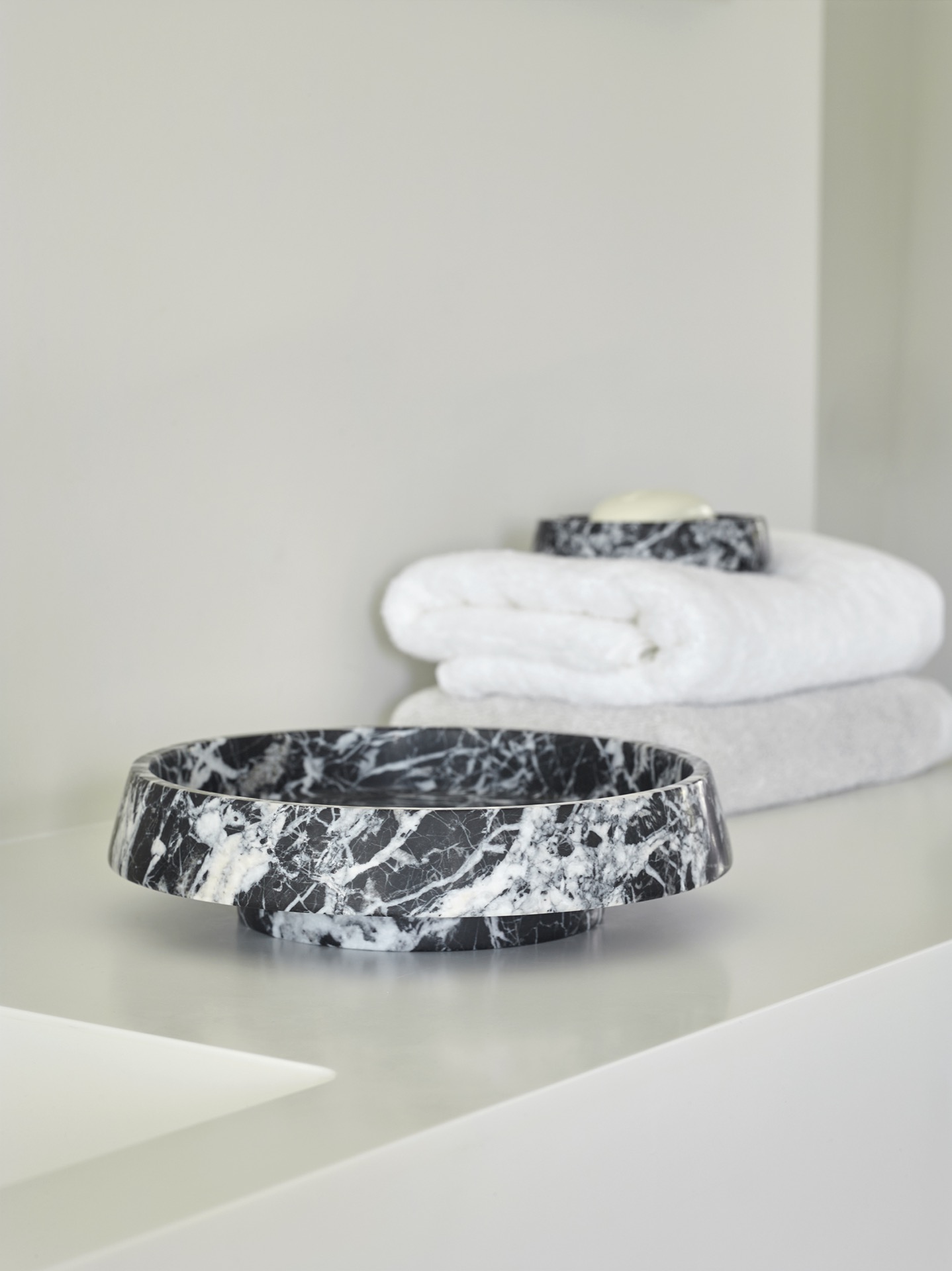
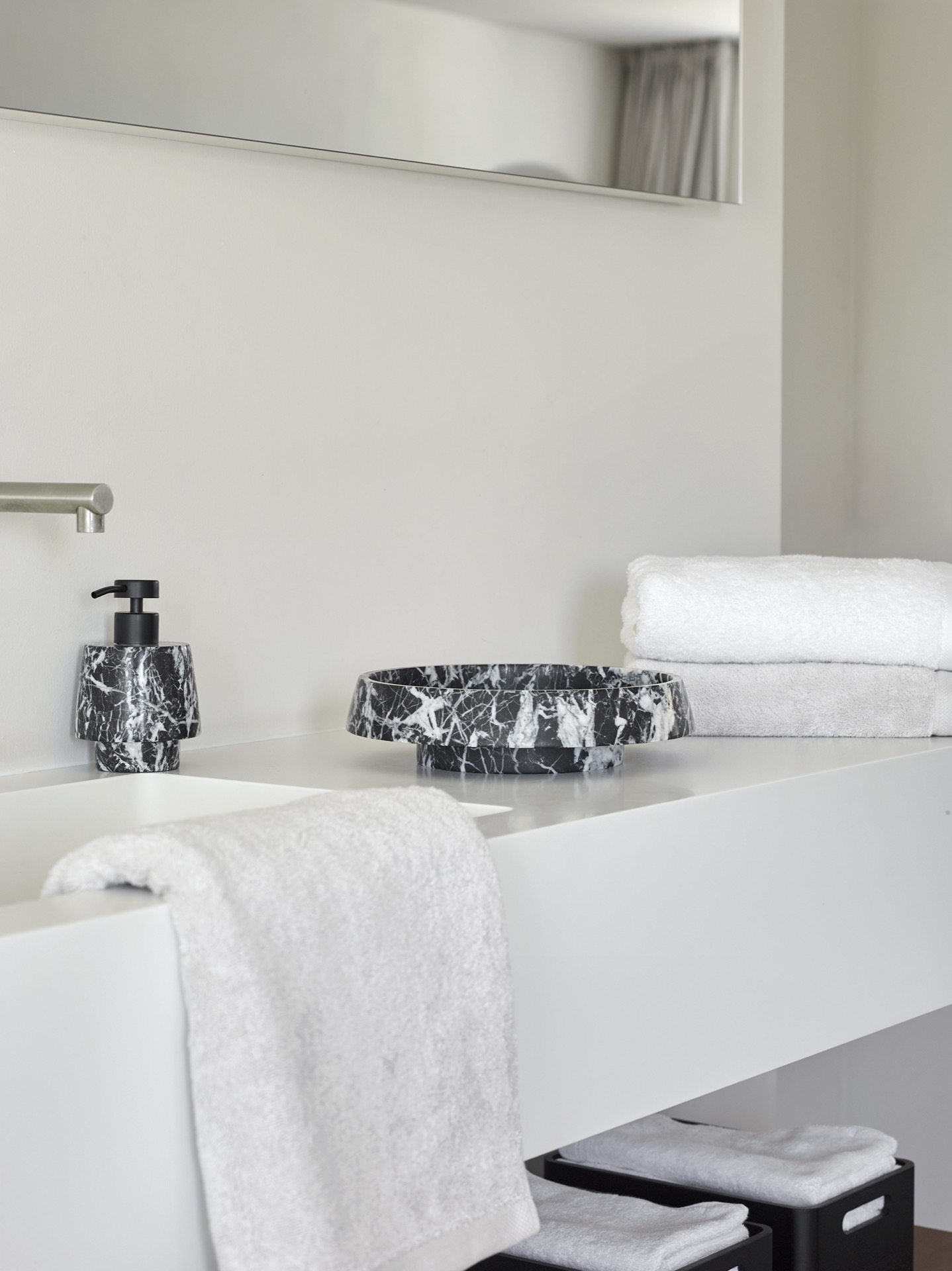
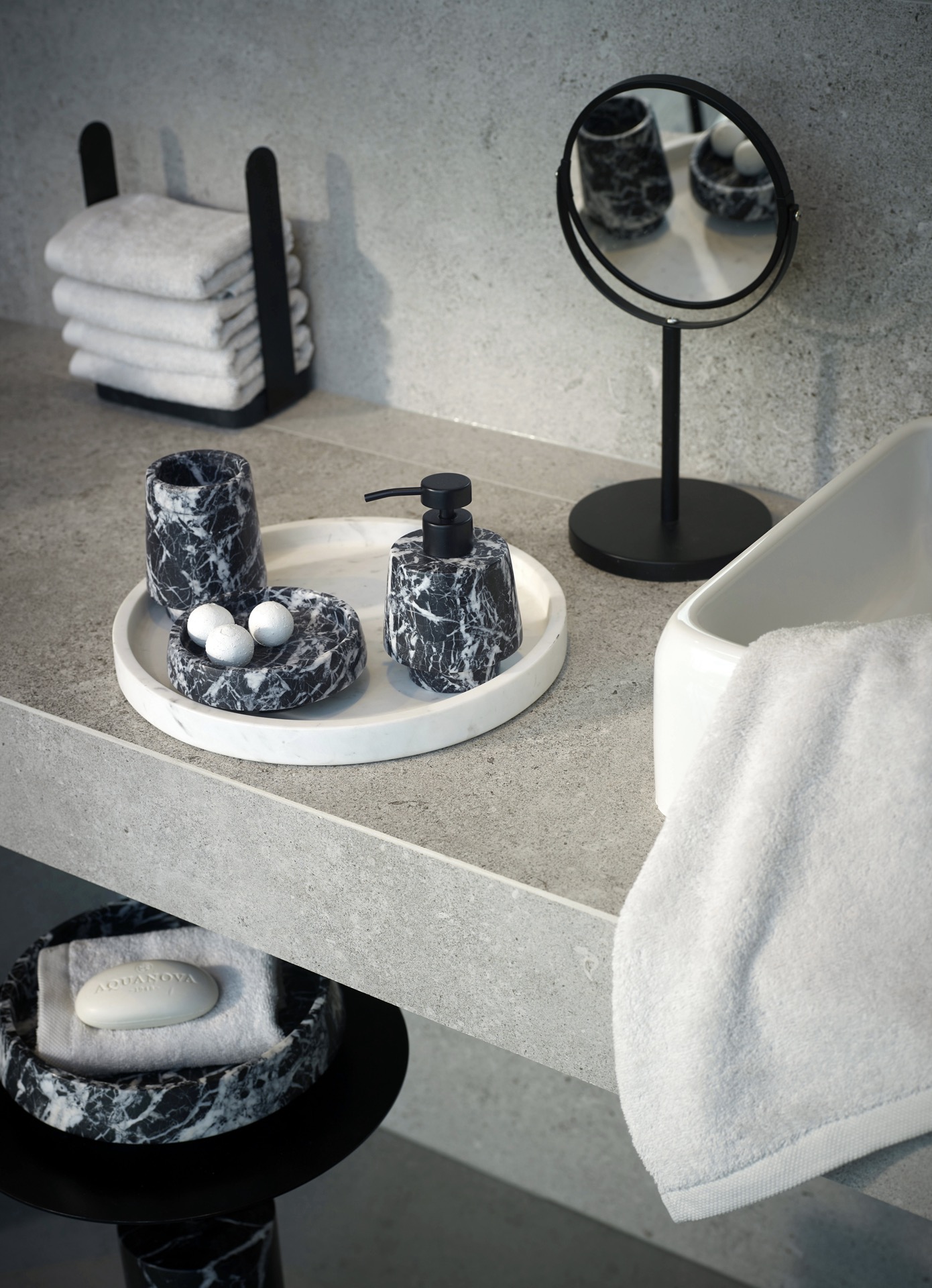
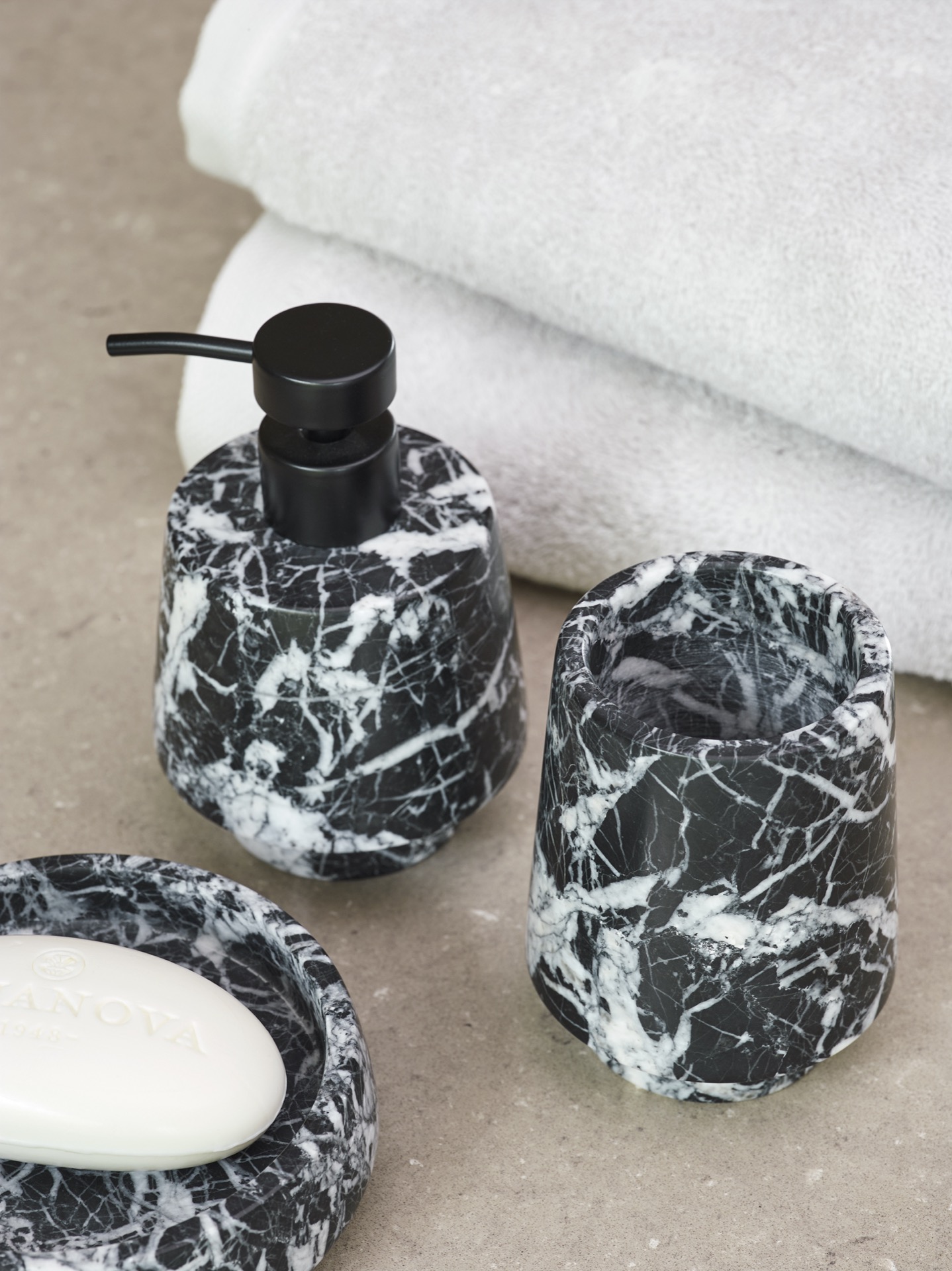
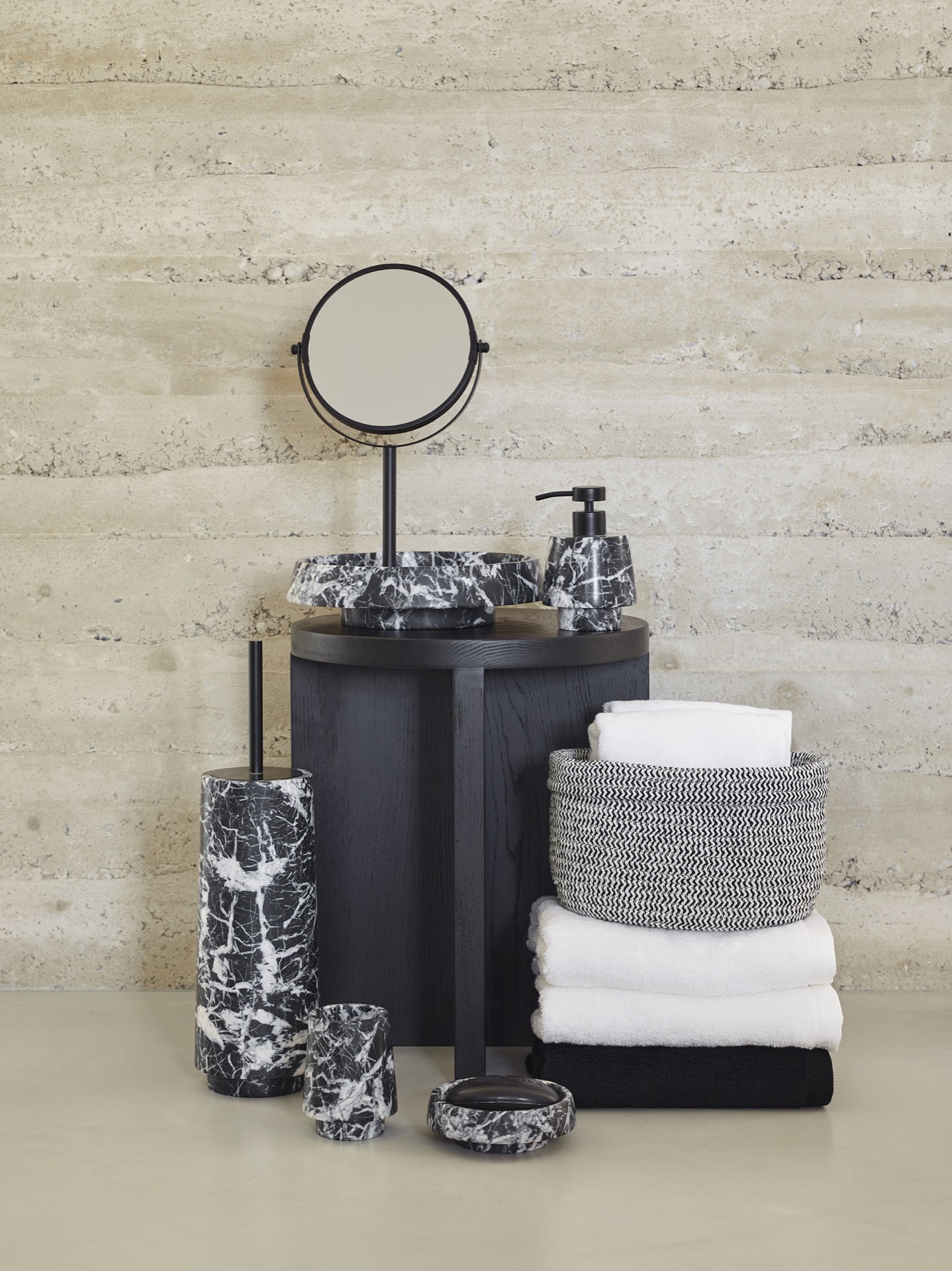
The collection reads clearly in a neutral bathroom. On a white basin ledge or console, the black marble-look pieces sit with enough presence to register immediately, yet the lighter background keeps the composition open. White towels in the rear of the images push the contrast further and make the veining easier to read. This is where black marble-look bathroom accessories with white veining make sense: they sharpen the room without adding visual noise.
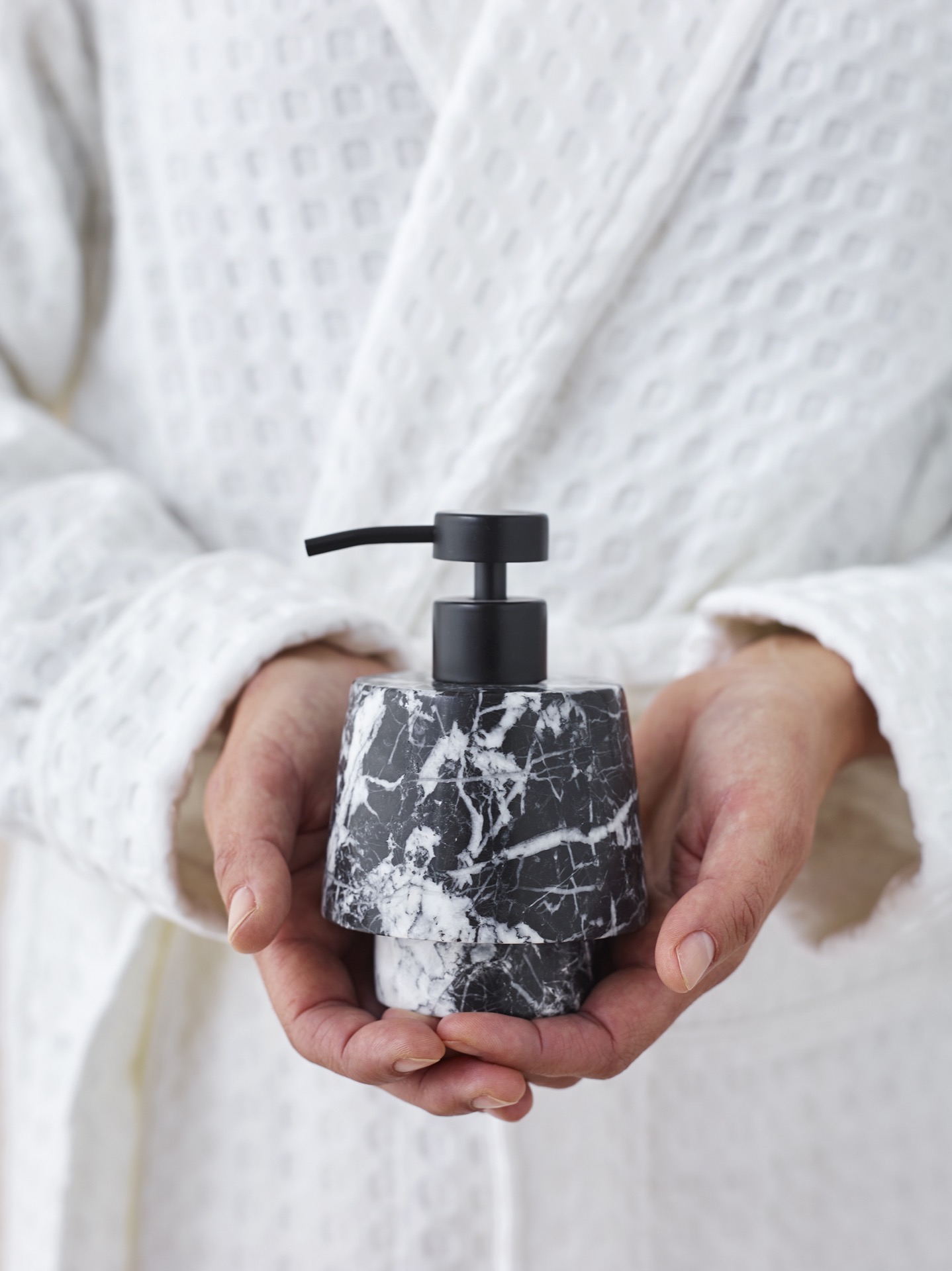
The material effect is part of the appeal. The surfaces are not smooth and anonymous; the white patterning gives each piece a directional grain that catches light differently from the matte black details around it. A soap dispenser, a small bowl, and a tray-like form all carry the same language, so the set can be read as one black and white bathroom accessory set even when each object is shown separately. The result is graphic, but not rigid.
Rounded edges that soften the composition
Subtle curves are woven through the design. In the close-ups, the black dispenser has a curved spout, and the bowls and trays lean into rounder outlines rather than strict angles. That small shift changes the mood of the accessories. Against the slab-like surfaces in the bathroom, those curved profiles keep the objects from feeling heavy. They also explain why the pieces work so well as luxury black and white bathroom accessories: the form carries some of the refinement, not just the finish.
A round mirror on a black stand reinforces that same idea. Its circular frame and slim support echo the softer outlines of the accessories below it, while the stand itself adds a clear vertical line. The mirror is not treated as a decorative extra; it becomes part of the visual rhythm. Seen together with the marble-look bowls and dispenser, it gives the arrangement a measured geometry that feels deliberate without being overworked.
A matte black soap dispenser with a clear role
One of the strongest details in the series is the matte black soap dispenser. Its darker body disappears and reappears depending on the angle, while the curved spout gives the object a distinct profile in the frame. In the close-up images, it sits beside marble-look pieces that repeat the same black-and-white palette, so the dispenser reads as both useful and sculptural. That balance is what makes the set practical for a neutral bathroom: each object still does a job, but it also contributes to the overall composition.
The grouping works best when the pieces are kept close together on a light surface. A shallow bowl, a small dish, and the dispenser create a compact cluster that feels easy to place near a basin or along a console. The pale countertop sets off the dark edges, and the white towels behind the arrangement keep the scene calm enough for the veining to stay visible. There is no need for extra colour here. The contrast already carries the project. That makes the black marble-look bathroom accessories with white veining part of the architectural character rather than a loose finish.
Marble-look details seen up close
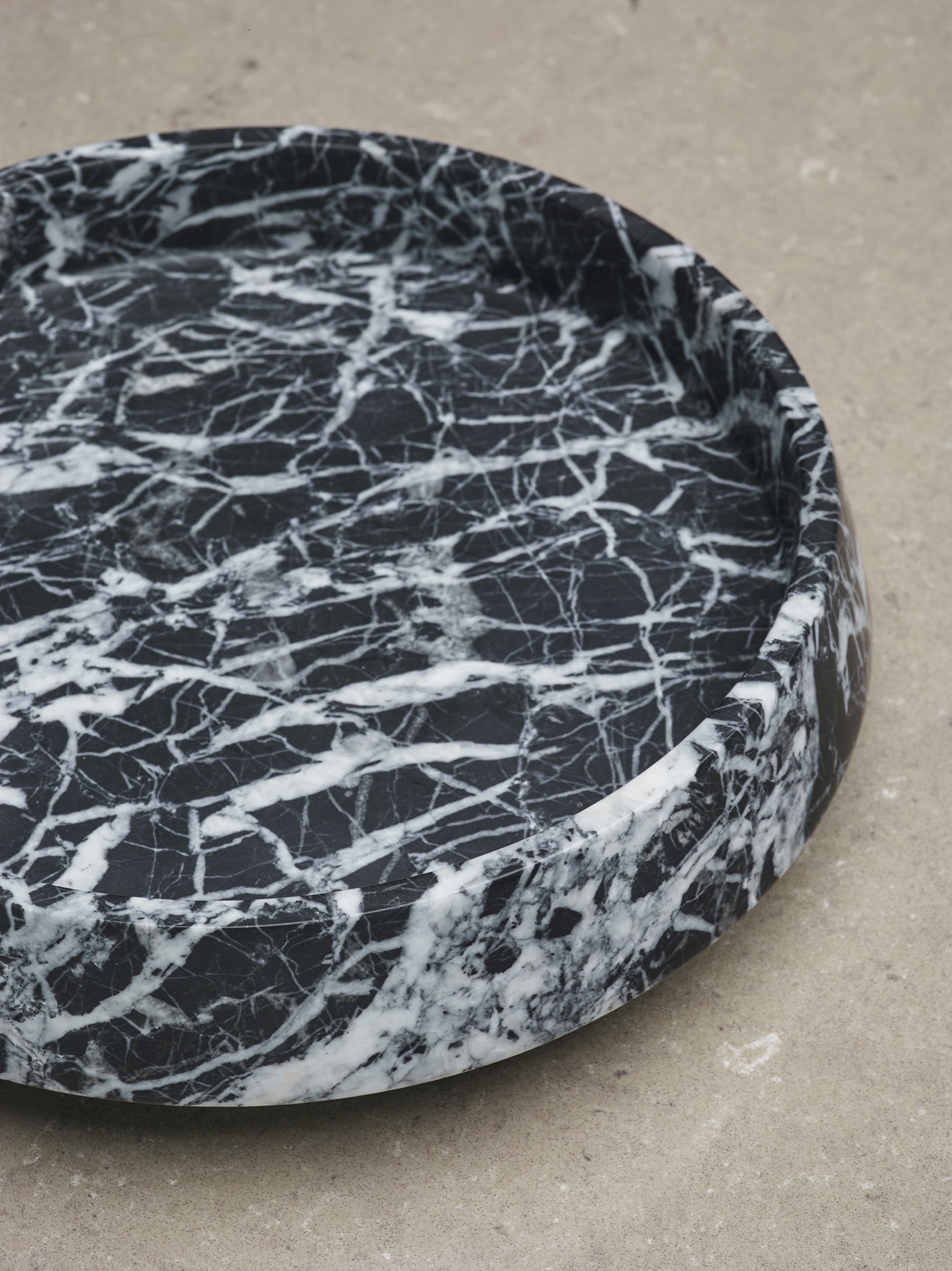
In the detail shots, the black marble-look surface with white veining becomes the main event. The lines are irregular, which gives the material its movement, but they stay fine enough to avoid a busy effect. That balance is important in a bathroom, where too much pattern can quickly take over a small surface. Here, the veining stays contained by the round shapes and the matte black accents, so the eye moves from one piece to the next without losing the thread.
The close framing also shows how the pieces respond to their setting. A bowl against a white ledge, a dispenser beside rolled towels, a tray catching a sliver of light from the side: each image uses the same material story from a different distance. That makes the collection useful as a bathroom styling reference as much as a product set. For anyone looking for black marble-look bathroom accessories with white veining, the appeal is not only the finish itself, but the way it holds up in a pared-back room.
An expansion from an earlier marble-look collection
This design builds on the success of an earlier marble-look range and extends that idea into a new form language. The source text points to that development, and the images make it visible through the shift toward softer contours. Instead of repeating the same object silhouettes, the collection uses rounded bowls, a curved dispenser, and a mirror on a circular base to add variation within the same material family. It feels like an expansion rather than a reset.
That approach suits the broader use of marble-look with white veining in the bathroom. The material can be read from across the room, but it is most convincing at close range, where the surfaces, edges, and shadows reveal how the pieces are built. Against stone, concrete, and white textiles, the black-and-white palette remains strong. The collection does not need ornament. Its effect comes from the contrast, the repeated round shapes, and the way the surfaces pick up light.
How the set reads in a neutral bathroom
Placed on a white console or near a basin, the pieces introduce a darker note without closing the room in. The black marble-look bathroom accessories with white veining sit naturally among the light stone wall, grey floor, and folded white towels shown in the images. That setting matters, because it shows the collection as part of an actual bathroom scene rather than as a standalone object study. The accessories hold their own, but they are strongest when the background stays quiet.
The final impression is one of disciplined contrast. Black surfaces, white veining, round forms, and matte black details all work within a limited palette, yet the result is not flat. It is the combination of material texture and gentle curvature that gives the series its presence. In a neutral bathroom, that is enough: a few carefully shaped pieces, a light surface, and a dark line of veining that carries across the objects from one image to the next. That makes the black marble-look bathroom accessories with white veining part of the architectural character rather than a loose finish.
Want to see more of Aquanova? View the page of Aquanova for even more great projects and company information.


.png)