






Modern luxury loft villa with open-plan kitchen, stone accents, wine cellar, and built-in fireplace niche
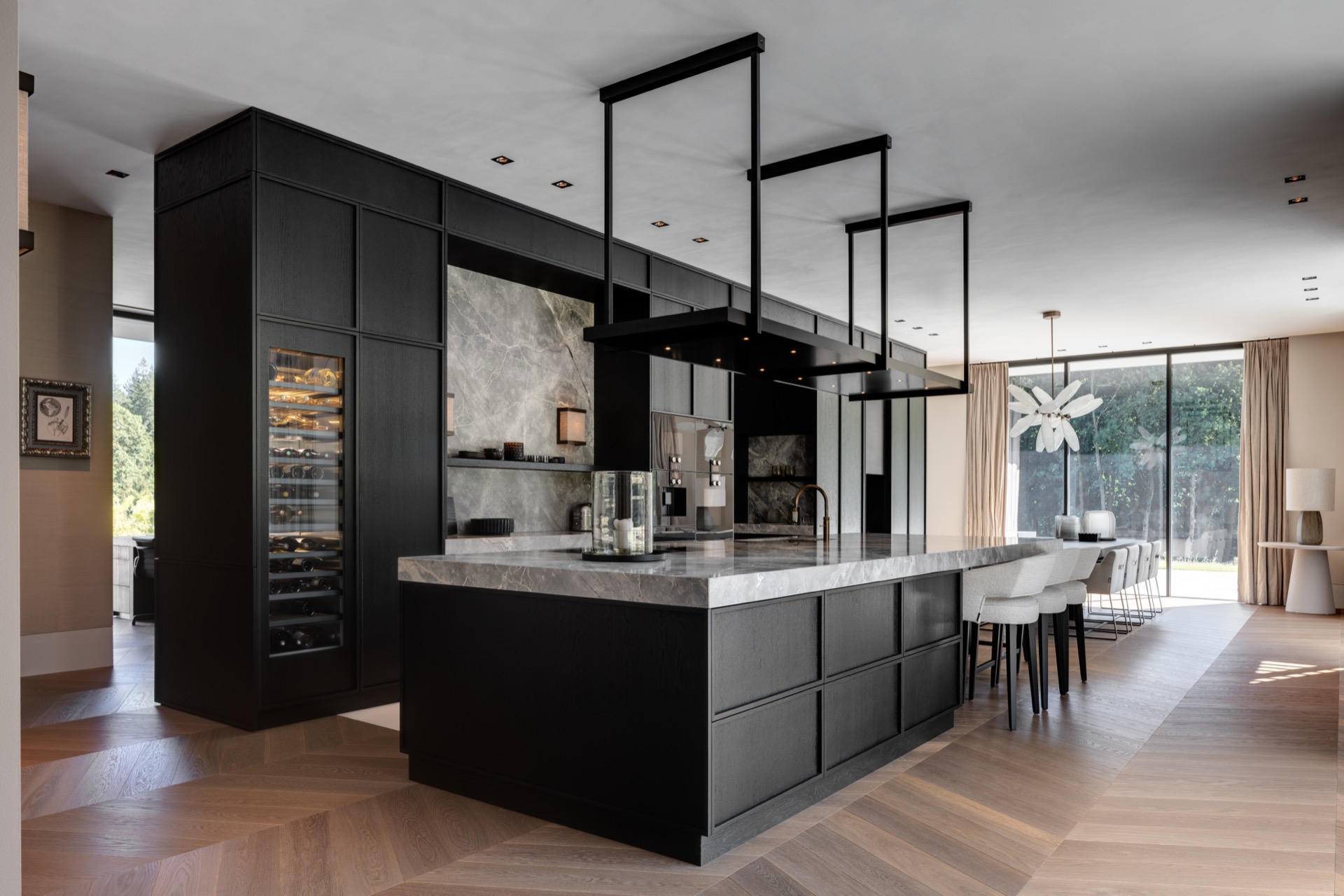
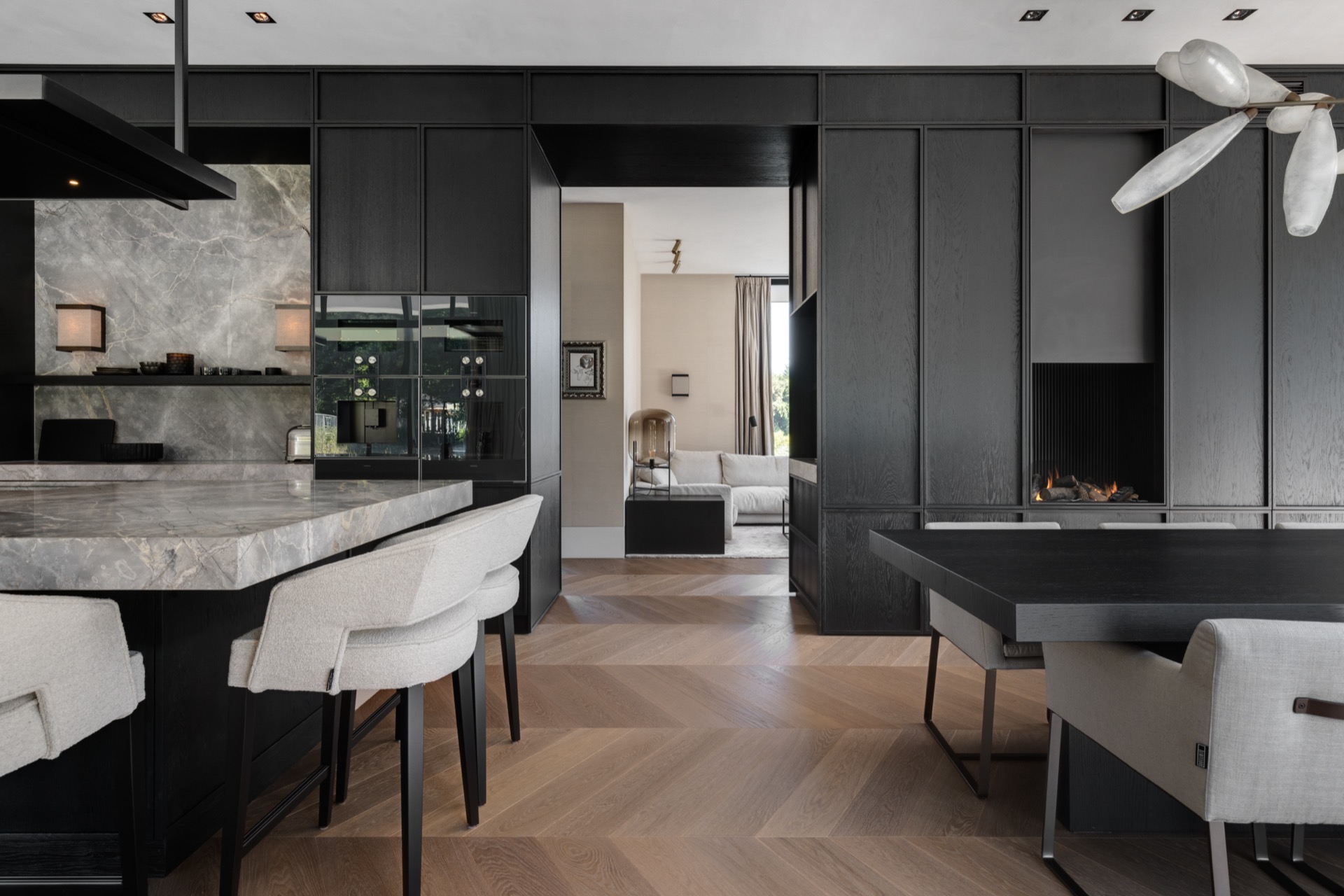
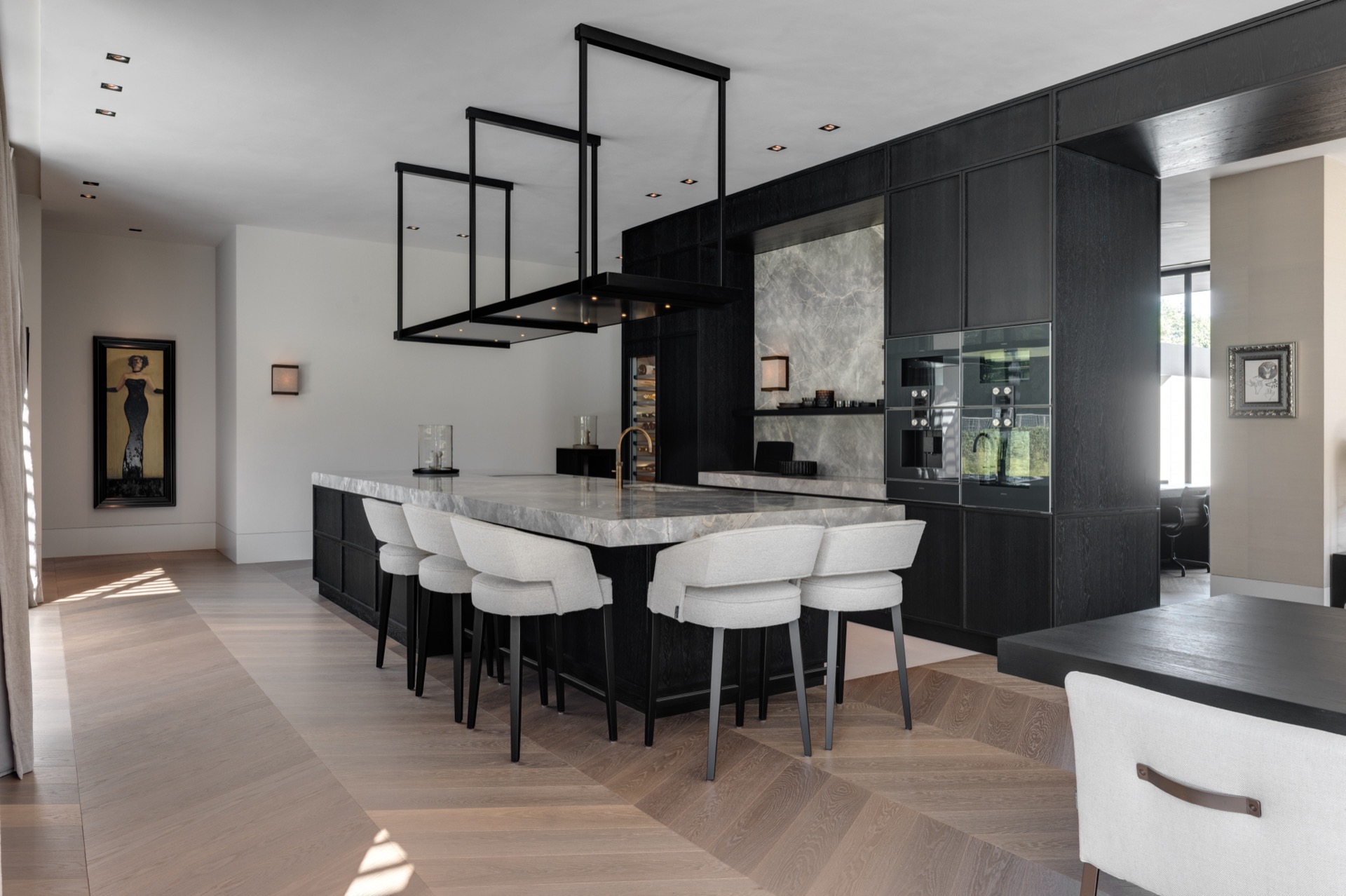
The modern luxury loft villa with wine cellar and open-plan kitchen is immediately visible in the way the project is framed. The first thing you notice is the way the kitchen reaches into the living area without a hard break. Dark built-in cabinetry runs upward in clean planes, while the island sits low and grounded, edged with stone-look surfaces that catch the light from the windows beside it. In this single-level loft villa, the open-plan kitchen is not treated as a separate room but as part of a larger sequence of views, materials, and built-in details.
modern luxury loft villa with wine cellar and open-plan kitchen as the architectural starting point
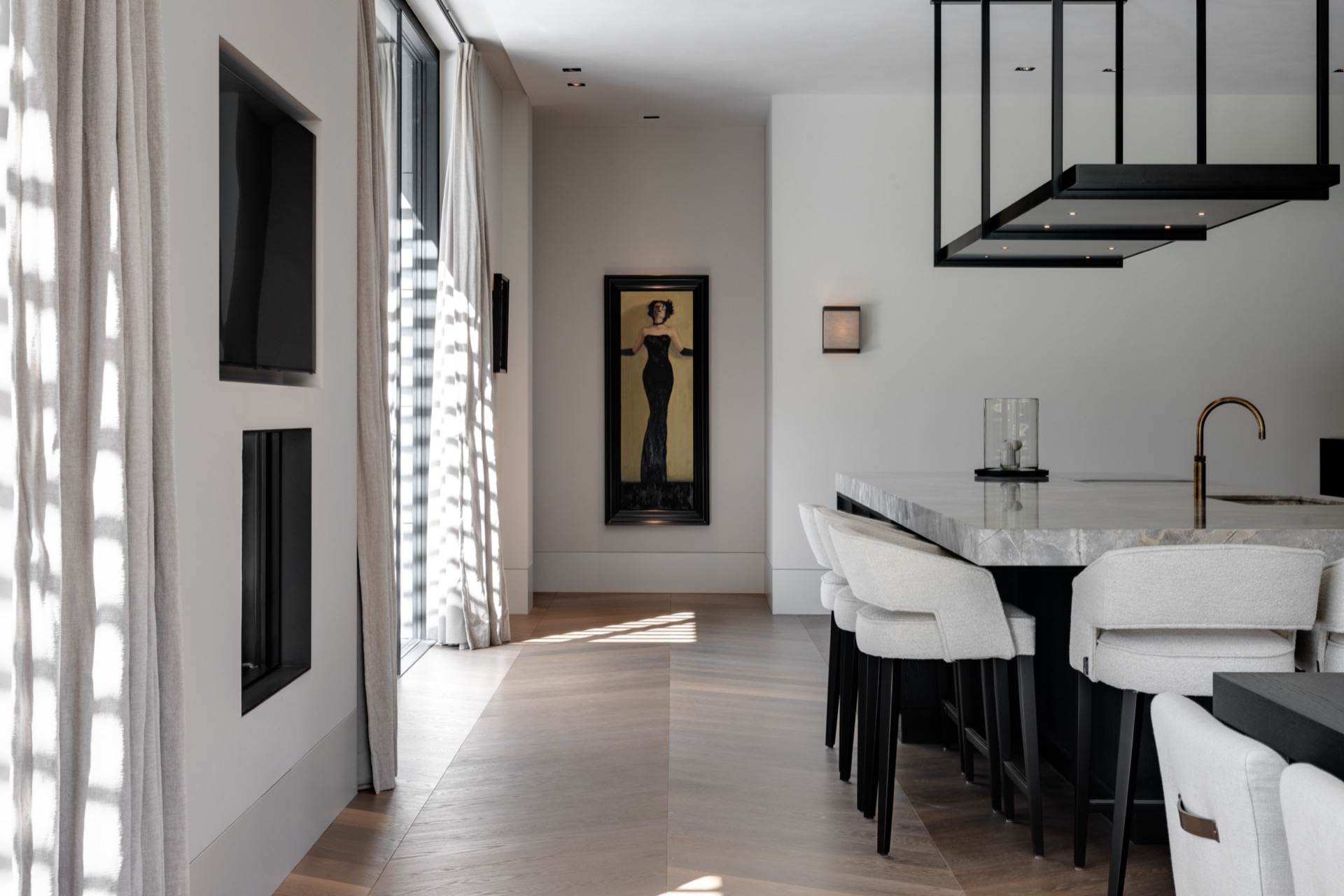
The ground-floor plan keeps movement easy and visual links open. From the kitchen, the eye moves toward the dining table, the lounge, and the fireplace wall, each zone defined by furniture, openings, or a shift in finish rather than by solid partitions. Large glass panels and glazed doors pull daylight deep into the interior, and the curtains soften the edges without closing the space. The result is a layout that feels measured, with each room flowing into the next through light and line.
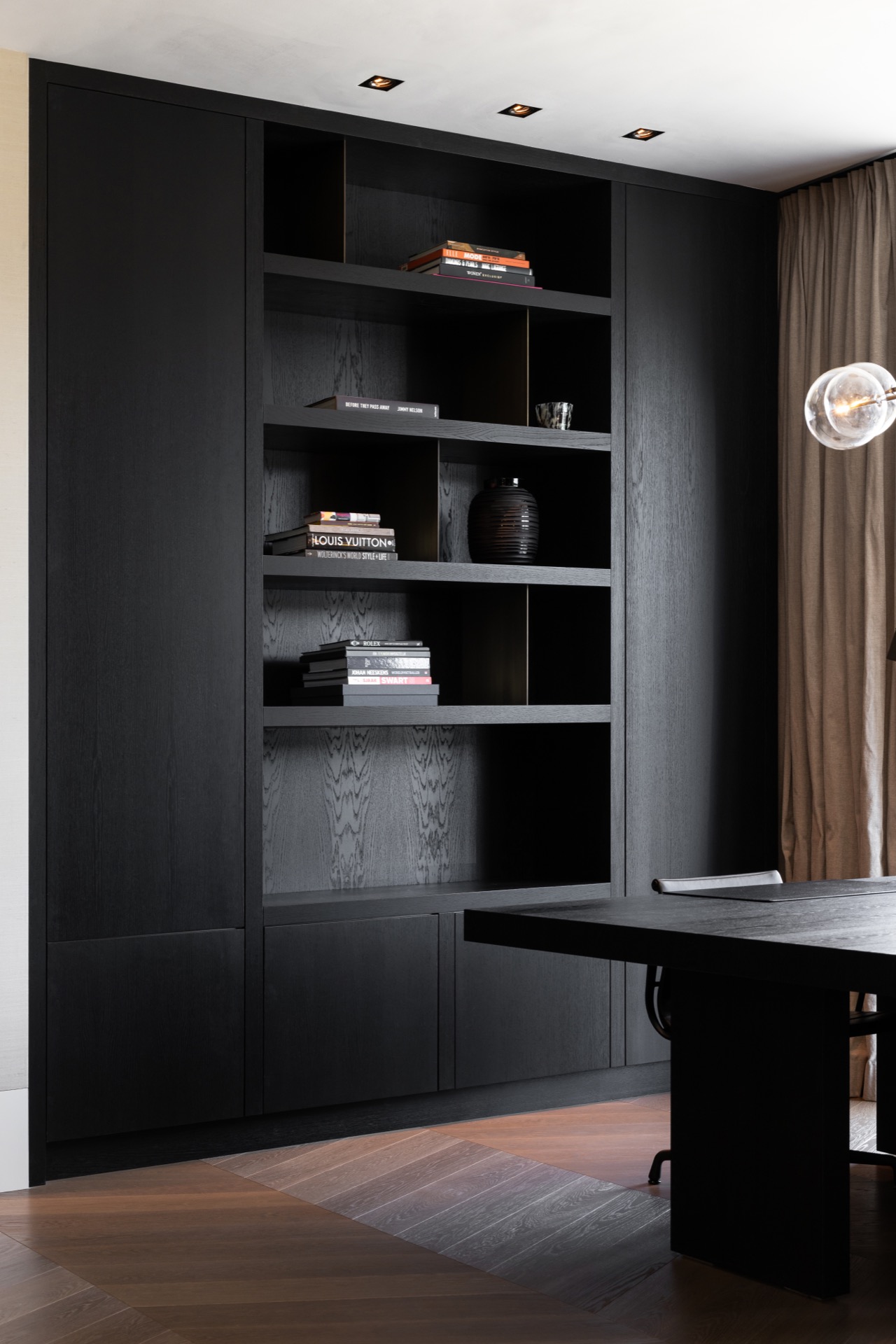
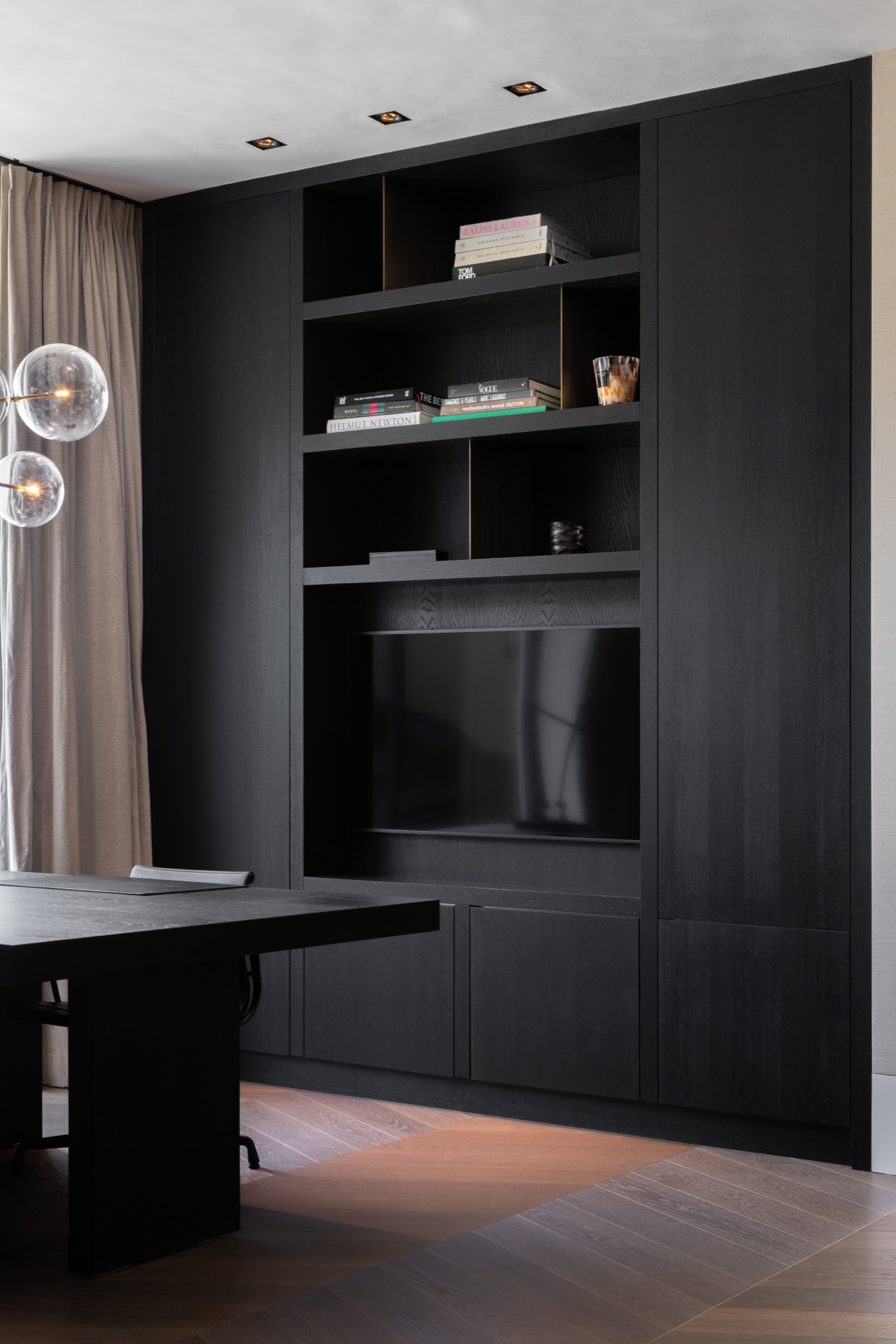
That openness also gives more weight to the custom joinery. Instead of reading as storage alone, the cabinetry becomes part of the architecture. Dark surfaces frame the cooking area, a glass-fronted section breaks up the wall of fronts, and the surrounding pale walls and wood flooring keep the composition from becoming heavy. The balance comes from contrast: black against stone, matte fronts against reflective glass, straight lines against the softer movement of drapery.
The kitchen island and the wall of dark built-ins
The open-plan kitchen island anchors the centre of the room. Its stone-look top has a solid, workmanlike presence, and the edge detail gives it enough definition to stand apart from the darker back wall. Behind it, the dark built-in cabinetry rises in tall vertical modules, including a glazed section that introduces a lighter note and allows the storage wall to read as a crafted composition rather than a flat block. The kitchen does not rely on ornament; it works through proportion, finish, and the way the components align.
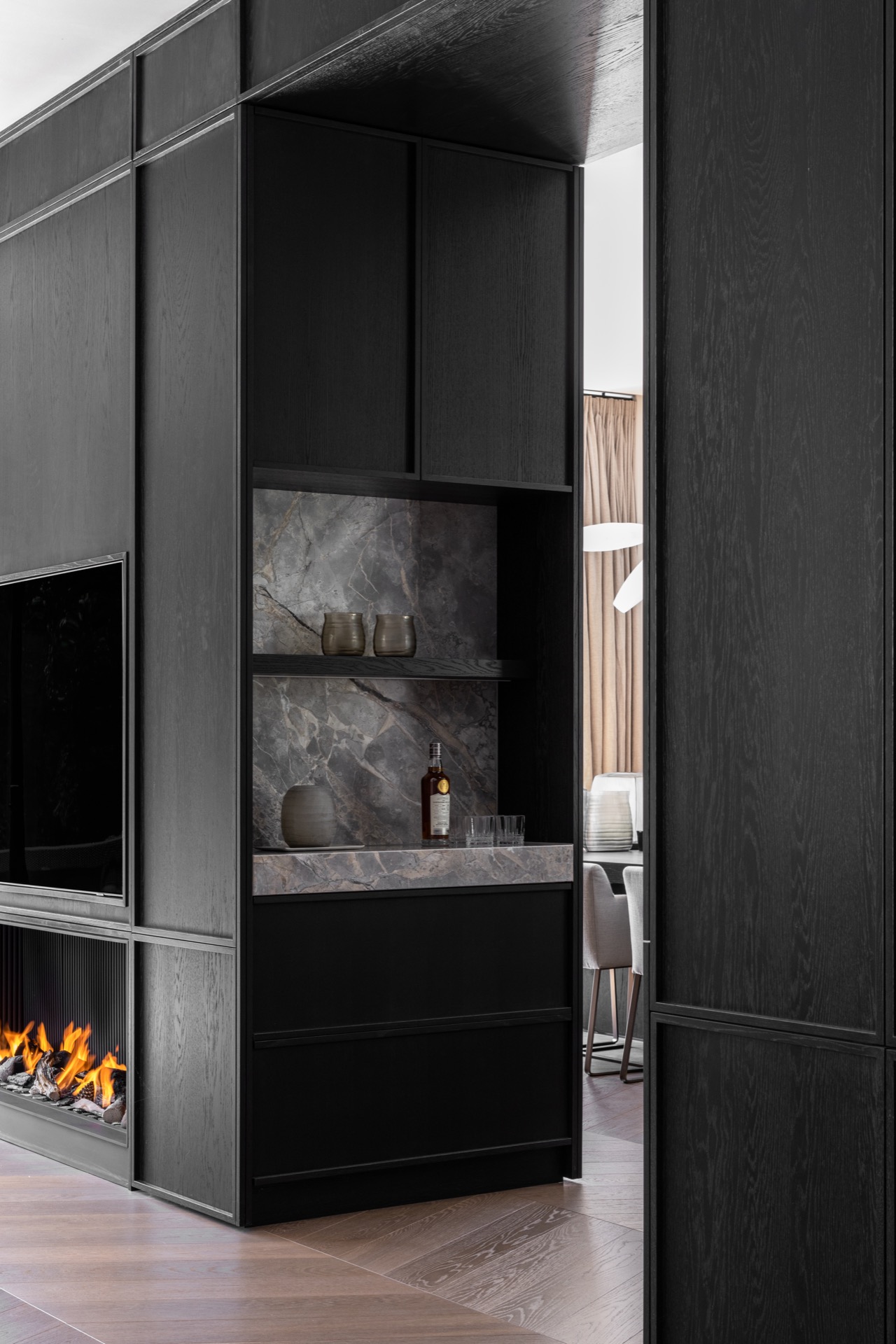
One side of the kitchen is shaped by a natural stone surface that sits against the darker fronts and reflects the underlight and spotlights above. These stone-look kitchen details are visible in the worktop and the backsplash, where veining and texture add movement to an otherwise restrained palette. The kitchen’s equipment is integrated into the layout, and the large wine climate cabinet becomes part of the visual rhythm rather than an afterthought. The result is a kitchen that feels assembled from precise layers.
Where the island meets the living area
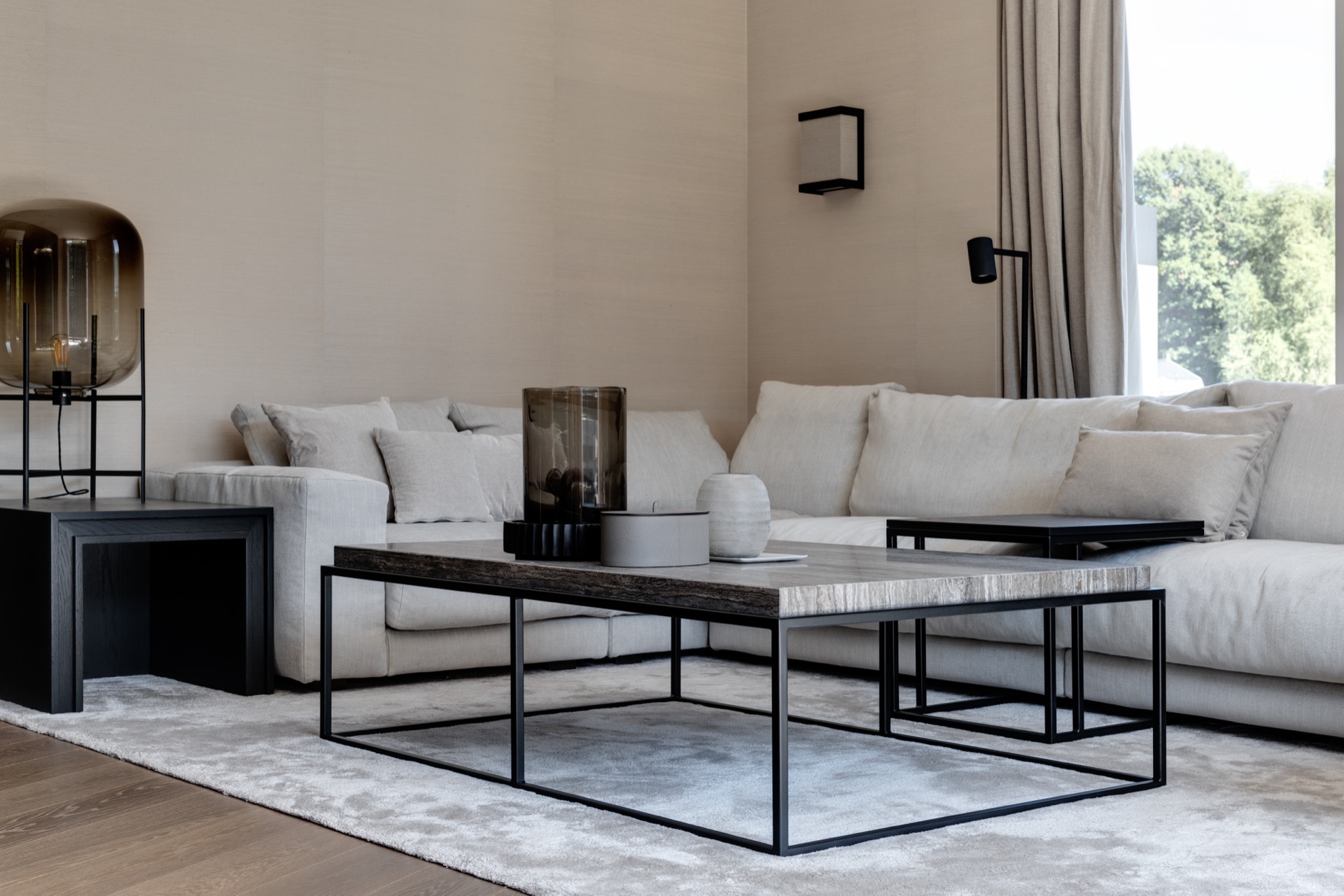
At the living side of the room, the island is close enough to support conversation but separated enough to keep the cooking zone legible. Bar stools turn the edge into a practical pause point, and the nearby niche-bar element extends that idea into the lounge. It is a small intervention, but it changes how the room is used. The kitchen now has a place to stop and gather, while the living area keeps its own identity through a lower table, a long sofa, and the deeper tone of the fireplace wall.
The built-in fireplace niche reinforces that separation without closing the plan. Set into a dark wall and framed with black lines, it draws the eye across the room and adds a clear focal point at seated height. In some views the flames sit low within the opening, almost like a line of light inside the wall. That measured placement suits the rest of the interior, where openings, recesses, and panel joints do most of the work.
Stone, glass, and the quiet weight of the interior
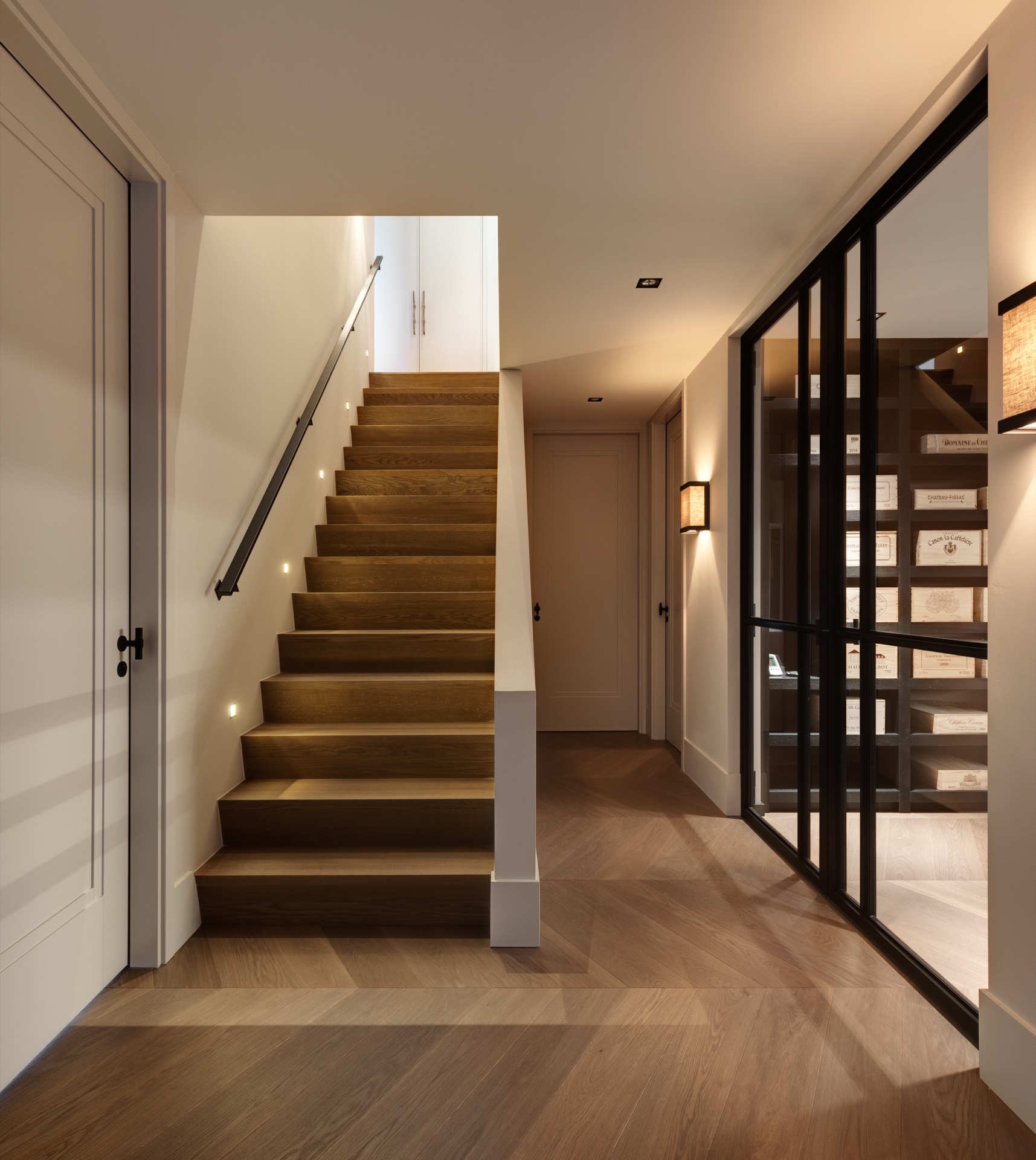
Stone appears in several places, but never in the same way twice. In the kitchen it is used as a surface with strong veining; elsewhere it appears in darker wall sections and around the fireplace, where it gives depth to the recessed opening. The variation keeps the interior from becoming repetitive. Even the wine cellar continues that material story, with shelves, framed compartments, and illuminated storage turning bottles and wooden crates into part of the room’s composition. That makes the modern luxury loft villa with wine cellar and open-plan kitchen part of the architectural character rather than a loose finish.
Lighting is handled with a similar precision. Ceiling spots sit flush and almost disappear, while integrated strips and internal lights give certain areas a clearer outline. The wine cellar lighting is especially noticeable because it picks out the bottles and open compartments against the darker background. In the lounge and kitchen, the effect is subtler: light washes over stone-look details, catches the glass fronts, and leaves the darker cabinetry readable without glare. The entire interior depends on that controlled mix of reflection and shadow.
Wine storage as part of the room, not a separate feature
The wine cellar is one of the most memorable spaces in the project because it turns storage into display. Wooden wine boxes, rows of bottles, and framed shelving sit under integrated light, so the contents become visible rather than hidden away. This is where the project’s interest in detail becomes most explicit. The room feels engineered around bottles, labels, and the grid of the shelves, yet it still belongs to the wider interior language of dark frames, clean edges, and restrained finishes.
Back in the living area, the fireplace repeats that same attention to built form. The dark surround, the inset opening, and the surrounding panel work keep the feature visually contained. It does not compete with the kitchen; instead, it holds the far end of the open plan and gives the room a second anchor. Between the island and the fireplace niche, the interior has two strong points of gravity, which helps the single-level layout feel structured even though the plan stays open.
Small interventions that change how the villa is used
Some of the most effective parts of the villa are the smallest. The niche-bar in the living room, for example, reads as a modest cut-out in the wall, but it gives the home a casual place to stand, pour, or sit. Nearby, the glazed wine cabinet and the built-in storage walls create a similar effect: each one makes the room more usable without drawing attention to itself first. These elements are not decorative extras. They shape how the kitchen and living area connect in daily use.
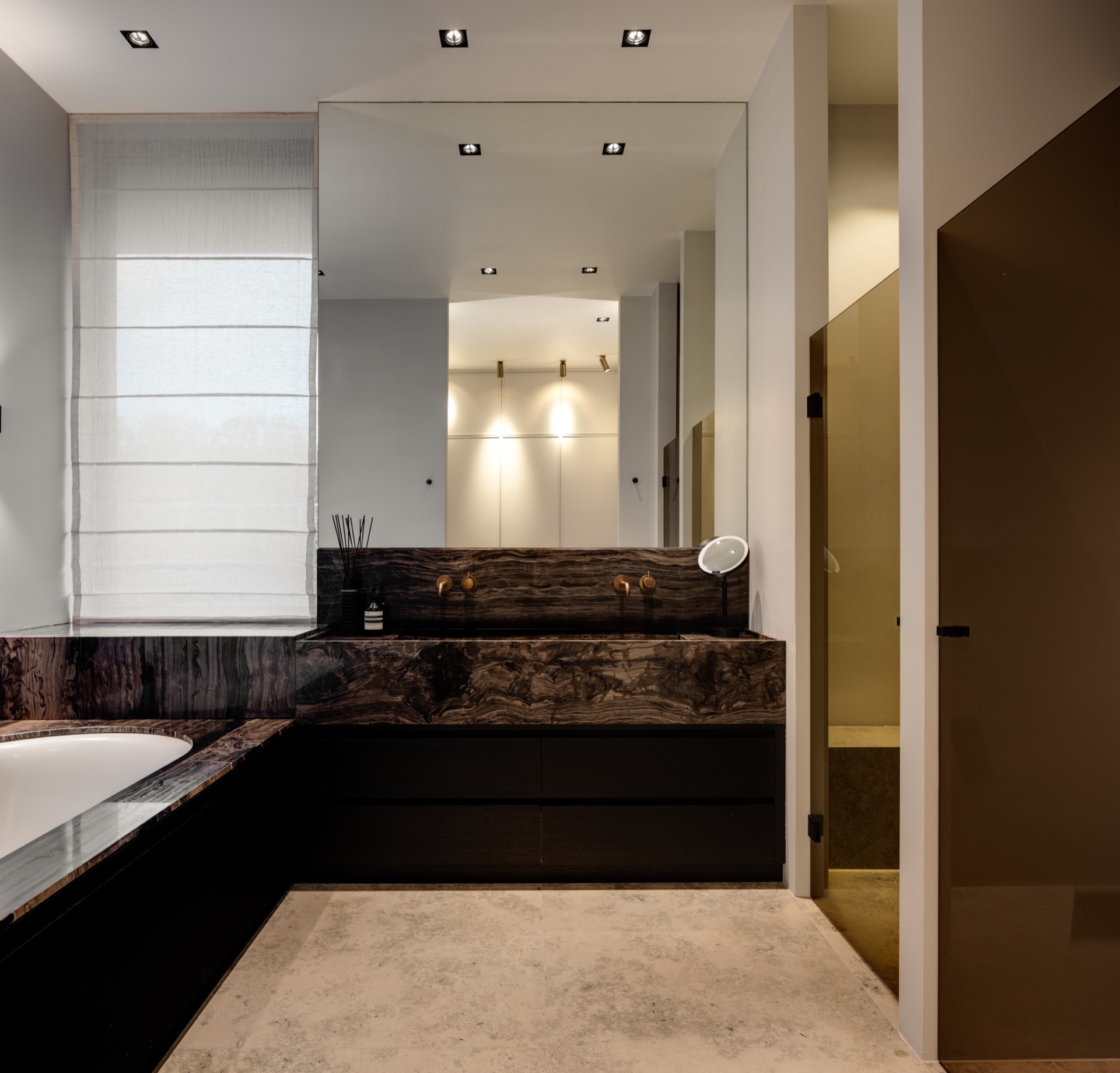
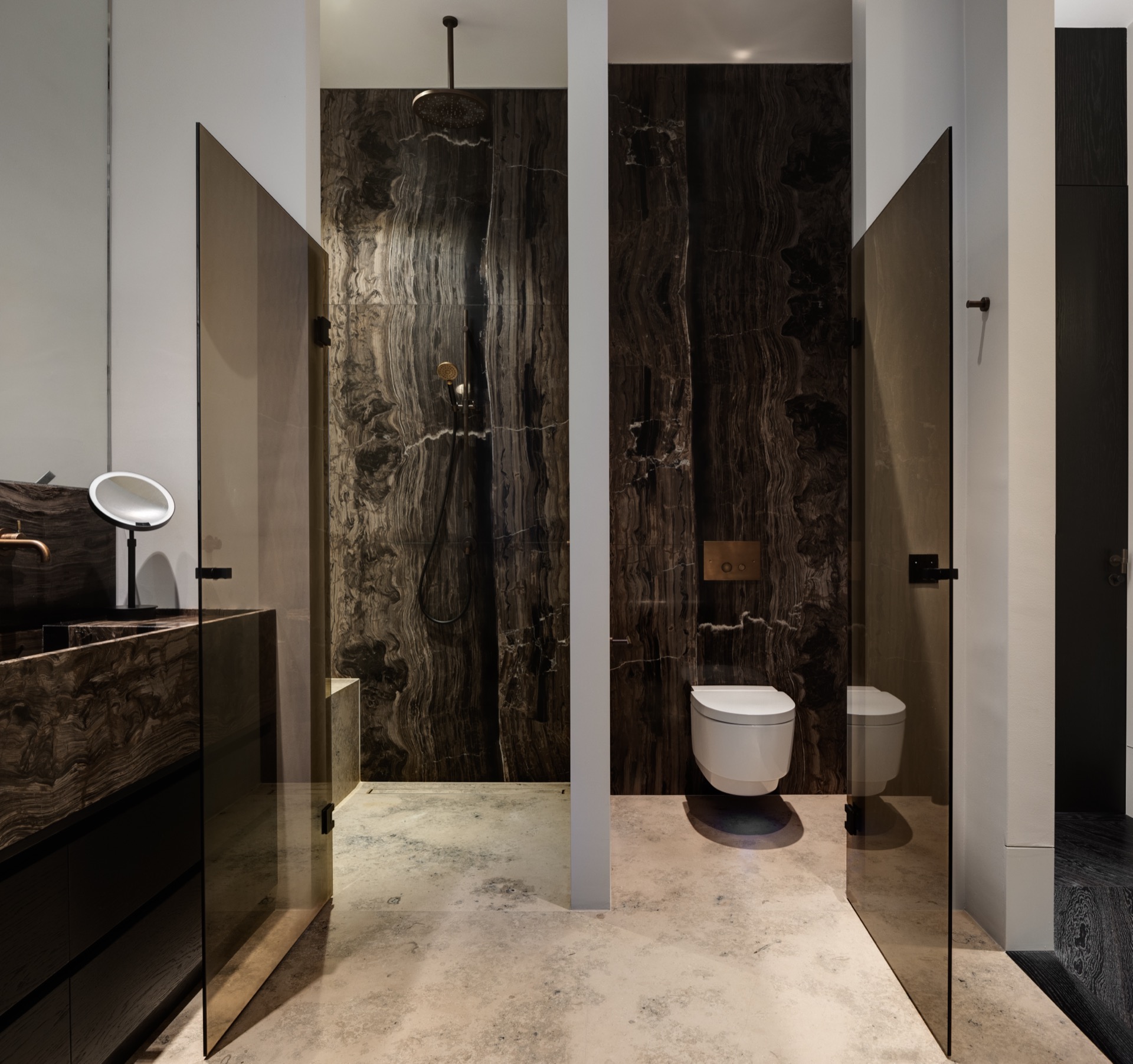
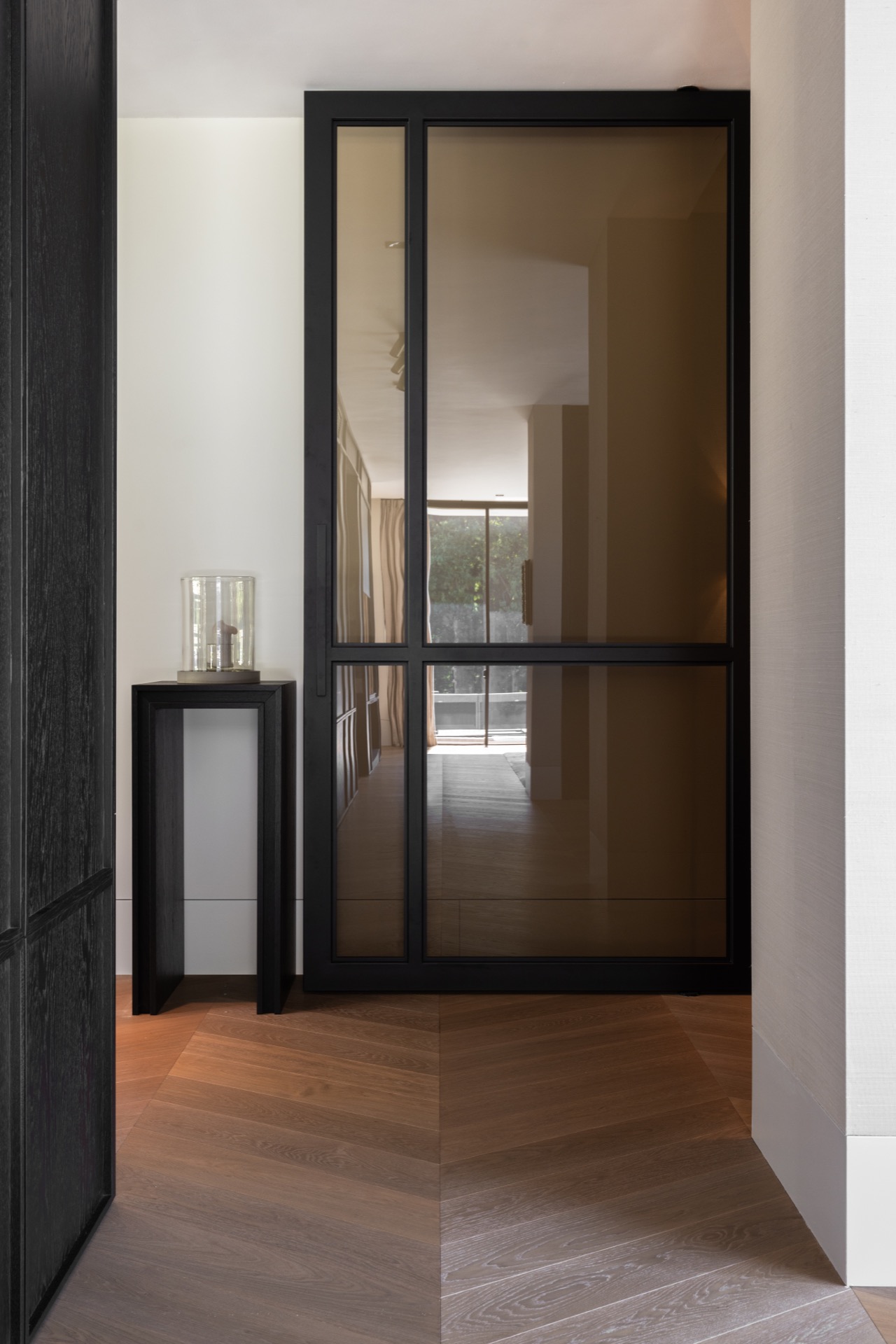
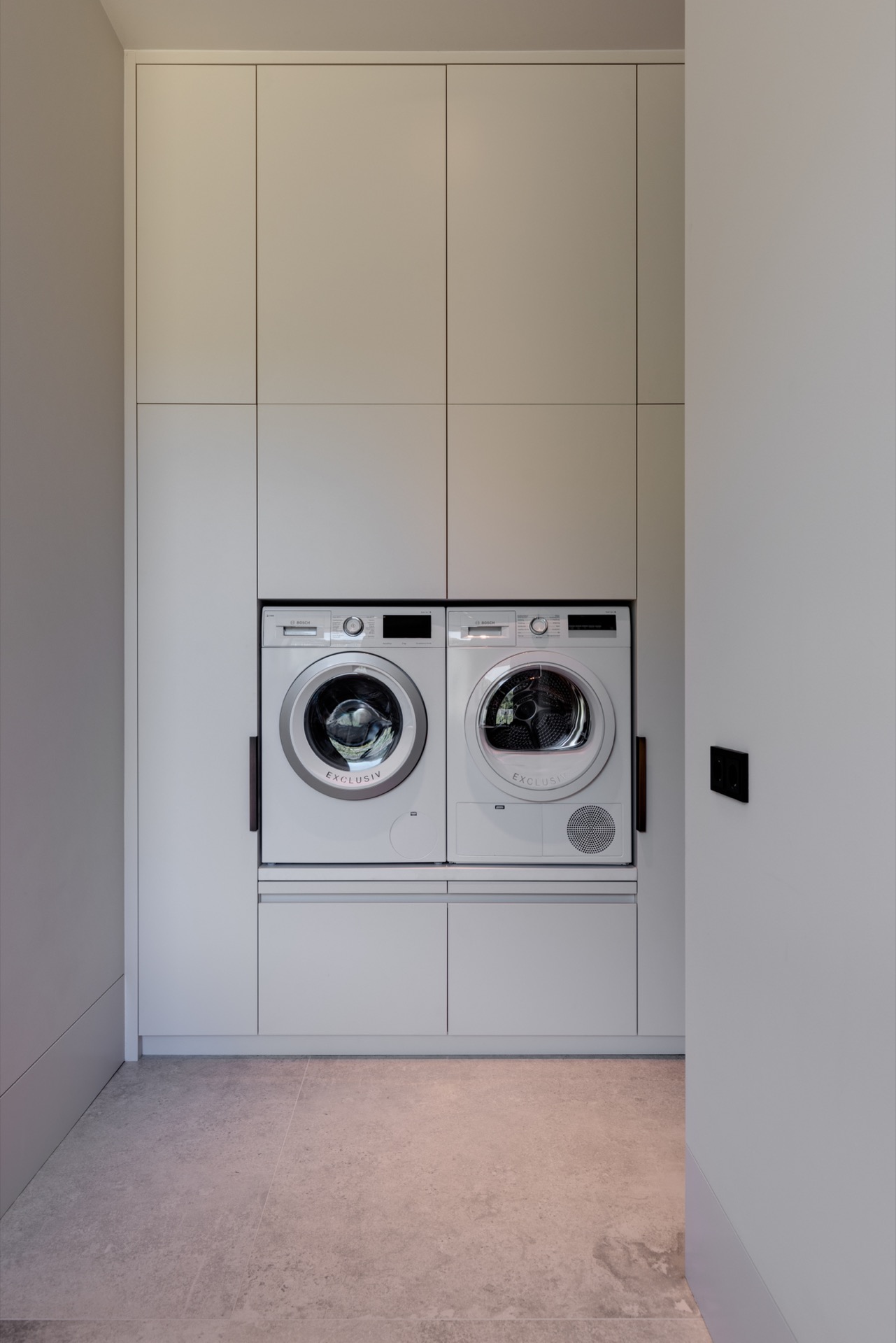
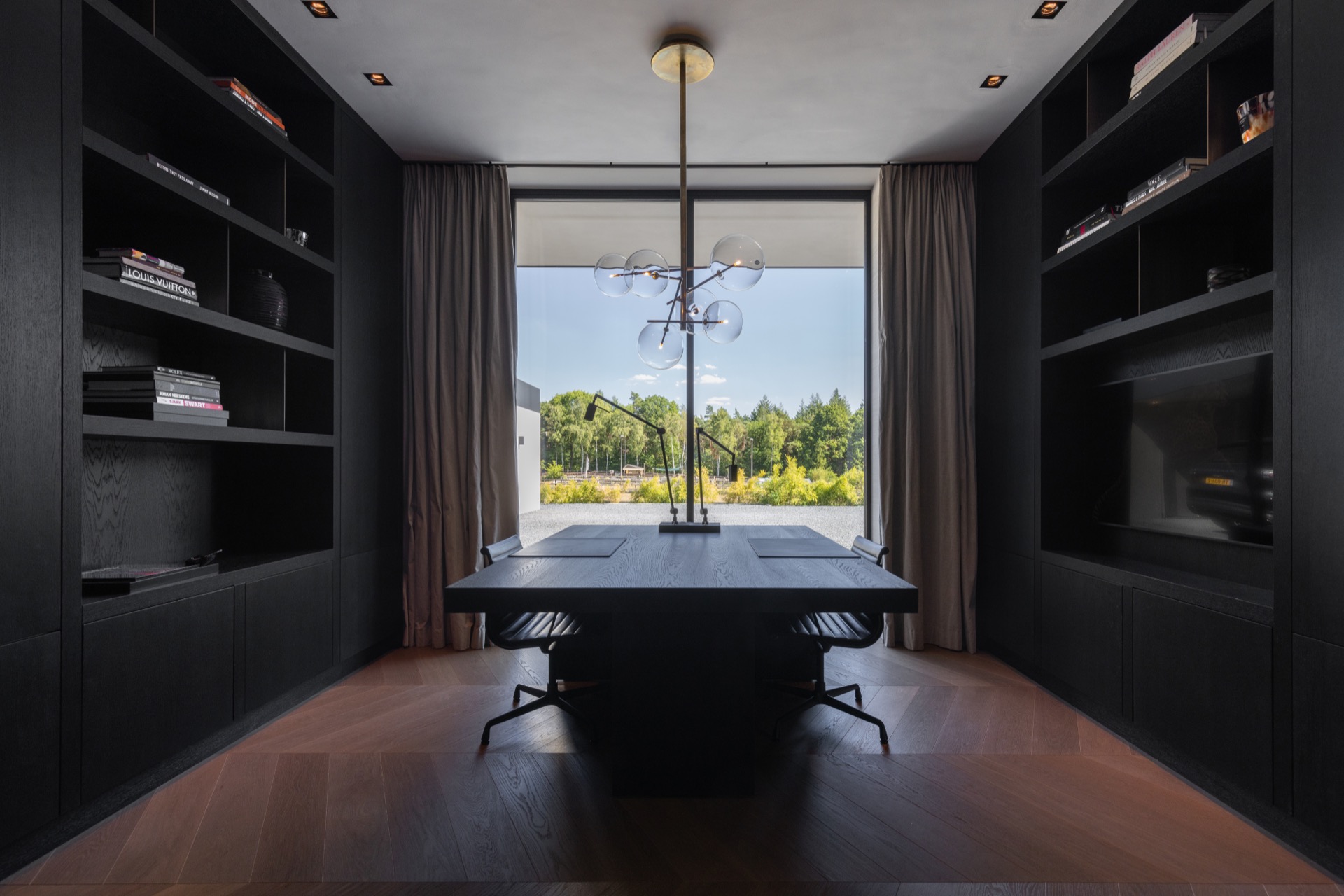
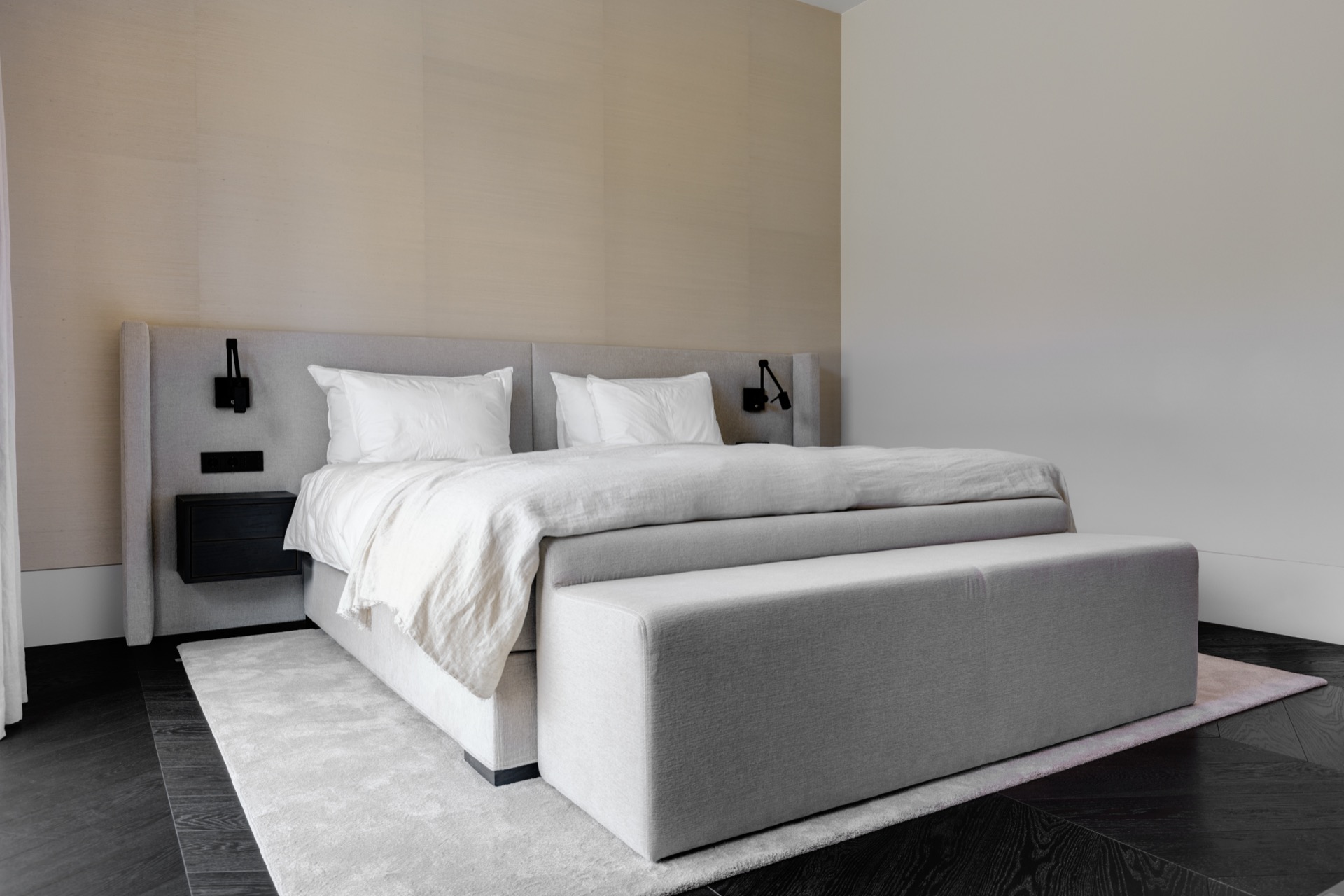
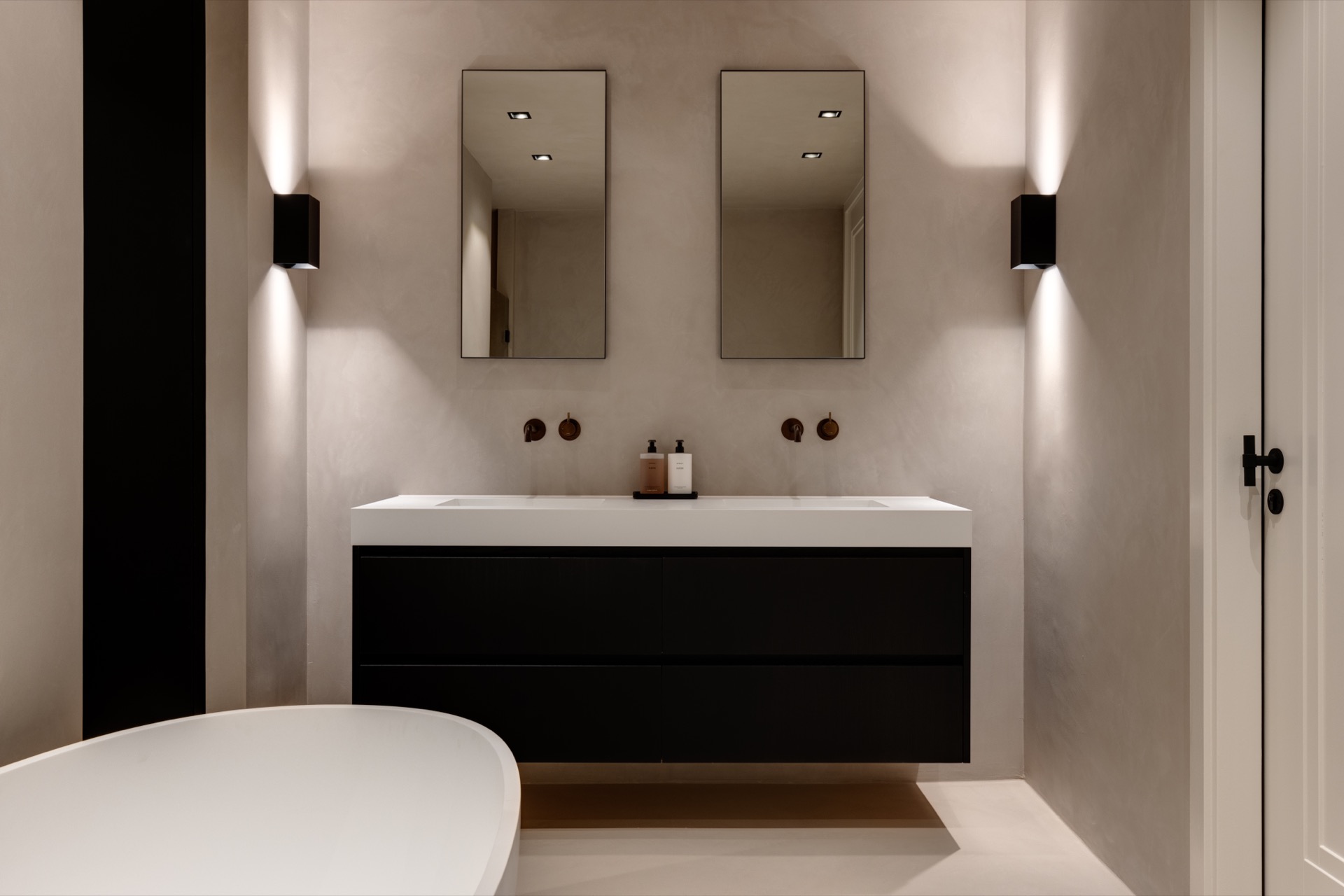
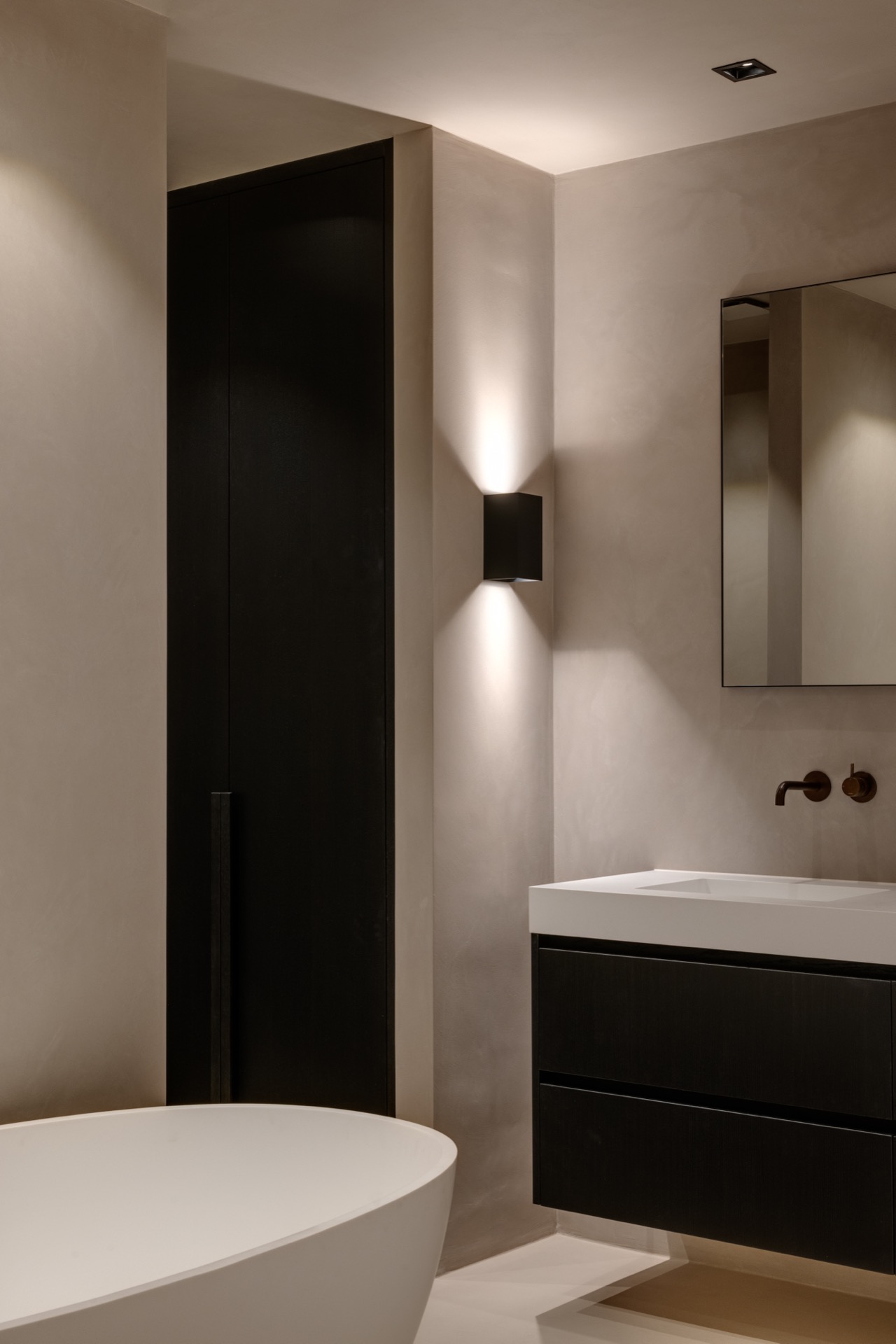
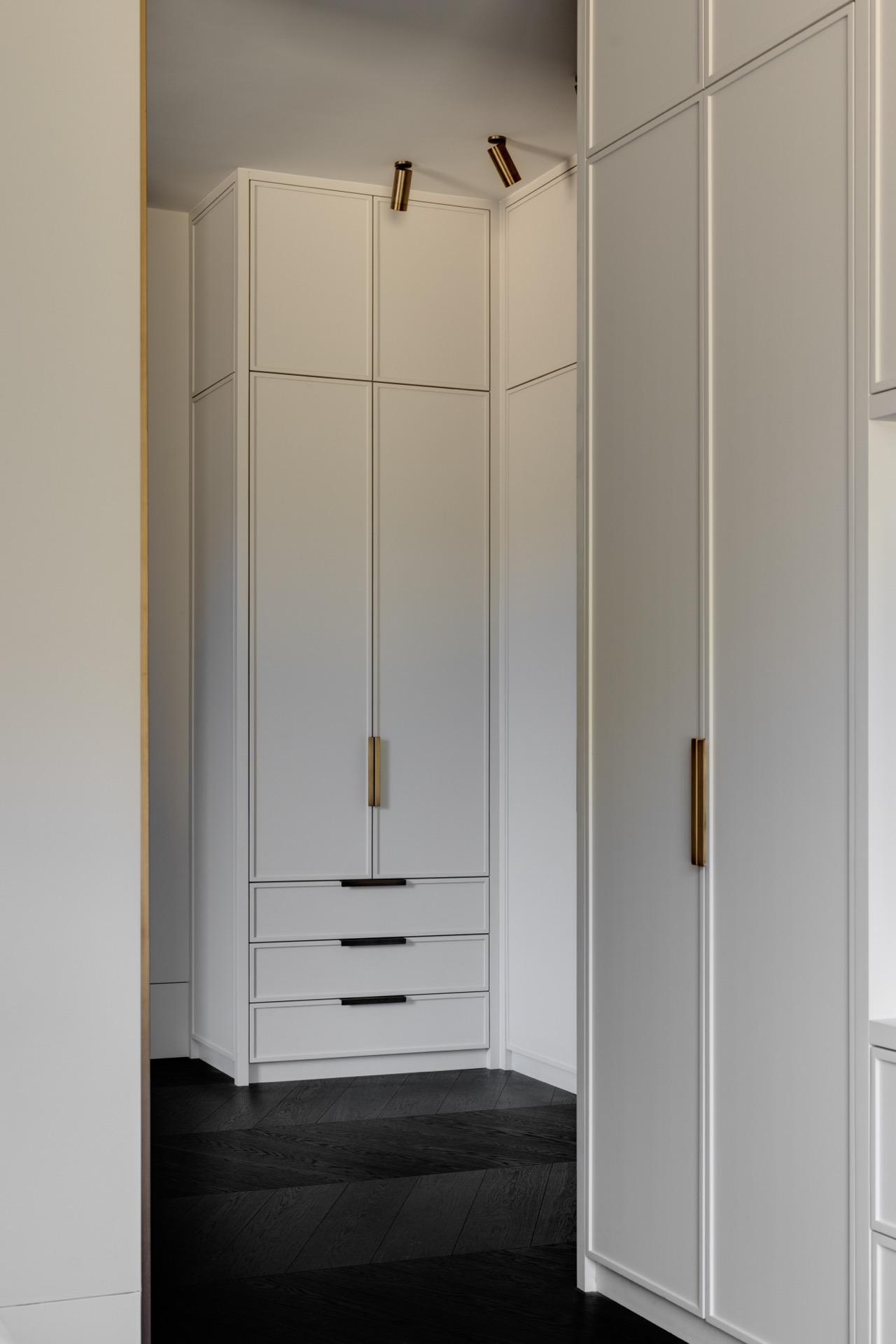
Elsewhere in the house, the same approach appears in the hall, the laundry room, and the quieter private spaces. Black-framed glass doors mark transitions, while white built-ins in the utility zone keep appliances out of sight. A bedroom shown in the imagery uses a lighter upholstered bed and dark bedside pieces to carry the same restrained contrast into a more private setting. In the bathroom, stone-look wall surfaces and a glass shower enclosure continue the material language without changing direction.
Viewed as a whole, the villa relies on consistency rather than repetition. Dark built-in cabinetry, stone-look kitchen details, wine cellar lighting, and the built-in fireplace niche all return in different forms, but each one is adjusted to the room it occupies. That is what gives the interior its clarity: every choice has a function in the plan, in the light, or in the way one space hands over to the next. The single-level loft villa stays open, but it never feels empty.
The project also shows how a modern luxury loft villa with wine cellar and open-plan kitchen can be shaped through restraint. The materials are limited, yet the combinations are varied enough to keep each room distinct. Glass softens the transitions, stone gives the main surfaces weight, and the dark joinery pulls the composition together without flattening it. The result is an interior that is easy to read from one end to the other, with the kitchen, wine storage, and fireplace all working as part of the same spatial line.
Want to see more of Céline van Haaren Interiors? View the page of Céline van Haaren Interiors for even more great projects and company information.


.png)
NEW 2026 Jubileum Edition The Best Interior Designers Benelux
Order Now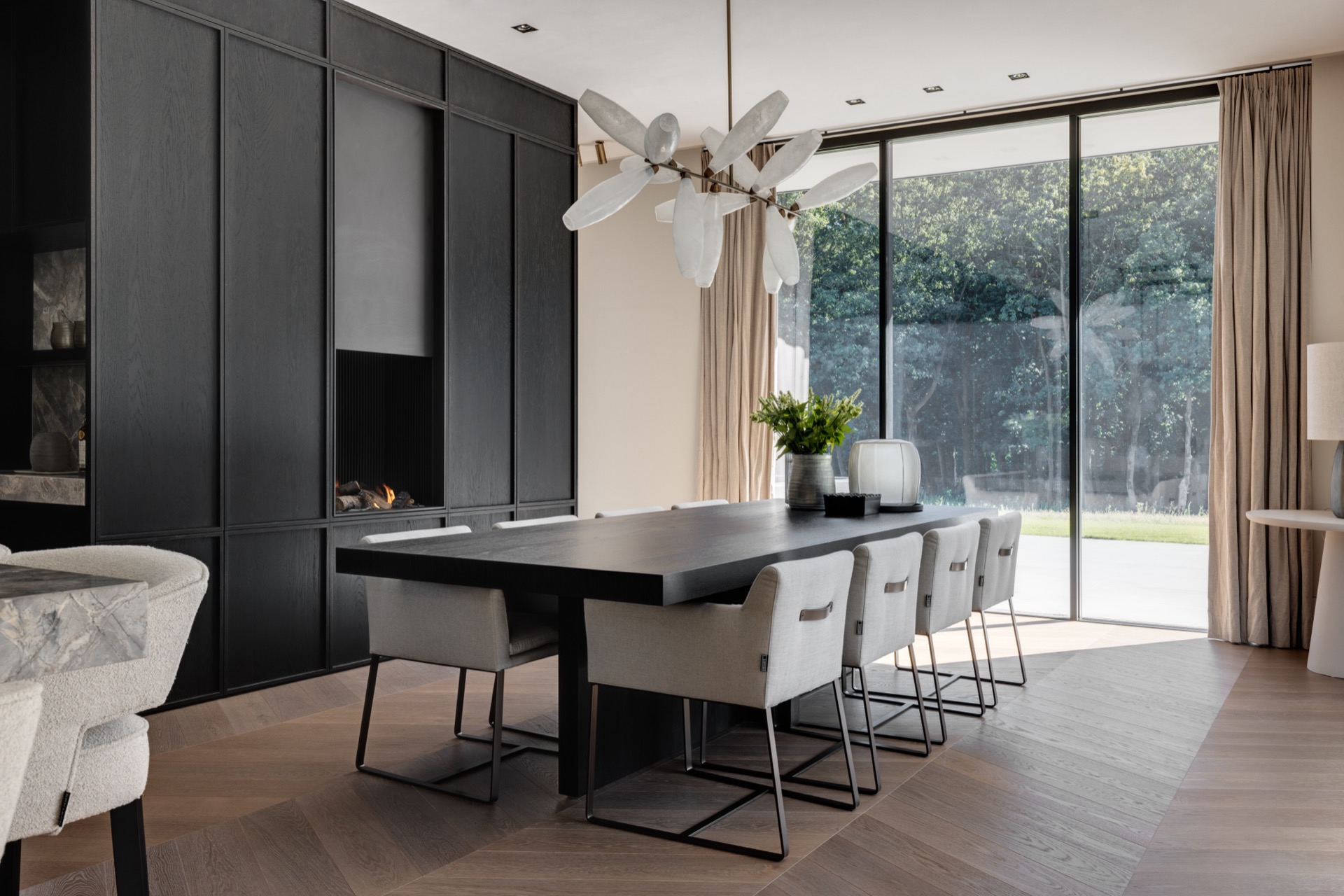
NEW 2026 Jubileum Edition The Best Interior Designers Benelux
Order Now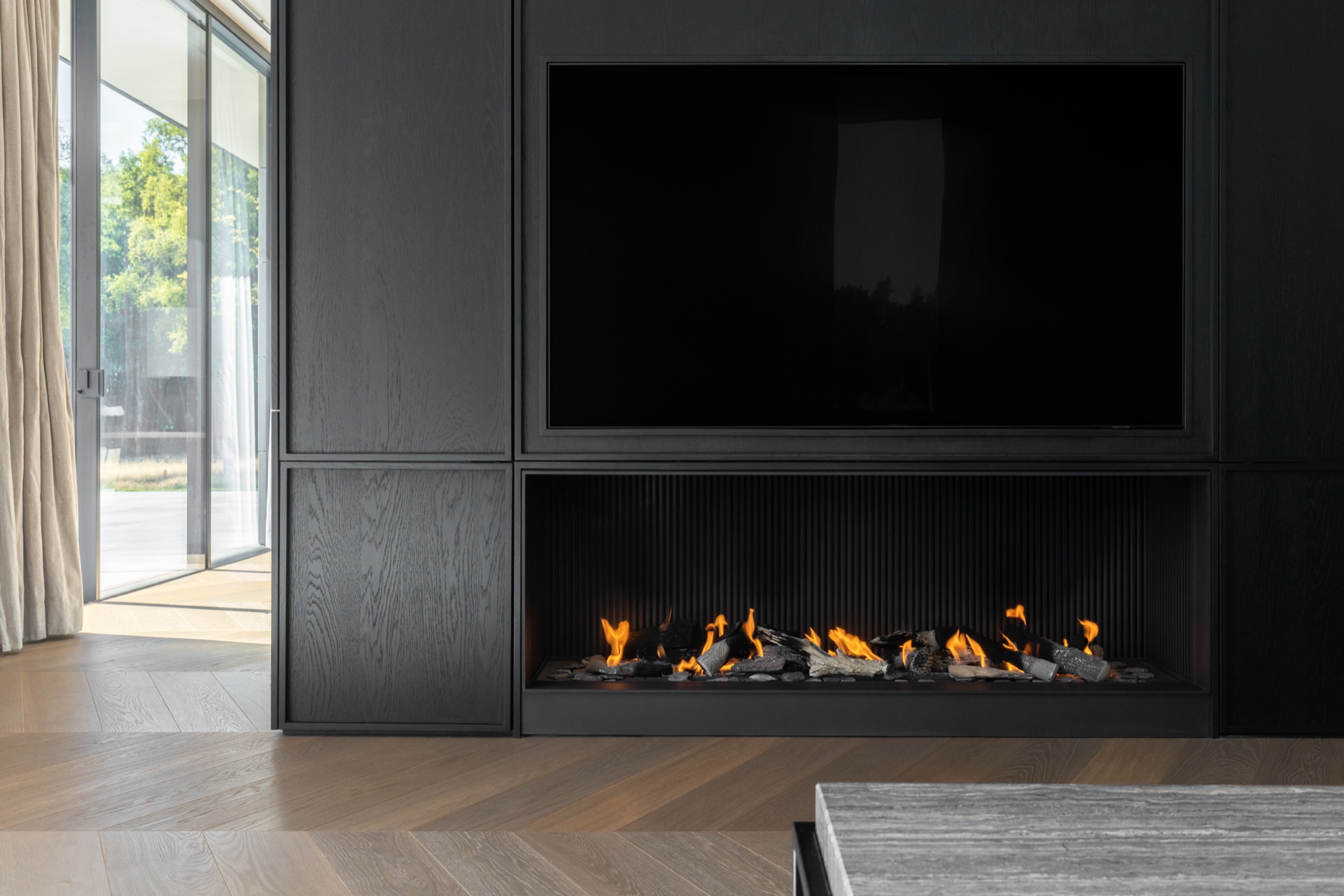
NEW 2026 Jubileum Edition The Best Interior Designers Benelux
Order Now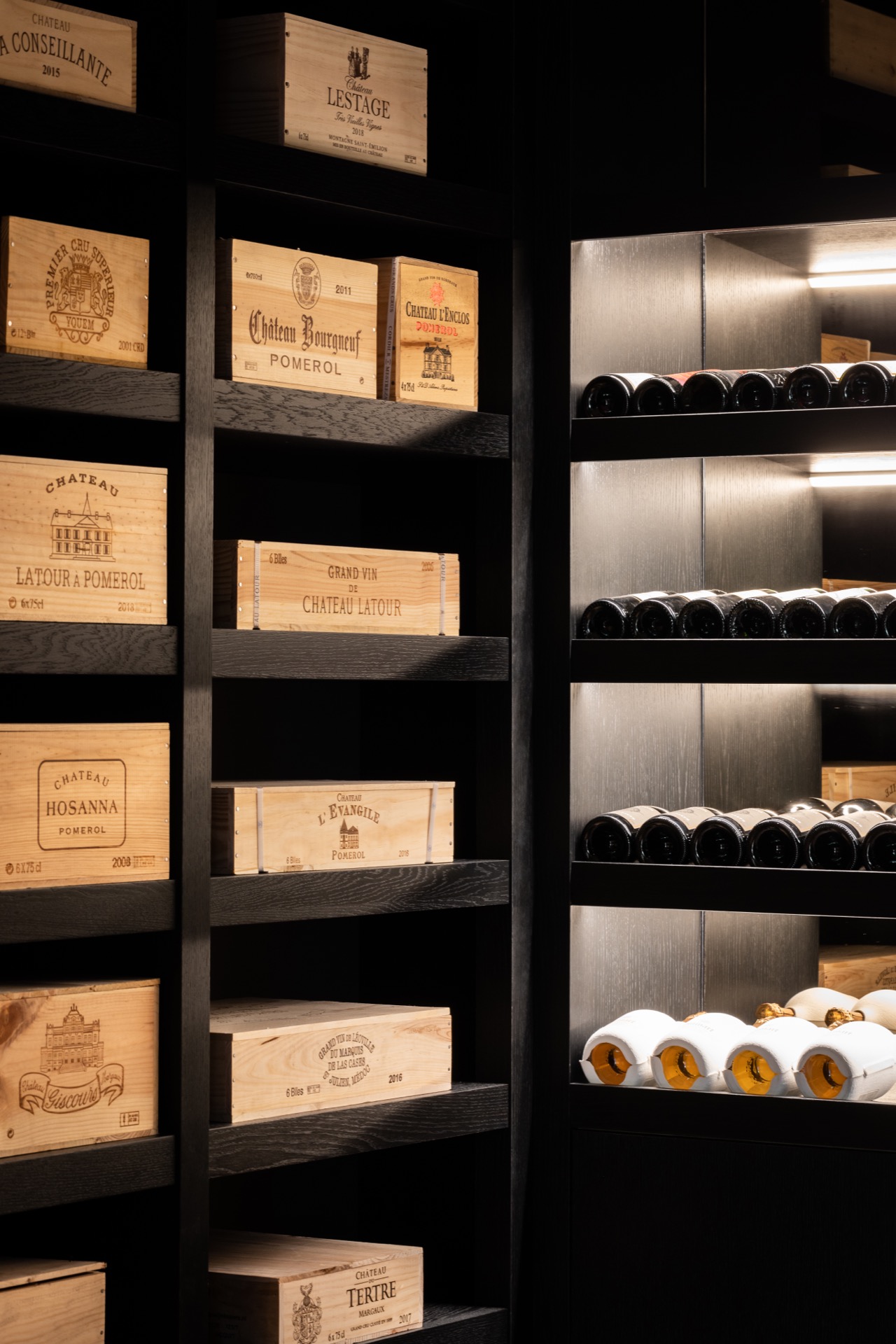
NEW 2026 Jubileum Edition The Best Interior Designers Benelux
Order Now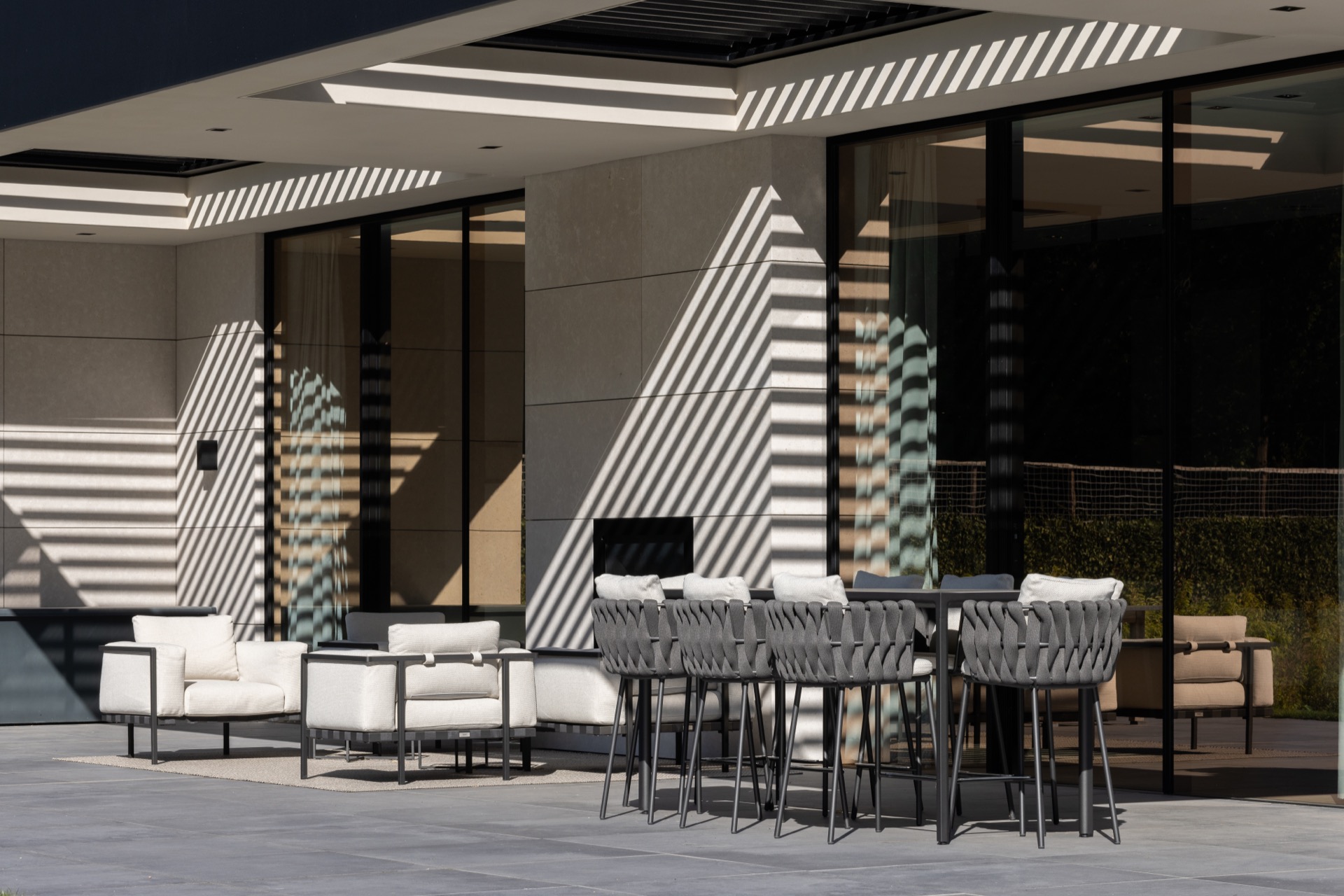
NEW 2026 Jubileum Edition The Best Interior Designers Benelux
Order Now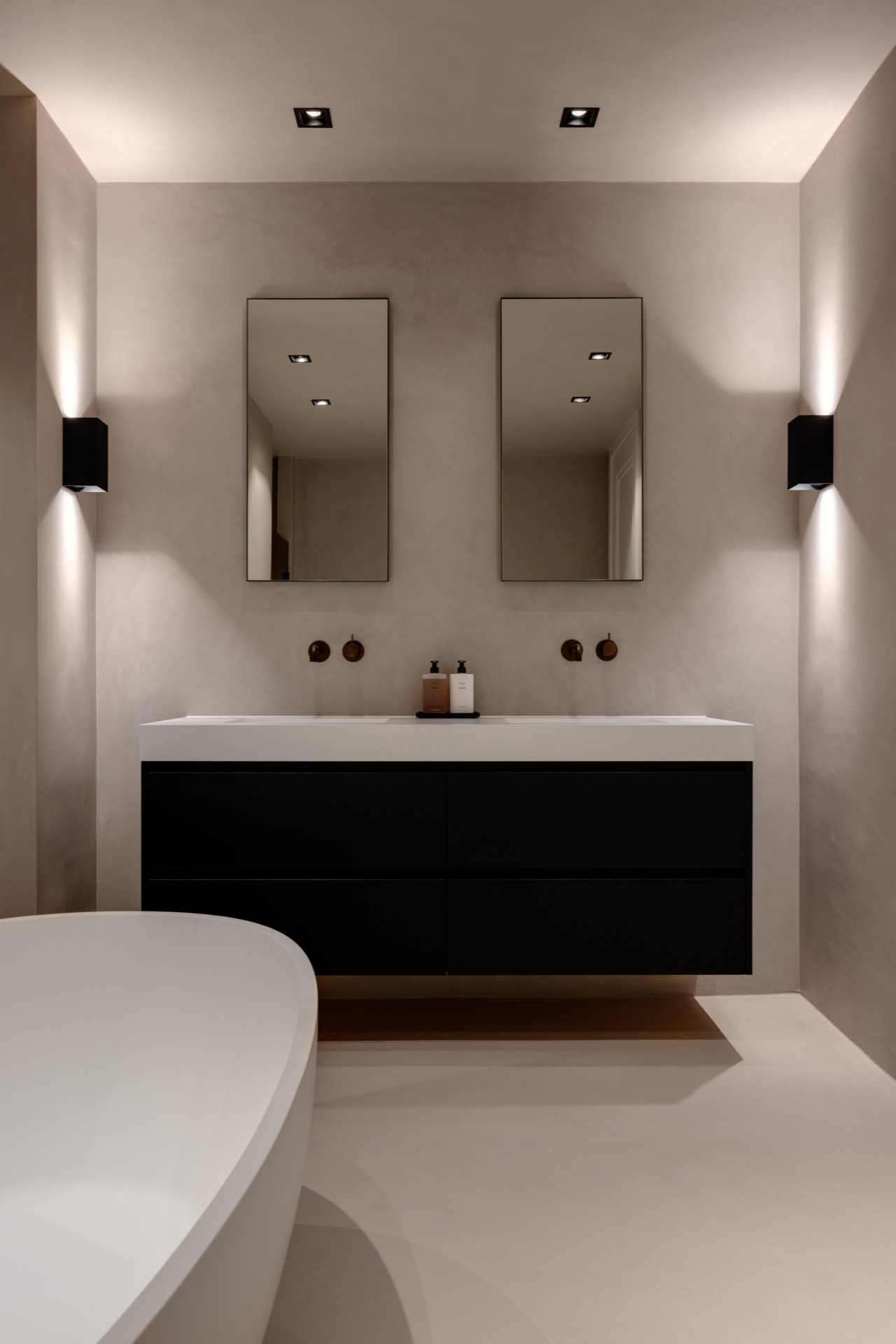
NEW 2026 Jubileum Edition The Best Interior Designers Benelux
Order Now