







Monumental canal house: interior renovation with historic detail preservation
The first thing you notice is the light on the arched wooden window frames. It lands across oak parquet, catches the edge of a marble fireplace surround, and then moves into the deeper parts of the rooms where custom joinery takes over. This monumental canal house interior renovation was completed in 2023 after two years of work, with the historic fabric left visible rather than smoothed away. The result is a modern interior with historic details that still reads as a house with age, proportion and weight.
Monumental canal house interior renovation as a spatial starting point
Restoration began with the parts that hold the house together visually: the classic façades, the wooden beams, and the old structural rhythm that runs through the rooms. Those elements were carefully restored, not redrawn. Their grain, joints and surface marks remain part of the interior’s character, while new finishes sit around them without competing for attention. In a house like this, the most telling move is often restraint. Here, the monumentality comes from keeping the frame legible.
The same approach continues in the way the rooms are opened up. The architecture was renewed with attention to structure and layout, which means the circulation now feels more direct and the rooms can work in a contemporary way without losing their original proportions. Door openings, wall planes and built-in elements are used to guide the eye rather than interrupt it. That allows the restored wooden beams and older details to stay in conversation with the new interior, instead of being reduced to decoration.
A renewed layout with clear spatial moves
Inside, the renewed architecture is expressed through a series of measured transitions. A glazed arch, a deep niche, a run of cabinetry, and a change in floor pattern each mark a shift in use. None of these gestures are loud, but together they make the plan easier to read. The rooms feel composed around fixed points: a fireplace, a wall of books, a kitchen edge, a dining table placed beneath large curtains and tall windows. That clarity is what gives the renovation its calm rhythm.
Throughout the house, the oak parquet herringbone pattern adds a visible layer of direction. It pulls the eye through sitting areas and toward the more enclosed zones, where custom furniture defines the walls. In the work or children’s room, for example, the built-in volumes sit close to the ceiling line and leave the centre of the room open. The result is a layout that uses joinery as architecture, with storage and proportion working together rather than separately.
Interior design built from joinery, colour and finish
Kiek Concepts shaped the interior and furnishing with luxury finishes, custom-made furniture and a balanced palette that stays close to the materials themselves. Light walls, timber, marble and muted upholstery do most of the work. Because the palette is restrained, each surface gets room to register: the sheen of stone, the darker tone of a cabinet front, the soft fall of curtains across a tall opening. Nothing asks for extra emphasis. The rooms are defined by surface changes and by the way light moves across them.
That approach is especially clear in the storage pieces. Built-in bookshelf niches appear as part of the wall rather than as separate furniture. In one room they are dark and open, in another they rise in lighter timber around a more enclosed work zone. These changes are small, but they keep the house from feeling repetitive. They also let the interior carry the weight of daily use without losing the clarity of the original rooms. The design relies on fixed elements that can do more than one job. Monumental canal house interior renovation remains connected to the layout, materials and daily use of the home.
Marble, timber and the kitchen wall niche
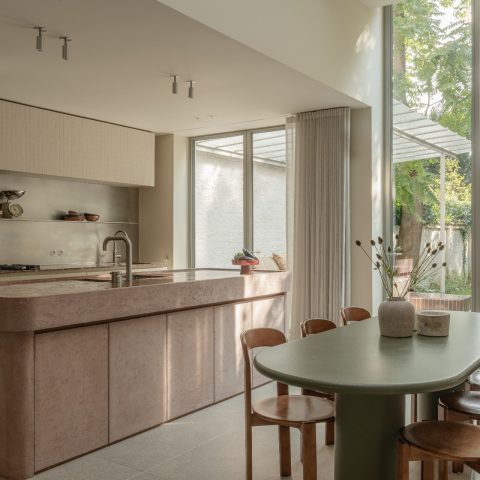
The kitchen is shaped by the meeting of stone and wood. A marble kitchen countertop runs along the working edge, while the wall behind it is broken by a niche with integrated lighting. That recessed detail does a practical job, but it also changes the depth of the room. It creates a pause in the wall, a place where the eye can settle before moving on to the tall cabinet fronts. Near the cooking zone, darker finishes tighten the composition and make the marble read even more clearly.
Several kitchen views show how the same materials are repeated with slight shifts. A marbled surface appears beside a profile-lined wall, then returns lower as a worktop under high cabinet fronts. In another angle, the countertop is paired with a darker base and a framed opening that suggests a bar wall or serving niche. The lighting stays close to the architecture, so the room feels composed through edges, not through ornament.
Living spaces shaped by wood and stone
The living rooms gather around a marble fireplace surround, a detail that is visible from several angles and acts as a fixed point in the plan. Around it, arched wooden window frames bring in large amounts of daylight and soften the scale of the walls. One image shows the frame of a glazed arch cutting through the room above the oak parquet, while another places the built-in bookshelf niche next to the fire zone. The combination keeps the room grounded: stone at the centre, wood around it, and daylight moving across both.
The dining area continues that language with less contrast and more length. A long timber table sits under hanging light and beside tall curtains that pull the vertical line of the room down to the floor. The windows are divided by muntins, which gives the glass a stronger rhythm and links it back to the older structure of the house. Even when the furnishing is modest, the room feels measured because the openings, floor pattern and joinery all point in the same direction.
Bathroom surfaces and the quieter end of the house
The bathroom turns to a different set of textures. Wood slats wrap the vanity and appear again at the shower zone, where glass, stone and timber are layered in a compact arrangement. That sequence creates a spa-like bathroom design without relying on excess. The surfaces are simple to read: smooth stone on the countertop, vertical wood on the cabinet front, clear glazing around the shower. A freestanding bath is placed nearby, separated from the shower by the same restrained material language.
What makes the bathroom work is the repetition of small vertical lines. The slats continue across the vanity front, then return in the shower enclosure, so the room feels linked even when the functions change. Light is kept close to the surfaces, especially where the marble or natural stone catches a softer reflection. As in the rest of the house, the renovation avoids display for its own sake. It lets the material change do the speaking, and that is enough to carry the space.
Viewed as a whole, this monumental canal house interior renovation holds onto its original structure while making room for present-day living. The restored wooden beams, arched wooden window frames, built-in bookshelf niches and oak parquet herringbone pattern give the house its visible order. Marble, custom joinery and carefully placed lighting add depth without crowding the rooms. Two years of work resulted in a house where the historic shell remains readable, but the interior now moves with a different ease.
Wil je meer zien van Interior Studio van Maanen? Bekijk de pagina van Interior Studio van Maanen voor meer projecten en bedrijfsinformatie.


.png)
NEW 2026 Jubileum Edition The Best Interior Designers Benelux
Nu Bestellen


NEW 2026 Jubileum Edition The Best Interior Designers Benelux
Nu Bestellen


NEW 2026 Jubileum Edition The Best Interior Designers Benelux
Nu Bestellen


NEW 2026 Jubileum Edition The Best Interior Designers Benelux
Nu Bestellen


NEW 2026 Jubileum Edition The Best Interior Designers Benelux
Nu Bestellen


NEW 2026 Jubileum Edition The Best Interior Designers Benelux
Nu Bestellen