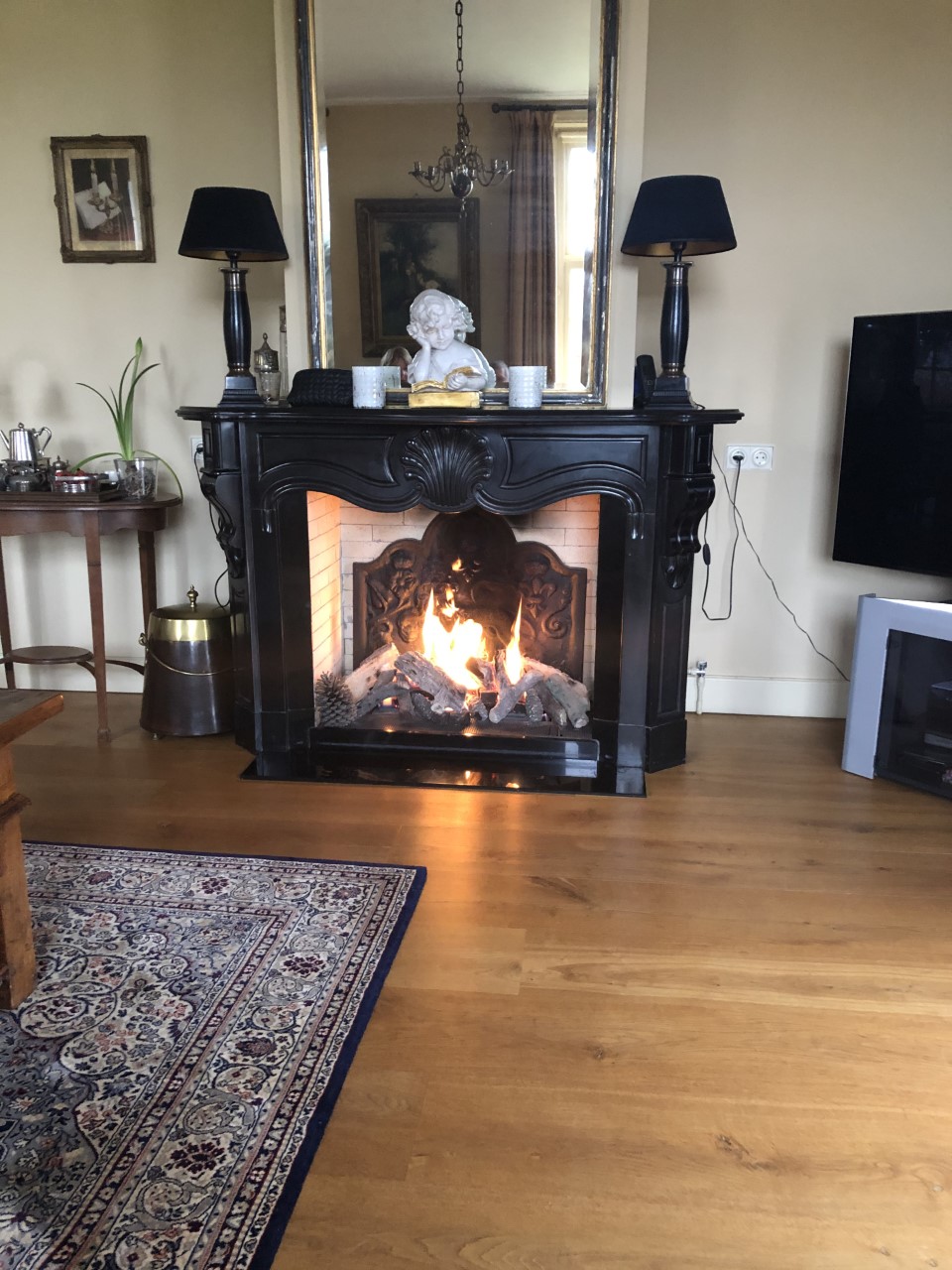







Black gas fireplace with mirror
The black surround is the first thing you notice. It sits low and solid in the room, then rises into ornamented lines that frame the fire opening and the tall mirror above it. The result is a black gas fireplace that reads as part of the living room rather than a separate object. In the photographs, the contrast is clear: dark timber and trim against pale walls, with the flames giving the opening a steady point of movement.
A full front view of the black gas fireplace
Seen from the front, the fireplace has a strong vertical rhythm. The lower section holds the opening, while the upper part gathers the eye toward the mirror. Its black finish sharpens every edge, especially where the moulded details catch the light. This is where the gas fireplace living room composition becomes visible: a hearth, a mirror, and a frame that locks the two together without crowding the wall around it.
The room itself stays quiet around the fireplace. White walls, a light floor, and a door to the side leave the surround to do the visual work. That restraint matters, because the ornament on the mantel would feel busy in a heavier setting. Here, the darker mass of the fireplace has room to breathe, and the mirror adds height without adding clutter. The black gas fireplace becomes the anchor of the seating area.
Flames, brickwork and the fire opening
Up close, the fire opening changes the mood of the whole piece. The visible flames flicker against a brick-lined back wall, which gives the opening a rougher texture than the polished frame around it. That difference is one of the most telling parts of the project. The gas fire detail flames bring motion; the brickwork holds that motion in place. It is a simple contrast, but it keeps the fireplace from feeling static.
In another view, the opening sits slightly lower in frame, so the viewer reads the fire before the decoration above it. The flame line is narrow and direct, and the dark surround tightens the composition around it. Because the hearth is not overloaded with objects, the eye stays on the changing light inside the opening. For anyone looking at a classic gas fireplace mirror arrangement, this project shows how little is needed when the proportions are right.
Classical details that stay legible
The ornament is not the kind that disappears into the background. It traces the edges of the surround and builds a measured pattern across the black surface. Seen in close-up, those carved profiles are what give the fireplace its character. They also explain why the mirror works so well above it: the frame repeats the same formal language, but in glass instead of wood. The two parts speak to each other across a short distance.
There is also a practical visual effect in the mirror. It opens the wall upward and brings a second layer into the room, catching light that would otherwise stop at the mantel. In the wider shot, the mirror sits neatly within the fireplace composition, almost like a continuation of the opening below. That vertical stacking is what gives the black gas fireplace its presence in the living room without needing a large footprint.
A living room built around one dark centre
The broader room is kept light and spare, which makes the fireplace feel more deliberate. A chair enters the frame at the edge, a few wall details sit off to the side, and the floor stays visually open. Nothing competes with the mantel. Because of that, the classic gas fireplace mirror becomes the room’s main axis. The composition reads from floor to fire to mirror in one move, and each layer has its own material presence.
The images also show how the black finish interacts with the surrounding materials. Timber, plaster, and glass all sit close to the fireplace, but none of them flatten its outline. Instead, the dark surface sharpens the edges of the ornament and keeps the opening distinct. In a gas fireplace living room setting, that clarity matters. It lets the viewer understand the shape of the surround before noticing the detail work.
What the close-ups reveal
One close-up focuses on the brick-like back wall, where the texture reads almost like a field of small blocks behind the flame. Another pulls in tighter on the upper surround, where the carved profiles and black finish meet. These are small shifts, yet they change how the fireplace is read. The first image tells you about depth; the second tells you about form. Together they give the black gas fireplace more than a front-on impression.
The wide image then resolves the whole arrangement again: fire below, mirror above, ornament around both. That balance of open flame and formal framing is what stays with you. It is not a showy room, but it is carefully composed in the way the parts are placed. The fireplace holds the centre, the mirror extends the line upward, and the dark surround ties the two into a single visual field.
Looking at the project as a whole
This project is best understood through its surfaces and proportions. The black frame, the visible flames, and the large mirror each carry part of the composition. Together they create a fireplace that feels rooted in the living room rather than attached to it later. The brick-lined opening adds texture, while the ornament keeps the form readable from across the room. It is a straightforward idea, executed through detail rather than excess.
For viewers interested in gas fireplaces, the value here lies in the visual discipline of the piece. The fire does not need much help; the surround sets it off, and the mirror gives it height. That is why this black gas fireplace stands out in the photographs. It is a room element shaped by line, material, and reflection, with the flames providing the only moving part.
The project page may be brief in source text, but the images do most of the telling. They show a classic fireplace surround, a living room with pale walls and timber flooring, and a fire that remains visible through the opening. The final impression is not about technical explanation. It is about how the black gas fireplace sits in the room, how the mirror lifts the composition, and how the fire brings the centre of the wall to life.
Want to see more of C.W. Rustiekbouw? View the page of C.W. Rustiekbouw for even more great projects and company information.




NEW 2026 Jubileum Edition The Best Interior Designers Benelux
Order Now €125