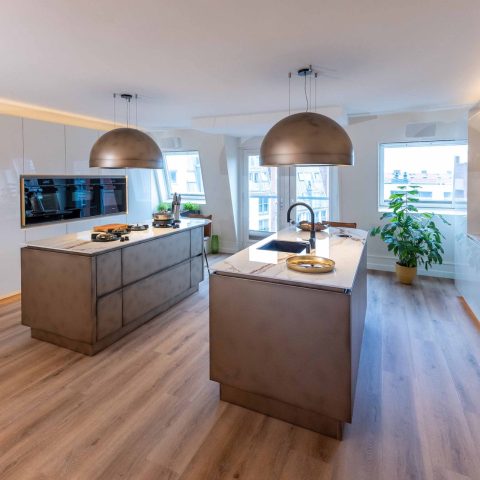








Black handleless kitchen with island
A dark granite surface catches the light before anything else. In this black handleless kitchen, the eye moves from the island to the tall cabinet wall, then back to the cook zone set into the worktop. The front panels are entirely black, yet the wood grain in the finish keeps the planes from feeling flat. Round smoked glass pendants and ceiling spots add reflections across the island and the glazed oven fronts, giving the room a layered, measured rhythm.
A black kitchen with island and a quiet, continuous line
The room is built around a black kitchen with island and a full cabinet wall, so the layout reads clearly at a glance. There are no handles breaking the fronts. Instead, the lines stay long and direct, from the island edge to the tall units along the back wall. That calm base leaves room for the objects on the counter, a flower stem, or the glow from the pendants above. It is a black handleless kitchen, but the surface treatment keeps it from becoming visually hard.
Up close, the fronts show a fine wood-grain texture. It runs across the cabinetry and softens the black finish without changing the overall character of the room. The grain becomes more visible where daylight or the ceiling spots hit the panels. On a page like this, that detail matters: it explains why the kitchen feels restrained rather than blank. The handleless kitchen island continues the same language, with a dark top and flush fronts that keep the composition compact.
The island holds the cooking zone
The cooking area sits directly in the granite worktop, so the surface stays visually calm. The recessed hob is part of a Bora Professional induction system with black rotary controls and side extraction, which avoids a separate hood above the island. That decision changes the feel of the room more than a technical list can suggest. Sightlines stay open. The island remains usable from all sides. In a black kitchen with island, that is what gives the centre of the room its clear, uncluttered presence.
The dark granite worktop has a deep black tone described in the source as Nero Assoluto Antiek. It brings weight to the island and gives the cooking zone a defined edge. Because the hob is set into the stone, the shift from appliance to surface is precise and tight. The granite also appears on the cabinet run, tying the island to the rest of the kitchen. The effect is not decorative in the usual sense; it is mostly about the way the material holds the room together in one uninterrupted band.
Built-in ovens set into the tall cabinet wall
Along the cabinet wall, the built-in ovens sit inside the dark fronts rather than standing apart from them. There are two ovens in total: a Miele combi steam oven and microwave, plus a second Miele oven with conventional and fan functions. A warming drawer for plates sits below. The result is a tall, vertical strip of equipment that keeps the island free from extra appliances. In this black handleless kitchen, the cabinet wall acts as a quiet backdrop while still carrying most of the kitchen’s working functions.
The glazed oven fronts reflect the pendant lights and the spots above, which gives the wall a slight sheen against the matte-looking cabinetry. Seen from the side, the unit wall reads as a continuous surface with only the appliance frames interrupting it. That is one of the stronger gestures in the room: the work is concentrated in a single line, while the island remains open and low. It is a practical arrangement, but one that also shapes the visual order of the whole space.
Light that stays close to the surface
Lighting is used as another layer, not as a statement piece. Ceiling spots pick out the worktop and the darker wall panels, while the round smoked glass pendants hover above the island. Their dark glass picks up reflections from the granite and the oven doors. Because the lamps are circular, they contrast with the straight cabinet edges and the rectangular plan of the room. The effect is subtle but visible, especially in a black kitchen with island where light has to do some of the work that colour normally would.
The pendants also mark the island as the centre of the composition. They hang low enough to connect visually with the countertop, yet they do not interrupt the sightline across the kitchen. That matters in a handleless kitchen island, where every line needs to stay readable. The fixtures do not add clutter; they sit within the space and describe it. Together with the spots, they make the dark finishes legible instead of heavy.
Water, stone and the practical side of the room
The tap is black as well, chosen to sit inside the same restrained palette. A Quooker Cube Flex provides boiling, chilled, purified and sparkling water, so the sink area remains part of the same dark composition rather than becoming a separate feature. Because the source mentions the tap explicitly, it also reinforces the project’s consistent choice: every visible element follows the black base. In a black handleless kitchen, even the smaller fittings are treated as part of the overall line of the room.
Granite is described in the source as impact-resistant and wear-resistant, and that makes sense here because the worktop is used as both surface and structure. The stone is cut as a single natural material, which reduces the look of joints and supports the clean geometry of the island. The note on maintenance is practical too: a cleaner and impregnating product used once or twice a year helps preserve the surface. That information suits the page because it keeps the focus on the material as it is actually used, not as an abstract finish.
Why the room reads so clearly in the photographs
The images show a black kitchen with island from several angles, and each one emphasises a different part of the composition. One view takes in the full room, with the island, the cabinet wall and the hanging lamps in a single frame. Another moves closer to the front panels, where the grain and the handleless detail become visible. A third image places the cook zone inside the granite surface, which makes the recessed hob feel integrated rather than added on. Together, the photographs explain the room through surfaces, height and light.
Seen across the project, the strength of this black handleless kitchen lies in restraint. The island carries the cooking zone, the tall wall holds the ovens, and the granite worktop gives the room its dark centre. Nothing is overdrawn. The materials do the work through their texture, their reflection and their edges. That is why the kitchen reads so clearly: it is built from a small number of visible decisions, repeated with discipline across the space.
Want to see more of Tieleman Keukens? View the page of Tieleman Keukens for even more great projects and company information.




NEW 2026 Jubileum Edition The Best Interior Designers Benelux
Order Now €125