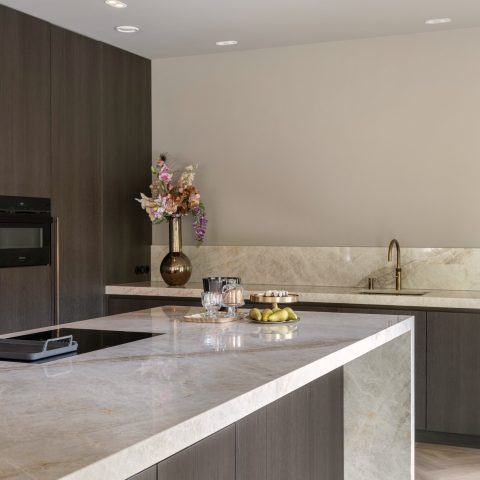








Bronze kitchen with black marble
The bronze kitchen sets the tone the moment the island comes into view. Bronze front panels catch the light in thin horizontal lines, while the black marble-look worktop pulls the composition into a darker register. The veining is light and direct, running across the surface instead of disappearing into it. Against the matte black tall cabinets, the bronze finish reads as a deliberate surface choice rather than a decorative accent.
Bronze surfaces and a clear horizontal rhythm
The project is built from long, low lines. Drawer fronts and island panels stretch across the room, so the bronze kitchen feels ordered without becoming rigid. That horizontal rhythm is repeated at the edges of the cabinets and at the join between the worktop and the base units. In close-up, the bronze finish does not behave like a bright metal. It sits flatter, with a muted glow that changes as you move past it. That keeps the eye on the shape of the kitchen, not only on the sheen.
On the island, the black marble countertop anchors the whole setting. Its lighter veining softens the dark slab and gives the surface a visible direction. The stone is not treated as a backdrop; it is one of the main elements of the room. The countertop also creates a clean boundary between the bronze cabinetry below and the darker wall of storage behind it. In the photographs, that contrast is what defines the room most clearly.
Matte black cabinets that recede instead of compete
The tall cabinet wall is finished in matte black, which makes it disappear more than it announces itself. This is where the built-in appliances are visually absorbed into the composition. Doors, niches and equipment sit in the same dark field, so the storage wall reads as one plane. That choice leaves the bronze kitchen island free to carry the visual weight in the room. It also sharpens the difference between the working zone and the surrounding interior.
Seen from the side, the cabinetry has a measured depth. The fronts are flush and the edges stay quiet, so the materials do the talking. The matte surface avoids reflection, which gives the black volume a solid presence next to the brighter bronze faces. This is a kitchen with bronze details, but it does not rely on ornament. The finishes are used to set up contrast, shadow and line.
A kitchen island built as the main surface
The luxury kitchen island is not only a place to work. It is the clearest reading of the material palette in the room. Bronze fronts support the dark stone top, and the proportions let the island sit as a separate block within the larger interior. The surface appears long and calm, with the edge of the worktop sharply defined against the lighter veining. That detail matters because it shows how the materials meet: stone above, bronze below, black storage behind.
In the wider shots, the island also marks the transition between kitchen and living space. The room opens beyond it toward pale walls, timber elements and a chevron-like floor pattern. Those softer tones keep the kitchen from feeling closed in. Instead of ending at the cabinets, the eye continues into the adjoining interior. The project works because the kitchen is designed as part of that larger room, not as a separate block dropped into it.
Light, windows and the edges of the room
Natural light arrives from the large windows and the glazed opening beside the kitchen. It lands on the bronze surfaces first, then slides over the black marble countertop. Outside, greenery appears through the glass, adding a green edge to the otherwise dark and metallic palette. The view does not dominate the composition, but it prevents the room from becoming too enclosed. It is one of the quieter gestures in the project, and one of the most effective.
Warm accent lighting reinforces the material contrast. Wall lights and subtle downlighting pick out the countertop and the upper line of the cabinetry, especially in the evening views. The light stays close to the surfaces instead of flooding the room. That means the bronze finish, the black cabinets and the veined stone remain legible. Every line stays readable, from the appliance wall to the island edge.
Small fixtures, large effect
The bronze kitchen faucet and matching accessories sit within the same visual language as the fronts and the island. They are not isolated showpieces. In the photographs, they work best because they echo the larger material decisions already present in the room. The faucet rises against the dark top, while the surrounding surfaces hold the frame. Even the smallest elements keep the project’s tone: restrained, precise and material-led.
That restraint continues in the way the equipment is concealed. Appliances fall back into the wall units, so the room is not broken up by stainless-steel interruptions. The result is a cleaner reading of the kitchen as architecture. Front, stone, cabinet wall and light each take their own role. Nothing shouts, but nothing disappears without reason either. The room is built from controlled contrasts.
One room, two registers
What makes the bronze kitchen distinctive is the shift between the warm bronze blocks and the darker, quieter storage wall. One side reflects light; the other absorbs it. One side holds the island in place; the other closes the room with a solid vertical field. That exchange gives the interior its structure. It also explains why the project reads well from several angles: close detail, full room and the sightline toward the adjacent living area all show a different part of the same composition.
For readers looking at luxury kitchens, the appeal lies in those visible transitions. Bronze front panels, matte black cabinets, a black marble countertop and large windows are not presented as separate ideas. They are arranged as a single interior sequence, with the island at the center and the living space extending beyond it. The kitchen feels designed to be seen from the room around it, not only from the work zone itself.
Want to see more of Rhijnart Keukens? View the page of Rhijnart Keukens for even more great projects and company information.


NEW 2026 Jubileum Edition The Best Interior Designers Benelux
Order Now €125


NEW 2026 Jubileum Edition The Best Interior Designers Benelux
Order Now €125


NEW 2026 Jubileum Edition The Best Interior Designers Benelux
Order Now €125


NEW 2026 Jubileum Edition The Best Interior Designers Benelux
Order Now €125