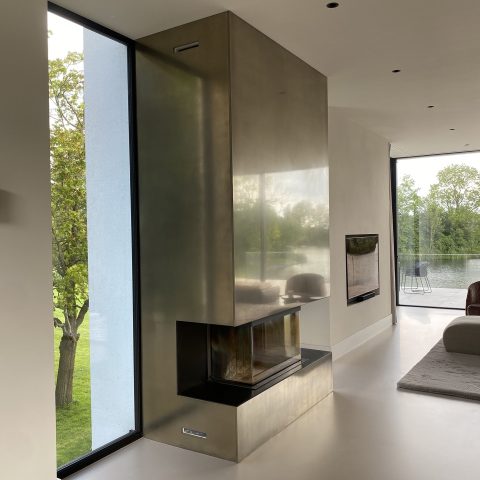









Cracked Gunmetal – cracked gunmetal metal-look in a modern interior
Dark, cracked gunmetal metal-look surfaces set the tone from the first view. The finish sits against light-grey marble-look stone panels with a crackle and veining pattern, so the kitchen reads as a study in contrast rather than decoration. Around the kitchen unit, the gunmetal tint sharpens the edges and gives the composition a denser, more grounded presence. Seen together, the materials turn the cracked gunmetal metal-look interior into the strongest visual line in the room.
Gunmetal at the kitchen edge
The kitchen is built around large vertical panels in a pale stone look, marked by deep veining and fine crackle texture. Against that surface, the darker metal-look finish wraps the unit and underlines the volume. The result is not loud, but it is direct: light stone above and around, darker gunmetal at the edge and underside. Handleless fronts keep the reading clean, while the integrated appliances sit back in a dark recess, where glass reflections break the flatness of the cabinet wall.
That contrast does most of the work. The marble-look stone panels carry movement across the wall, while the cracked metal finish holds the kitchen in place. Small changes in sheen matter here: matte areas absorb light, darker borders pick it up. The kitchen does not rely on ornament. It depends on the meeting point between the stone-look faces, the gunmetal accent in the kitchen, and the sharp lines that frame each surface.
A floating black staircase cuts through the space
Above the kitchen, the floating black staircase adds a second strong line. Its dark treads and metal support read as a suspended block, with the underside left open enough to keep the view moving. The staircase does not hide in the background. It frames the room and introduces a heavier note of black metal that answers the gunmetal finish below. In the same sightline, the stair and kitchen set up a clear rhythm of dark and light, solid and reflective.
From this angle, the interior feels built from a few precise moves rather than many separate gestures. The stair landings, the dark ceiling strips, and the stone-clad wall all push the eye forward. The cracked gunmetal metal-look interior gains its force from that restraint. Every dark element is placed where it can sharpen a joint, outline an opening, or mark the edge of a volume. Nothing is left to drift.
Stone texture, seen up close
The close-ups bring out a different register. On the stone-look panels, the surface changes from broad grey fields to black crackle lines and fine speckling. Some joints read as dark seams; others fade into the print of the panel itself. That tension between surface and line gives the wall depth without adding bulk. In these details, the marble-look stone panels crackle texture becomes more than a background. It behaves like a skin, with the darker lines pulling the light across the surface.
At the kitchen block, the underside and side faces shift to a darker tone, closer to brushed black metal or gunmetal shadow than to the pale panels beside it. The transition is deliberate. A thin horizontal edge marks the change in material, while the darker side surfaces keep the block visually compact. This is where the finish does its best work: at the seam, at the corner, and where the eye catches the difference between a stone-look plane and a metal-look return.
Handleless fronts and integrated appliances
The kitchen fronts stay flush and handleless, which keeps the stone pattern readable across the width of the unit. Built-in appliances sit within a dark niche, so their glass surfaces and reflections do not compete with the panels around them. That choice matters in a room where texture already does a lot of the talking. The fronts remain calm, but not blank. Their surfaces hold the line of the composition while the recessed equipment adds a quieter layer of depth.
What stands out most is how the gunmetal accent in the kitchen is not used as a separate feature. It belongs to the larger surface arrangement. The darker finish wraps the block, folds under the worktop, and meets the stone-look panels without a break in the visual logic. Together with the floating black staircase interior, it gives the room its strongest contours.
Hand-finished details tied into the room
The source text points to hand-crafted details integrated with interior objects, and the images support that reading. The surfaces are not treated as loose parts placed in a room. Instead, they are fitted into the architecture of the interior so the transitions, borders, and corners all matter. Dark metal-look edges, visible joins, and controlled panel lines give the project its precision. The cracked metal finish works because it is drawn into those transitions, not applied as a separate flourish.
That approach gives the space a disciplined look without flattening it. The gunmetal tint deepens the kitchen, while the stone-look wall panels lift the tone back up. Between them, the floating staircase and the dark recess for appliances create pauses in the surface pattern. The cracked gunmetal metal-look interior is strongest when those pauses are read together: a change in material, a shift in reflection, a shadow line under the worktop, and a stair that crosses the view like a cut through the room.
In collaboration with Fred Constant.
Want to see more of Grezzo Concrete | Exclusive Handmade Interior Finishes? View the page of Grezzo Concrete | Exclusive Handmade Interior Finishes for even more great projects and company information.


NEW 2026 Jubileum Edition The Best Interior Designers Benelux
Order Now €125


NEW 2026 Jubileum Edition The Best Interior Designers Benelux
Order Now €125