










Curtains for tall windows that frame daylight in a warm interior
Light lands softly on the stone-like floor, then stops at the edge of tall curtains that rise beside the glazed openings. In this project, curtains for tall windows do more than cover glass: they shape the room’s daylight, hold the line of the openings, and sit naturally against wood, plaster, and the pale, mineral surface underfoot. The effect is quiet, but it is built from clear contrasts—sheer fabric against darker panels, straight hanging lines against arched openings, and a calm palette that lets the architecture stay visible.
Daylight filtered through layered curtain panels
The most visible move is the layering. A lighter curtain sits behind a darker panel, so the window dressing for daylight changes the room in small steps rather than all at once. In the bedroom views, this gives the glass a softer edge and keeps the opening legible even when the fabric is drawn. The curtains for tall windows also create depth in the frame itself: you notice the wall, then the textile, then the view, instead of one flat surface.
That approach works especially well where the openings are generous. The fabric falls in long vertical lines that echo the height of the rooms, while the darker outer panels hold the composition in place. Instead of competing with the architecture, the layered curtain panels let the windows remain the main gesture. The daylight still enters freely, but it is moderated, so the interior reads as a sequence of lighter and darker zones rather than a single bright field.
Arched window curtains beside wood and stone
Several of the openings are rounded at the top, and the arched window curtains follow that geometry without softening it too much. Beige and taupe cloths sit against the curved frames, making the shape easy to read. In one room, the curtain edge falls beside a beam and a broad wooden lintel, which gives the opening a firmer outline. The combination of curved masonry, timber, and textile is simple, but it carries a lot of the project’s atmosphere.
Wooden beams run across the ceiling in more than one space, so the curtains with wooden beams become part of a larger rhythm. The fabric drops from the top while the timber stretches horizontally above it, and that crossing of directions keeps the rooms from feeling static. On the floor, the stone-like tiles add another surface with their pale, slightly mottled finish. Together, those materials keep the rooms grounded while the curtains decide how much daylight reaches each corner.
Neutral curtain colors that stay close to the architecture
The palette stays restrained. Neutral curtain colors dominate: beige, taupe, brown, and deeper tones that lean into the room rather than pulling away from it. In the bedroom, a green-brown curtain layer sits near transparent fabric, while another view brings in darker brown panels with a heavier fall. In a different room, a red curtain introduces stronger color, but even there the fabric remains tied to the wood and the warm light around it.
What matters is how the textiles sit in relation to the room’s surfaces. The curtains do not read as decoration added at the end. They are part of the spatial sequence, especially where the openings reach high and the wall height would otherwise feel bare. Neutral curtain colors make that possible because they keep attention on proportion, on the depth of the reveals, and on the way the light changes as it passes through each layer of cloth.
Rooms that move between sleeping, washing, and gathering
The project is seen through several connected spaces, and the curtain treatment changes with each one. In the sleeping areas, the fabric is pulled close to the openings, softening the bright edge of the glass near the bed. In another corner, a curtain hangs beside a doorway-like opening and a lit recess, where warm light catches the folds at the edge of the frame. The room reads as calm, but not empty; the textiles help define where one zone ends and the next begins.
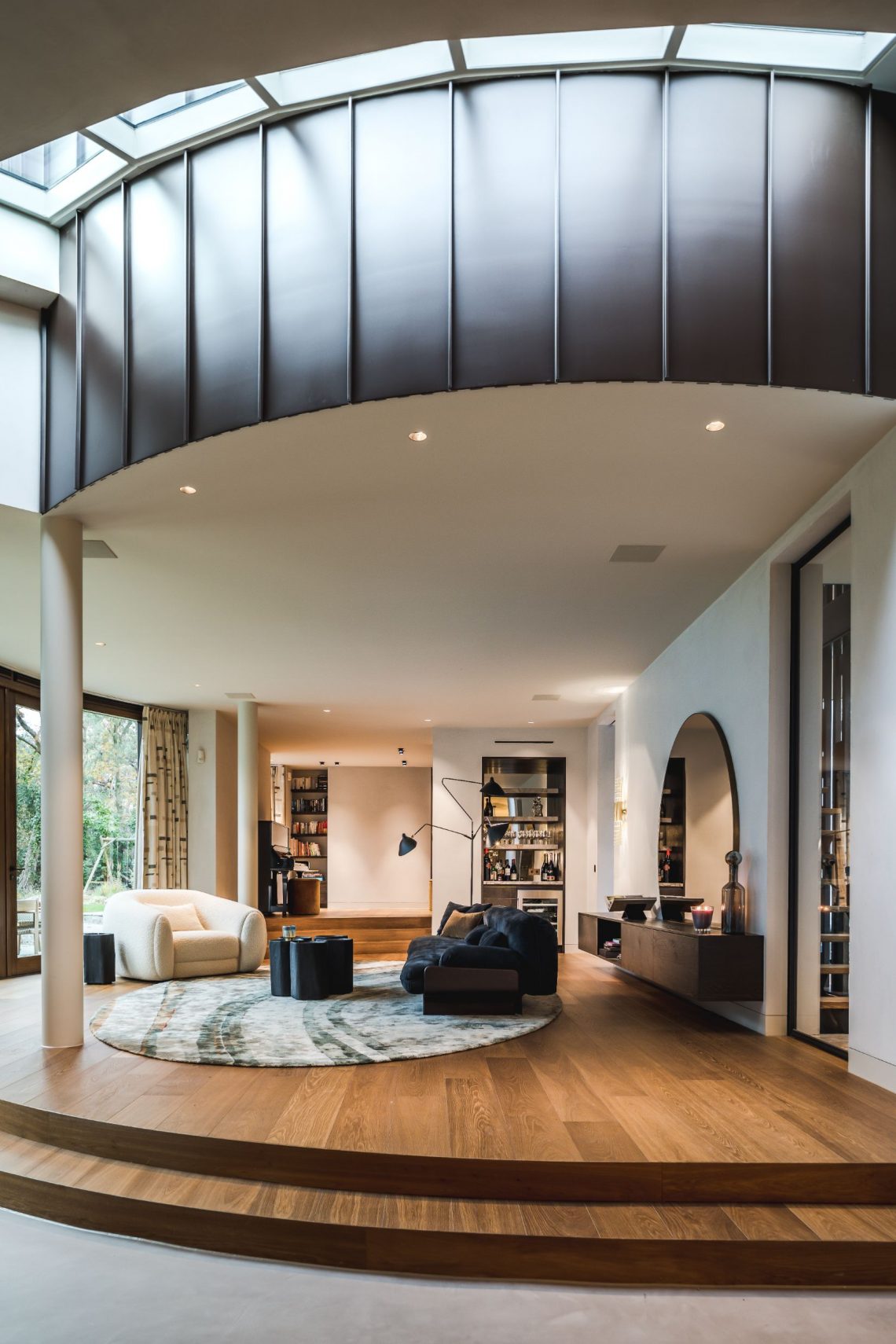
A spa-like corner appears with a stone-look floor, enclosed light, and a curtain set near a curved niche. The textile and the mineral surface are enough to slow the room down visually. In the shared living space, large glazed doors and double panels bring in more daylight, while a light inner layer and darker outer curtain keep the opening from feeling exposed. The same idea repeats across the project, but never in exactly the same way.
How layered curtain panels change a tall opening
Seen up close, the fabric does practical visual work. The inner layer catches light first and breaks up the glare; the outer layer gives the opening weight when it is closed or partly drawn. That is why layered curtain panels feel so effective here. They let a tall opening behave differently through the day without changing the room’s basic character. A narrow slit of light looks precise next to the heavy folds, and a wider opening keeps the window’s full height in view.
That same logic appears in the arched rooms, where the curtain line has to sit carefully beside the curve. The cloth does not fight the geometry. It follows it. In some frames, the fabric sits between wall and glass so the opening reads as a recess; in others, it hangs more openly and allows the timber around it to remain part of the scene. Those small shifts make the rooms feel measured rather than overworked.
A calm interior built from visible contrasts
What stays with you is the sequence of surfaces: cloth, wood, stone-like tile, glass. Each has a different weight, and the curtains for tall windows connect them without flattening their differences. The daylight is bright, but it is never left raw. It moves through the panels, lands on the floor, and fades into the corners where the warmer lighting takes over. That transition gives the rooms their pace.
The project also shows how a restrained interior can still hold variation. A beige curtain at an arched opening, a darker panel beside a glazed door, a red textile in a higher room, a translucent layer near a bed—each choice shifts the room slightly. The result is not a single repeated solution, but a set of responses to openings, height, and light. For anyone looking at curtains for tall windows, that is the useful lesson here: the fabric works best when it follows the room’s proportions and leaves the architecture easy to read.
Related project pages
Explore more examples of curtains and window treatments across rooms with high openings and strong daylight. You can also browse a gallery focused on tall windows and see how different curtain layers change the feel of a space. For a broader view, read about the approach from inspiration to selection and installation, and compare how each project uses textile, light, and proportion in a different way.
Want to see more of Onel Window Dressings? View the page of Onel Window Dressings for even more great projects and company information.



NEW 2026 Jubileum Edition The Best Interior Designers Benelux
Order Now €125


NEW 2026 Jubileum Edition The Best Interior Designers Benelux
Order Now €125


