










Custom boiserie combined with double oak interior doors
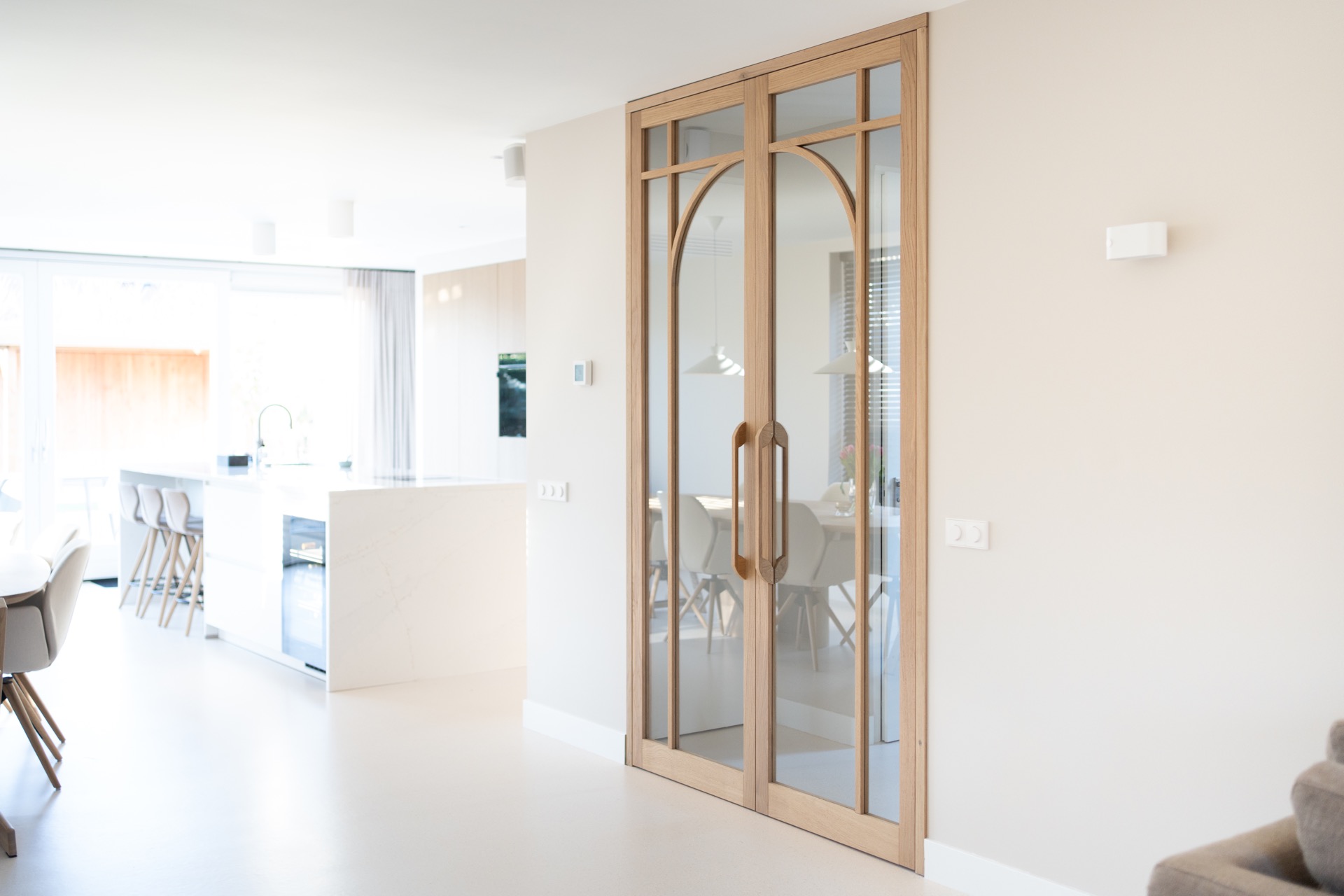
Double oak interior doors set the tone the moment the eye reaches the passage between kitchen and hall. The pair is built in solid oak, with glass panels that keep the opening light and visible rather than closed off. Around them, the custom oak door frames stay restrained, so the wood does not overpower the surrounding plaster walls. Handcrafted oak handles sit on the door leaves like measured accents, and the arched door design adds a softer line to the vertical rhythm of the frame and glazing.
A glazed door set that reads as part of the room
Seen from the hall, the oak hinged doors with glass act as a clear boundary and a visual link at the same time. The muntin pattern divides each glazed panel into smaller sections, giving the doors a drawn, almost architectural surface. Vertical stiles and horizontal bars keep the proportions orderly, while the rounded arch in the upper field interrupts that grid with a single curve. Because the frame is kept slim, the opening stays legible and the oak remains present without feeling heavy.
The material contrast is straightforward: oak, glass, and pale walls. That is enough to shape the passage. The wood carries the structure, the glass lets light pass through, and the white surfaces around it keep the composition calm. In the images, the door set appears both frontal and slightly oblique, which makes the depth of the frame visible and shows how the glazing sits back within the oak surround. It is a small move, but it gives the opening more weight than a plain flush door would have.
Oak handle details and the way the opening is built
Close-ups bring attention to the oak door handle details and the fixing points around the hardware. The handles are shaped by hand and follow the grain of the timber, so they read as part of the door rather than as an added component. Next to them, the edge of the glass and the join between frame and leaf become visible. Those details matter here because the project depends on precision at a human scale: the touch point, the hinge line, the narrow margins around the glazing.
Rounded lines inside a rectilinear frame
The arched door design softens the otherwise strict geometry of the opening. In the photographs, the curve appears inside a structure defined by straight stiles and repeated divisions, which makes the arch stand out even more. It is not decorative in isolation; it changes how the eye moves across the surface. Instead of reading the door as one flat plane, the viewer notices the rise of the arch, the smaller glass fields beneath it, and the way the oak frame holds everything together.
Another image shows the same double oak interior doors from a wider angle, where the door pair sits within a white opening and reads as a bridge between rooms. The glazing prevents the passage from becoming visually closed, while the oak gives it a defined edge. The custom oak door frames are thin enough to keep the composition light, but they still provide a clear border. That balance depends on proportion more than ornament, and the project uses proportion well.
Boiserie behind the bed in the bedroom
In the bedroom, the focus shifts from the opening to the wall behind the bed. Here, a boiserie behind the bed is built in oak and turns the back wall into a measured surface of vertical panels. The finish is not broad or decorative for its own sake. It is specific, with lines that break up the wall and an integrated niche or recess at the lower part of the composition. That niche gives the paneling a practical interruption and prevents the wall treatment from becoming monotonous.
The bedroom image shows how the wood paneling sits against a light surrounding wall. The oak introduces depth through its joints and vertical rhythm, while the surrounding plaster keeps the room from feeling visually crowded. Because the boiserie is placed directly behind the bed, the wall becomes the room’s main backdrop without needing additional objects. The detail is contained, but it still carries the same disciplined material logic as the door set: oak, straight lines, and a clear relation between frame and opening.
One material, two applications
The strength of the interior lies in repetition handled with restraint. Oak appears first in the double oak interior doors, then again in the bedroom wall finish. That repetition is not literal duplication. The doors work through glazing, frame depth, and hand-held details; the boiserie works through panel rhythm and the recessed niche. Together they show how custom work can connect rooms without turning them into the same space. The material stays consistent, but each application responds to a different function and wall condition.
What remains visible throughout is the relationship between craft and geometry. The door leaves, the custom oak door frames, and the boiserie behind the bed all rely on clean joins and controlled dimensions. The arched door design interrupts the straight lines of the glazed panels, while the bedroom wall keeps to a quieter vertical cadence. It is this shift in rhythm that gives the project its interest: one element opens a passage, the other anchors a sleeping area, and both are held together by the same oak language.
The images do not overstate the intervention. They show what is needed: glass fields, oak borders, a curved top line, a handled edge, and a panelled wall behind the bed. From one room to the next, the interior keeps returning to the same material and a careful reading of detail. The result is less about spectacle than about control over surfaces and transitions, where the double oak interior doors and the bedroom boiserie each have a clear role in the plan.
Want to see more of Indu Doors®? View the page of Indu Doors® for even more great projects and company information.





NEW 2026 Jubileum Edition The Best Interior Designers Benelux
Order Now €125


NEW 2026 Jubileum Edition The Best Interior Designers Benelux
Order Now €125


NEW 2026 Jubileum Edition The Best Interior Designers Benelux
Order Now €125


