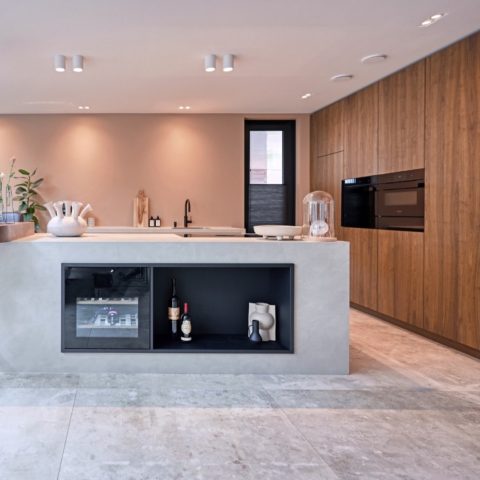







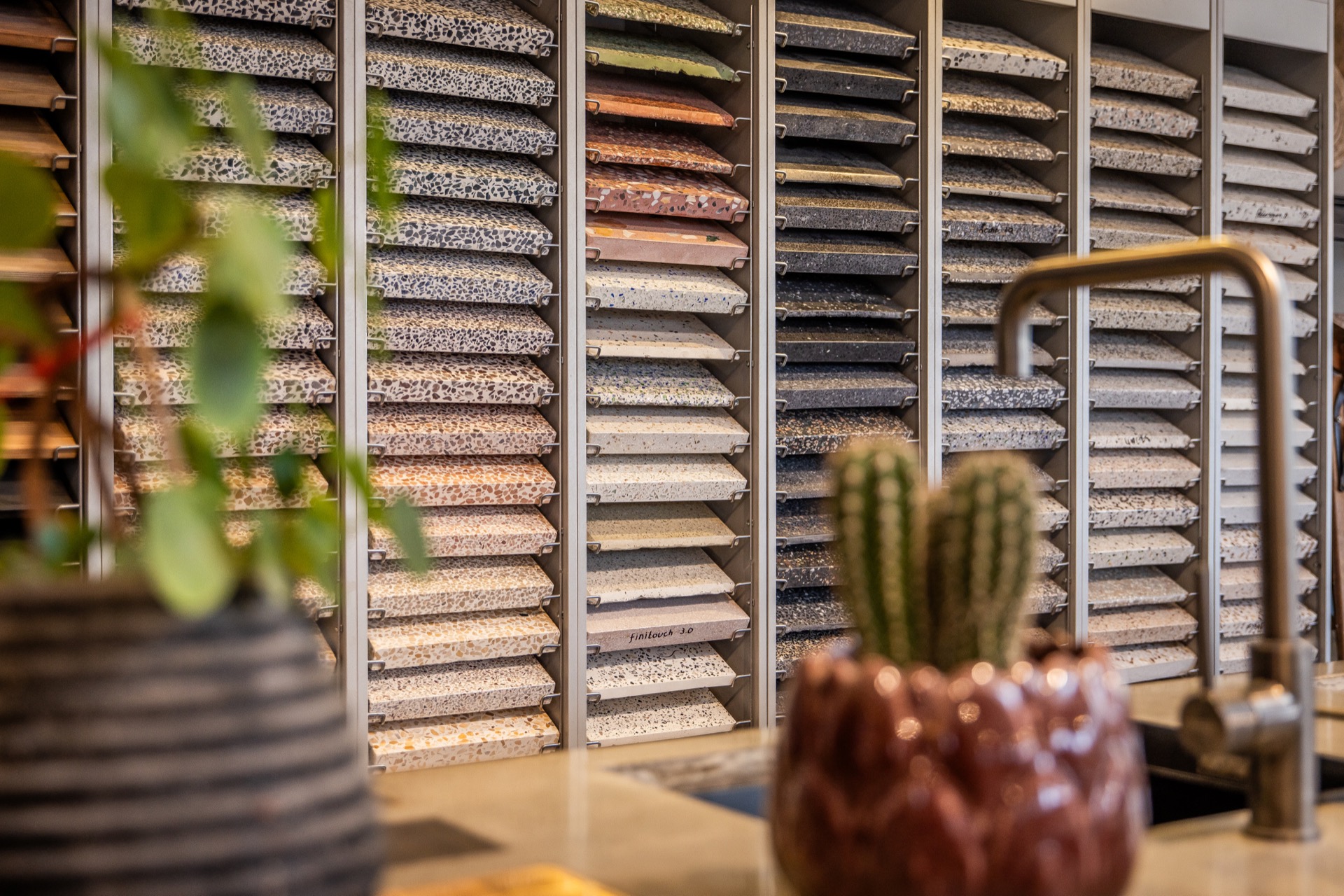
The first thing you notice is not a display board but the material itself: stone, steel, and wood laid out where they can be touched, compared, and moved into a plan. In this custom kitchen and bathroom showroom, the sample wall does more than fill a room. It lets color, grain, and surface finish do the talking. That approach runs through the whole space, from the workbench-like counters to the long presentation areas where sink details, fronts, and worktops are set out side by side.
Custom kitchen and bathroom showroom as a spatial starting point
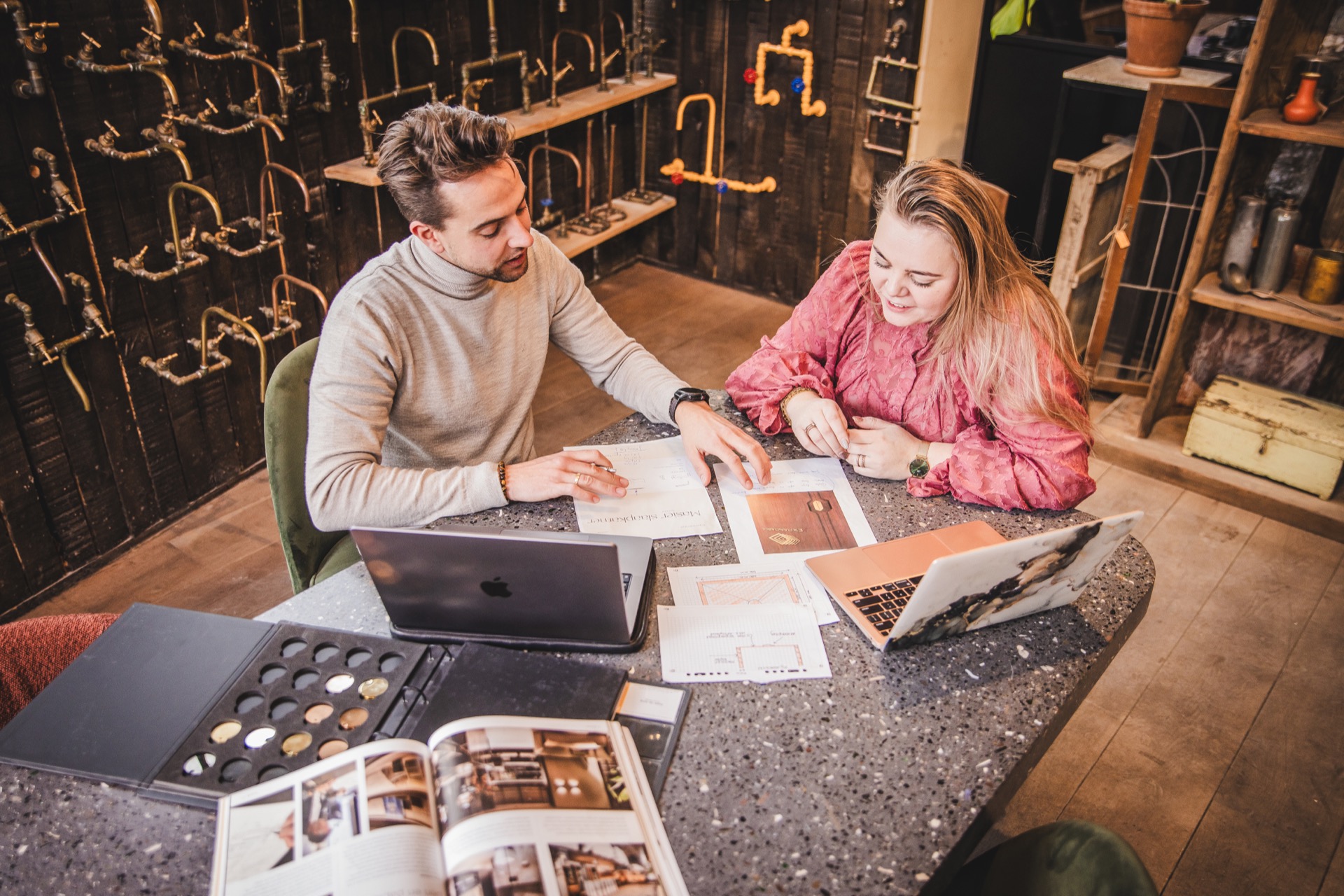
Contact begins by email or phone, followed by an invitation and a design consultation appointment. That step matters here, because the showroom is arranged for discussion rather than quick browsing. The room is clear enough to read, with complete setups for kitchens and bathrooms, but the focus stays on the conversation around them. A quotation based on design only comes once the layout, materials, and accessories have been chosen. The process is visible in the space itself: open, measured, and built around decisions rather than display.
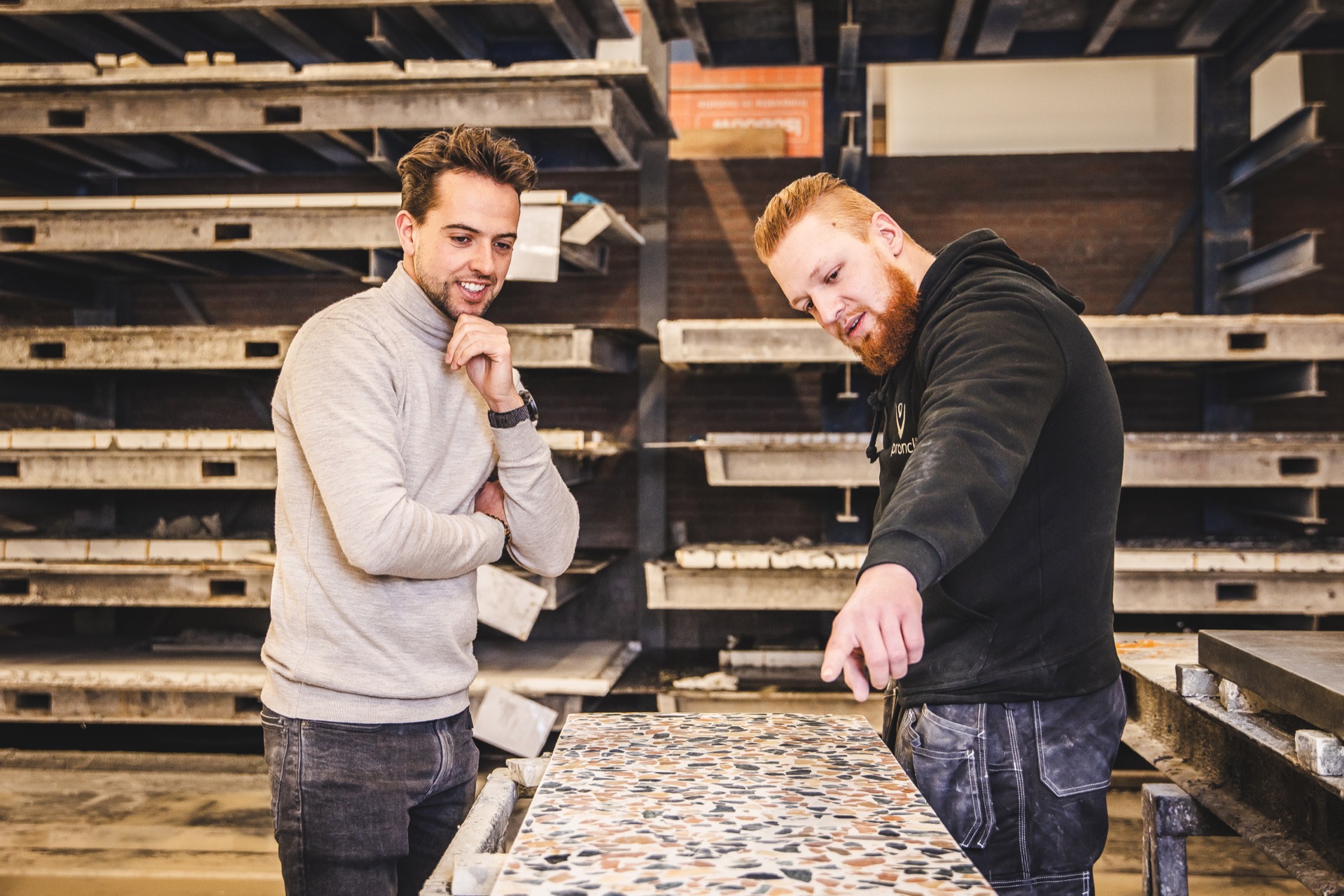
The setting feels closer to an active studio than a polished retail floor. Old workbenches appear in the office area, and the showroom sits next to a workshop where making happens alongside presenting. That mix gives the custom kitchen showroom a practical edge. Sample trays, counters, and test setups are not hidden away. They sit in plain sight, so you can trace how an idea might move from first sketch to finished surface, from cabinet front to sink cut-out.
Custom kitchens and bathrooms in real layouts
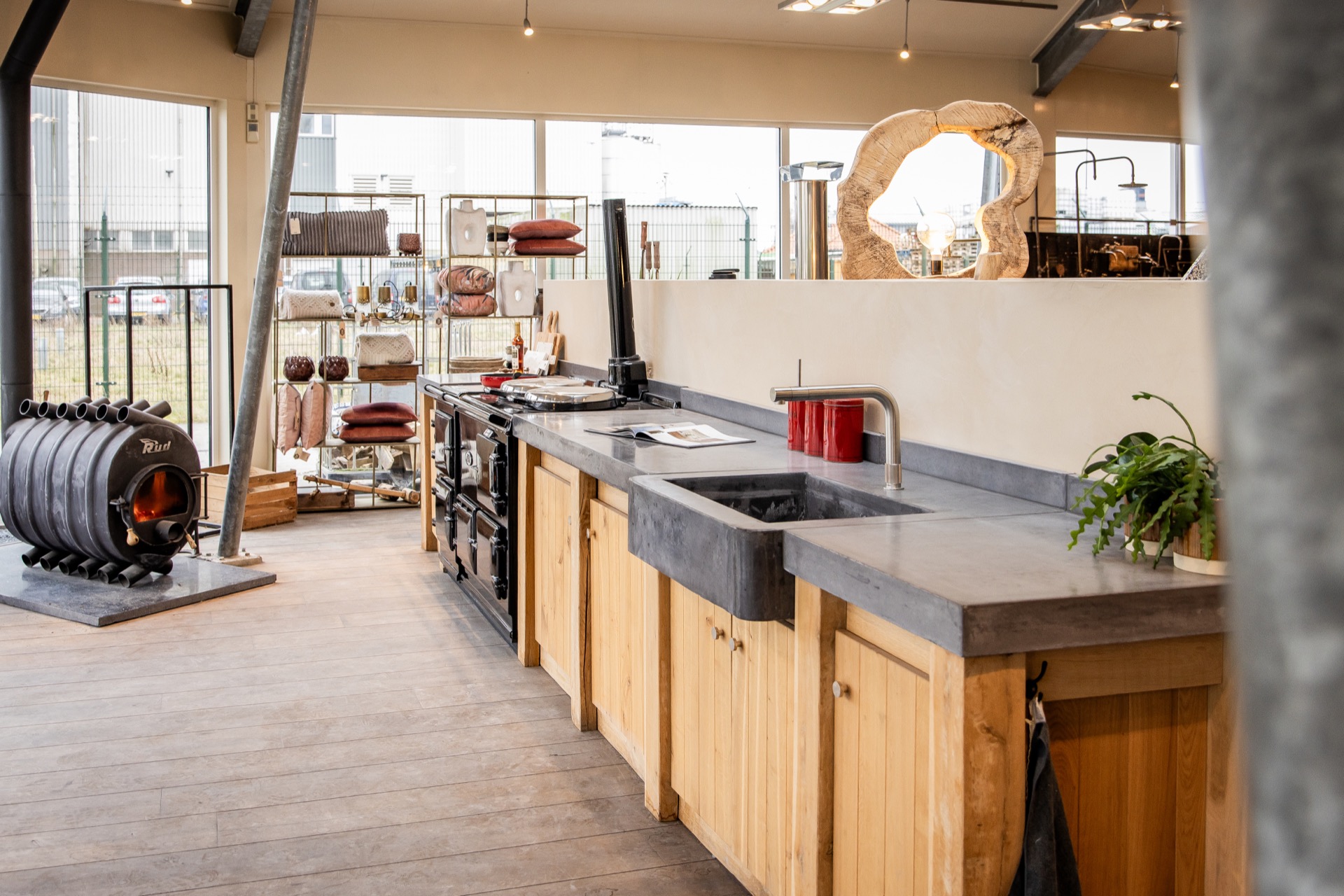
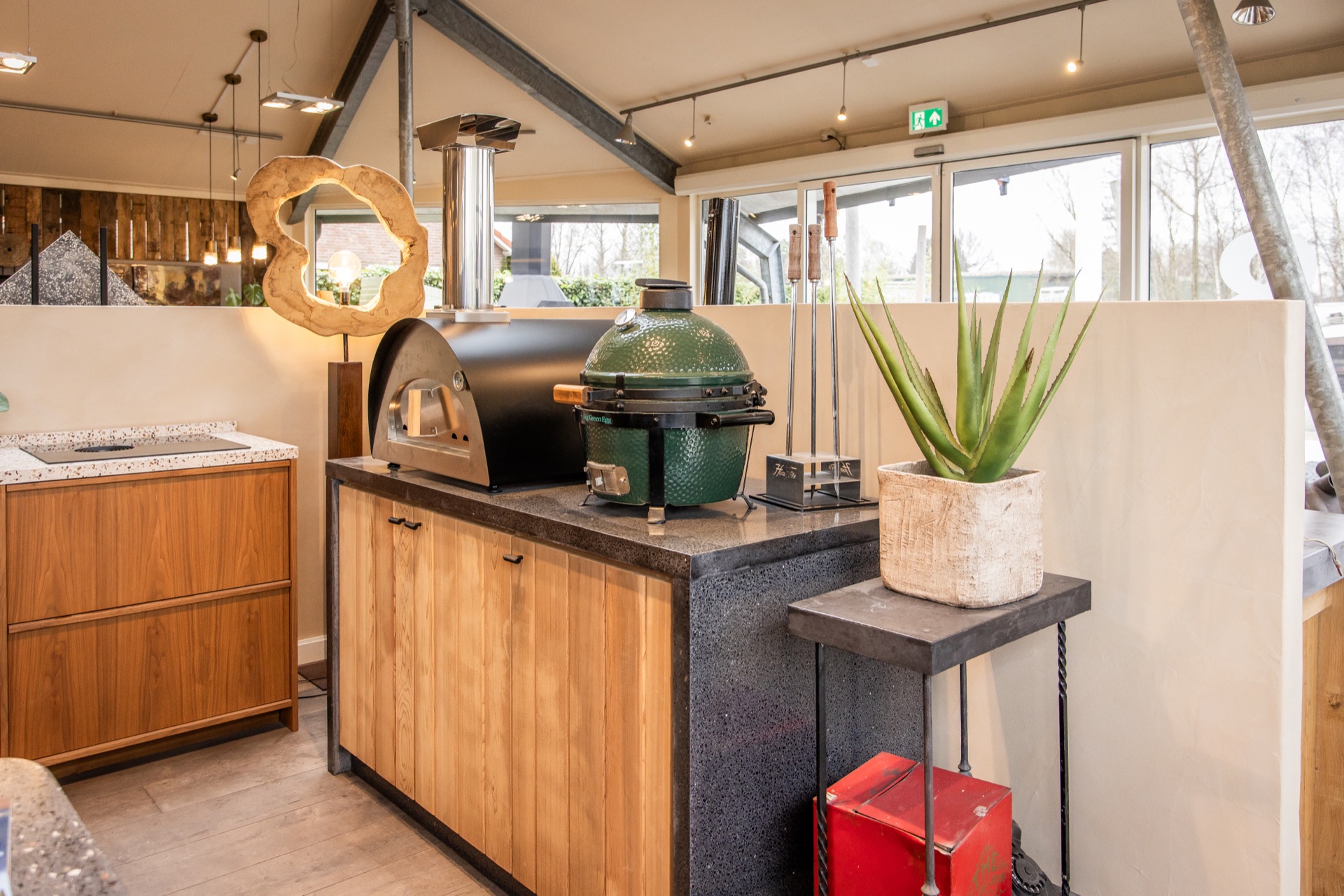
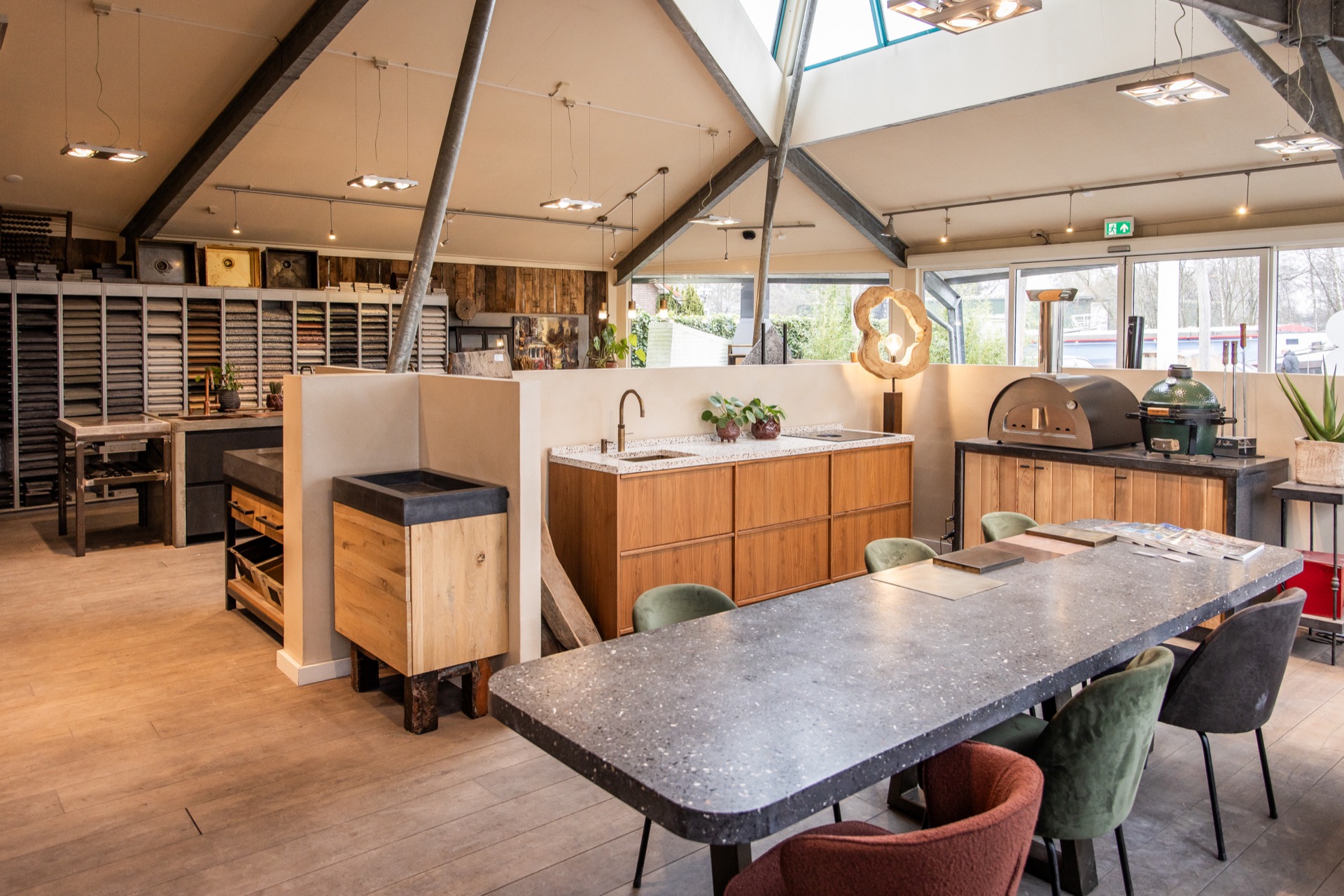
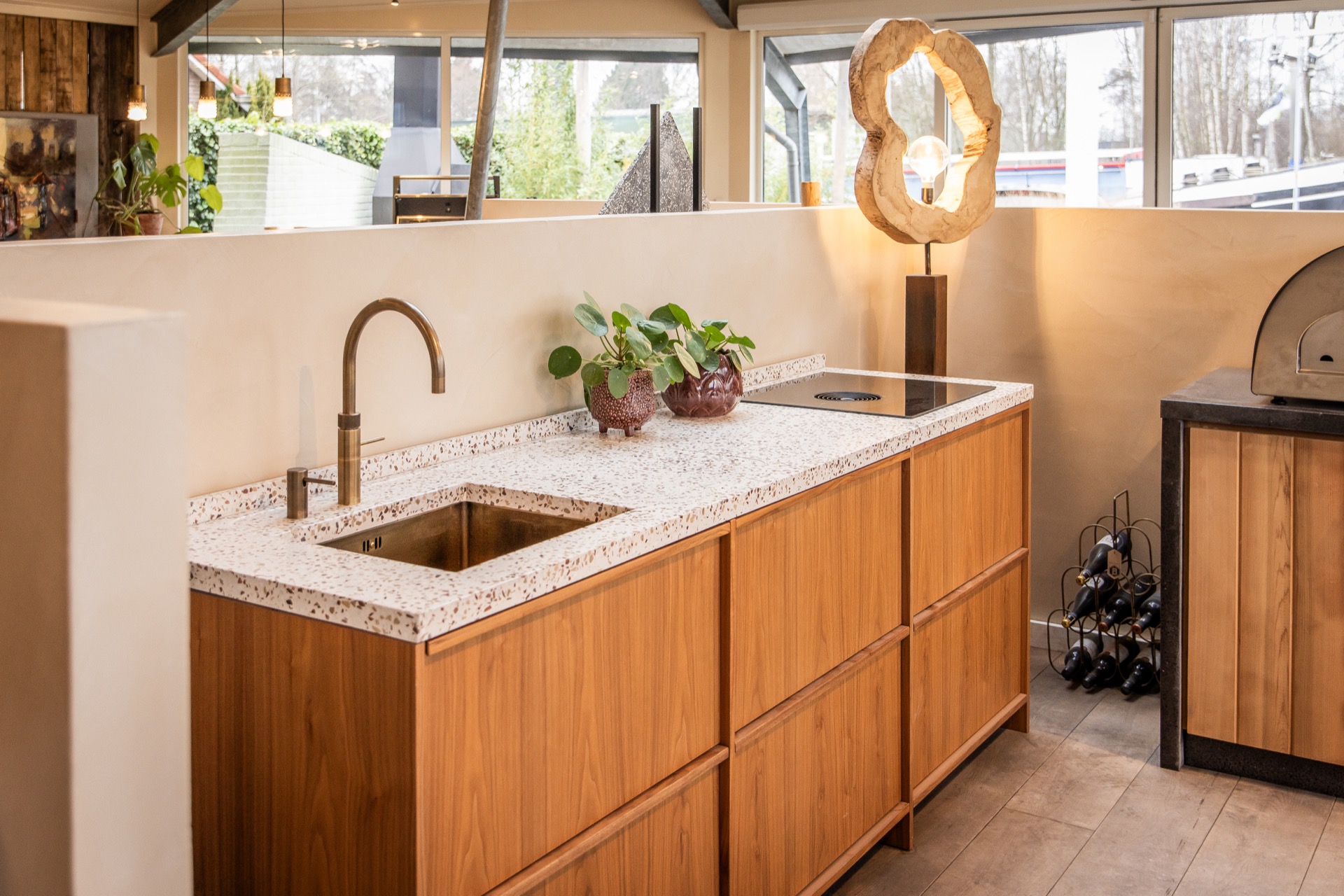
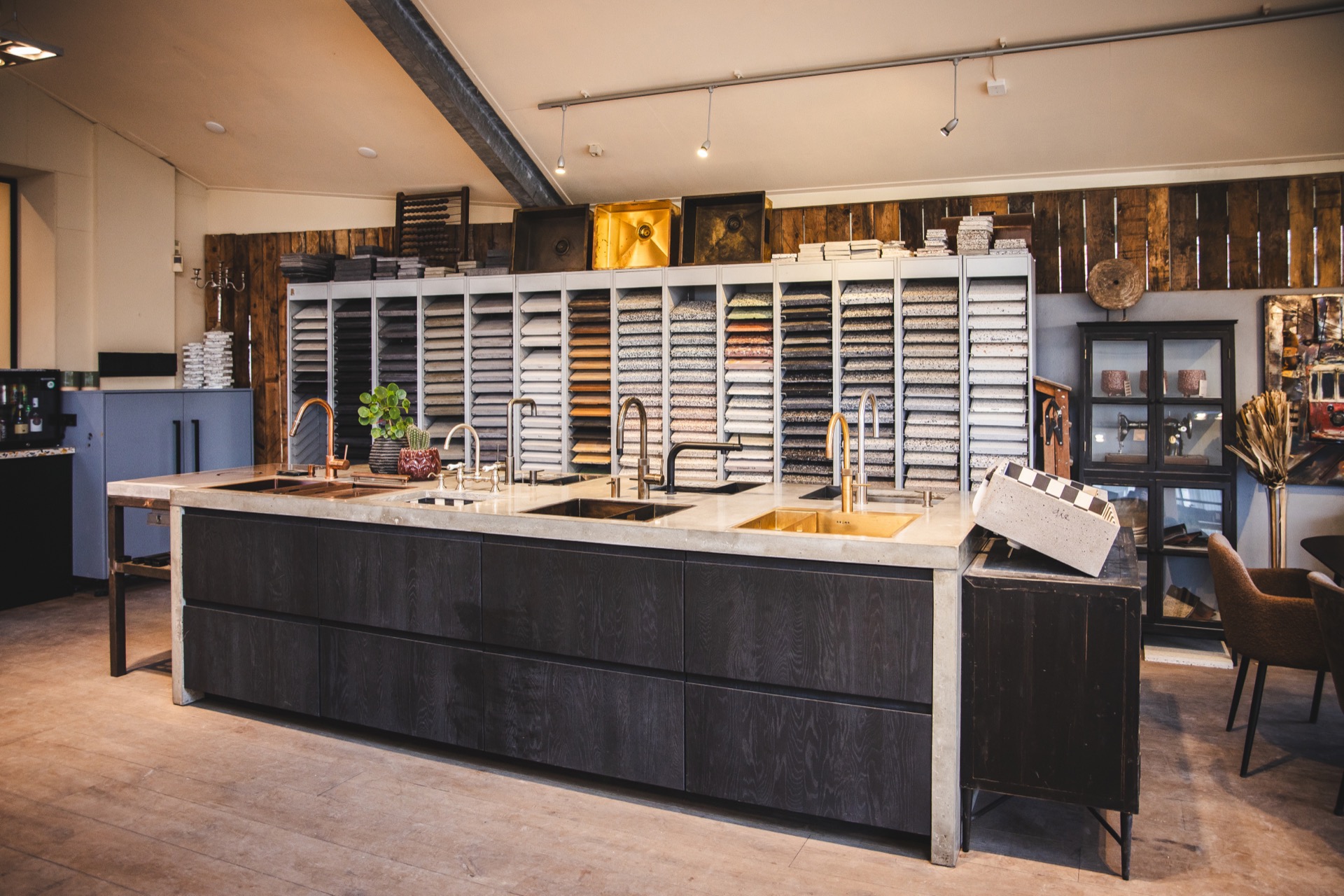
The custom kitchen and bathroom showroom shows complete arrangements rather than isolated products. Long runs of counters hold sinks, taps, and work zones, while nearby bathroom-inspired setups show how details settle into a room. This makes the difference between looking at an image and standing in front of a real assembly. Scale becomes easier to judge. So does proportion. A basin edge, a worktop thickness, or the distance between elements can be read immediately when they are placed in a full-size setting.
Several of the presentations lean into a restrained industrial language: exposed structure above, visible pipes, and rail lighting running across the ceiling. Against that harder frame, wood panels and cabinet fronts soften the line of the room without turning decorative. The result is practical to read. A brushed steel sink sits beside a stone surface; a timber front breaks up the colder material nearby. In a custom bathroom showroom, that kind of comparison helps people move from a single sample to a complete composition.
Material selection for kitchen and bathroom
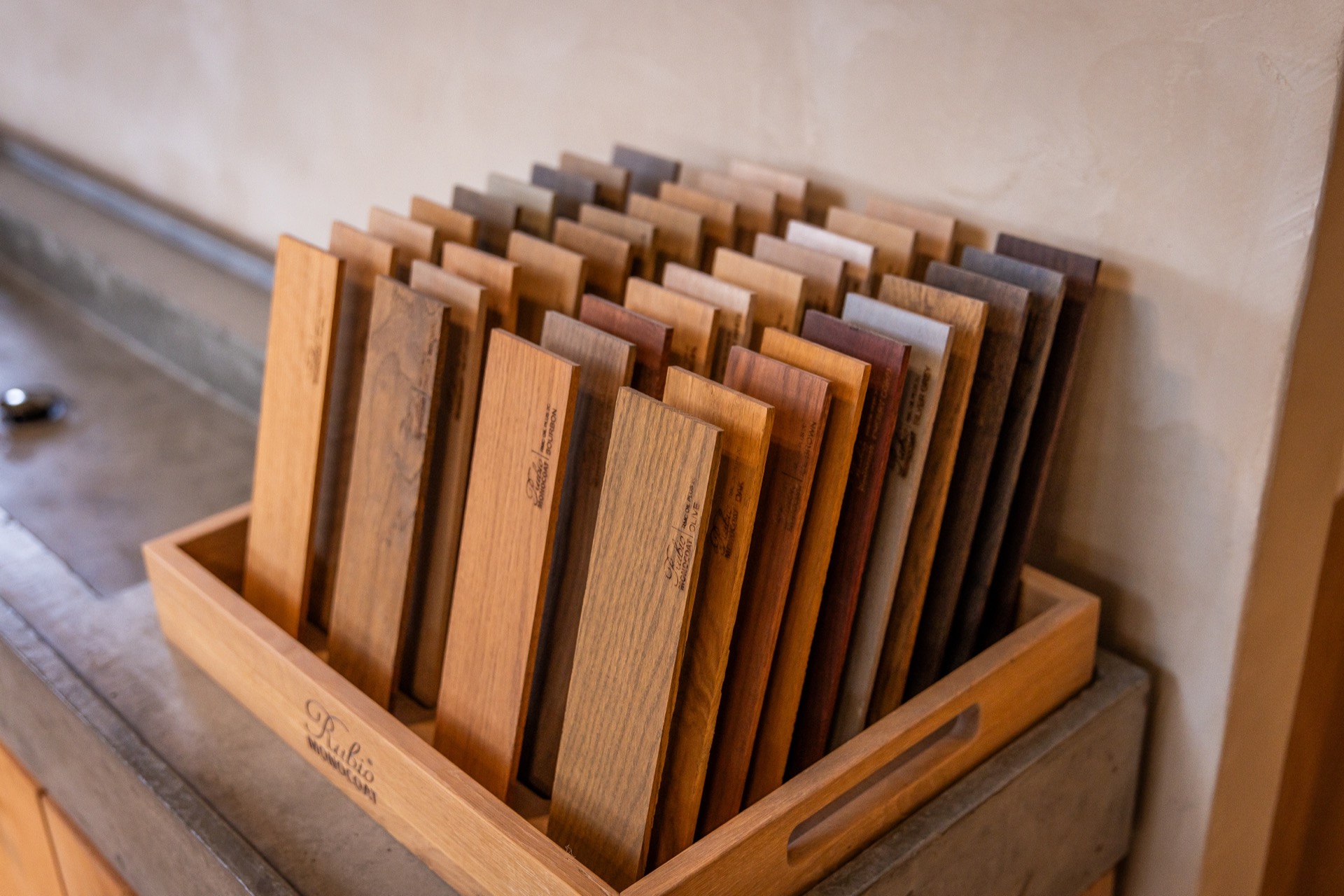
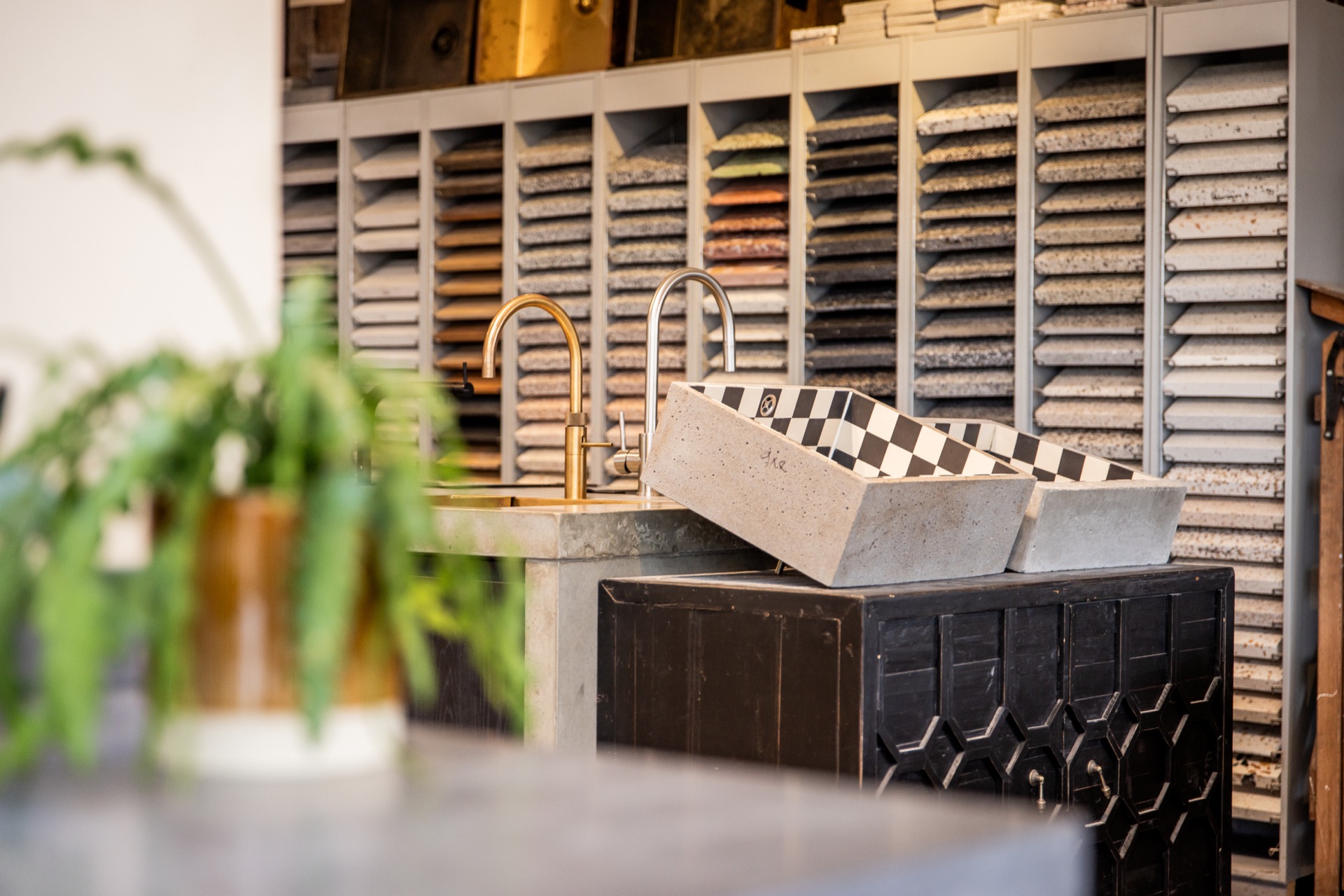
The showroom material library is one of the clearest parts of the project. Rows of samples are arranged by tone and texture, with stone and composite surfaces shown in many small variations. Some pieces are dark and dense, others carry lighter speckled patterns. Wood samples are stored upright in their own racks, so the grain reads from a distance before you even reach them. For material selection kitchen and material selection bathroom, that layout saves guesswork. You can compare a front finish with a worktop, then test how those tones sit together under the same light.
What stands out is the insistence on real materials. The showroom does not rely on images alone. A large material samples showroom needs enough physical scale to make choices legible, and here that means seeing a surface at arm’s length rather than on a screen. The texture of a stone slab, the reflectivity of stainless steel, and the direction of a timber grain all shift the reading of a design. That is particularly useful when the final scheme has to work across a kitchen, living room, or bathroom. Custom kitchen and bathroom showroom remains connected to the layout, materials and daily use of the home.
Surface, sink, and edge detail
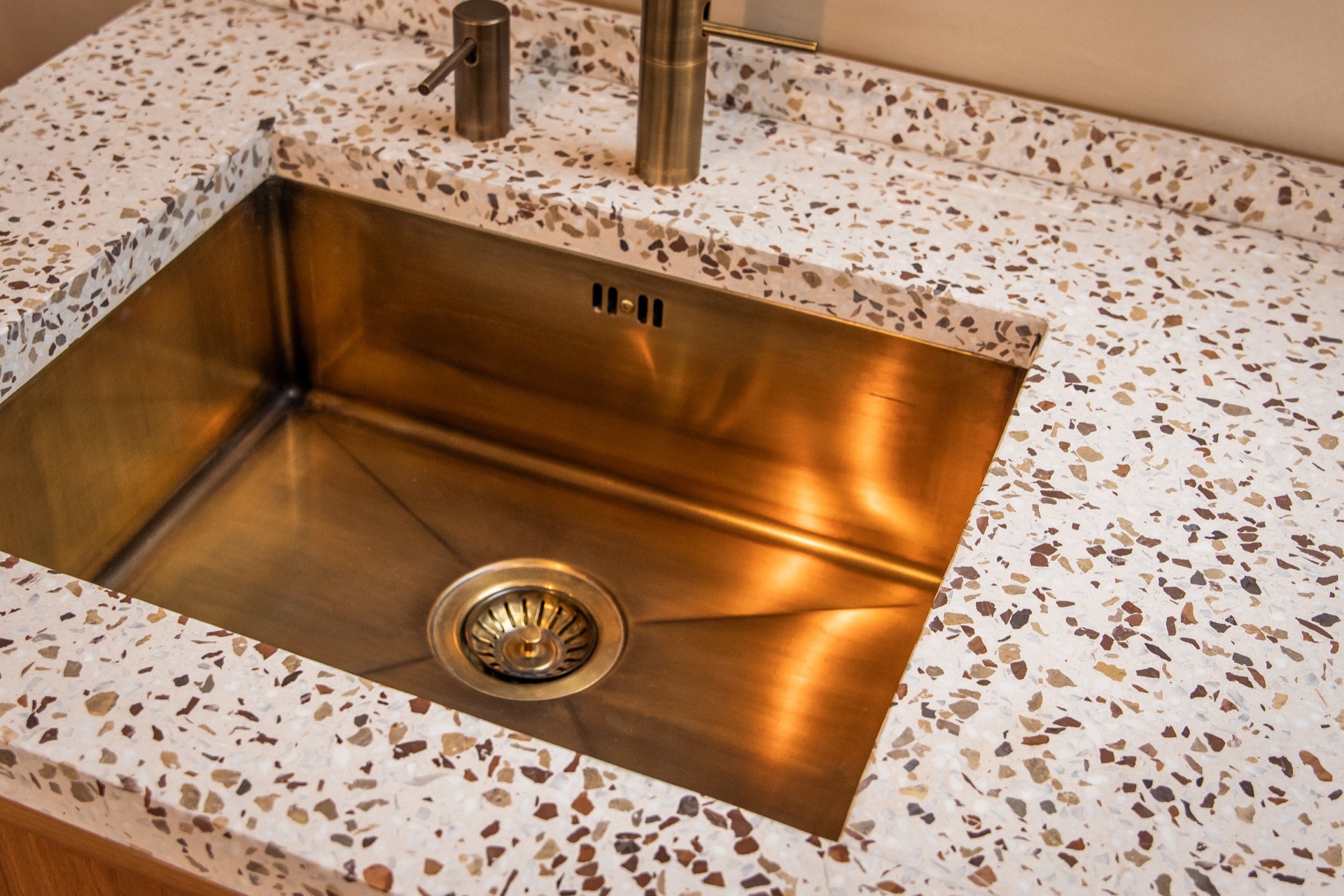
Some of the strongest images are the closest ones. A stainless-steel sink sits inside a stone-like worktop, with the rim and drain visible in detail. Nearby, the tap arcs over the basin with enough space around it to show how the surface is cut and finished. These are small elements, but they carry the logic of the room. A custom kitchen showroom has to show more than cabinet doors; it has to show the edges, openings, and junctions that determine how the room will be used.
Hout, steen en RVS appear together throughout the presentation, each material changing the tone of the others. The wood adds a visual break in the longer runs of cabinetry. The stone brings pattern and depth. The metal introduces precision, especially around sinks and tapware. Seen in combination, they tell you more than a single isolated sample could. That is the value of a showroom material library: it makes comparison immediate, and it lets small decisions carry through to the wider plan.
Showroom setups that make combinations readable
One long installation shows multiple work zones in sequence, with repeated sink points and broad counter spans. Another uses framed racks to display color and texture samples in tidy rows. Elsewhere, tall wooden panels stand upright like test pieces waiting to be assigned. These setups do not try to feel finished in the domestic sense. They are arranged to be read. For a custom bathroom showroom, that clarity matters. It helps reveal how a basin, a surface, and a cabinet front behave when placed next to one another under the same overhead light.
The room also makes room for sitting and looking. A small lounge area with upholstered seating and slatted timber wall treatment gives the advice moment a pause between the sample walls and the worktops. Nothing about the space is over-programmed. Instead, it supports the act of choosing. Materials can be laid out on the table, held against one another, and checked in different combinations. That is often where the project moves forward: not with a dramatic reveal, but with a sequence of small, practical comparisons.
From design decisions to a quotation
Once the layout, materials, and accessories are set, the next step is a quotation based on design. The process is described plainly, and the showroom supports that clarity. It is easier to ask for a price when the surfaces, equipment, and finishes have already been narrowed down in front of you. That is why the custom kitchen and bathroom showroom feels built around resolution. It does not stop at inspiration boards or loose references. It keeps moving toward a workable plan, supported by samples, measured setups, and direct advice.
For visitors weighing a kitchen, bathroom, or even a broader interior scheme, the strongest part of the experience is the way every material has a role. The stone sample is not abstract. The wood is not just decorative. The steel is not only a technical finish. Each one is shown in relation to the others, in the same light, at the same scale, so that decisions can be made with fewer assumptions. That is what gives this custom kitchen showroom its direction: a place where material choice, design consultation appointment, and quotation based on design all belong to the same room.
Photography: Fabian Boot Custom kitchen and bathroom showroom remains connected to the layout, materials and daily use of the home.
Want to see more of ? View the page of for even more great projects and company information.
NEW 2026 Jubileum Edition The Best Interior Designers Benelux
Order Now €125