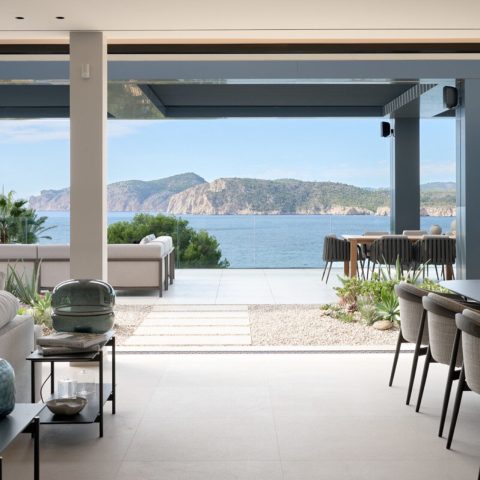







A dark aluminium frame sets the tone from the first view. The freestanding garden canopy stands on its own in the garden, with glass walls that keep the structure open to daylight and a wood back panel that changes the surface from hard to textured. It creates a sheltered seating area without closing the space off completely, so the terrace and the lawn remain visually connected.
Freestanding garden canopy as a spatial starting point
The canopy was designed for a corner of the garden that needed a clear destination. Instead of filling that space with a standard solution, the project uses a custom made garden canopy tailored to the setting. The frame follows a calm, rectilinear outline, while the three aluminium uprights give the construction a more deliberate rhythm. That detail is easy to read in the photos: the posts stand apart from one another, and their spacing strengthens the open character of the structure.
Seen from the side, the aluminium frame canopy reads as a light enclosure rather than a closed room. The terrace runs beneath it, while grass borders the paved surface on several sides. That contrast between hard paving and soft planting makes the canopy feel anchored without becoming heavy. The structure sits low and controlled, with the dark profiles drawing attention to the edges of the roof and to the vertical lines of the supports.
Glass walls that keep the view open
The glass wall garden canopy uses transparency to shape the experience of the space. Light passes through the panels, and the surrounding garden remains visible even when the seating area is sheltered. In the front and detail images, the glazing meets the dark profiles with sharp lines, which emphasizes the construction more than the surface treatment. The result is a canopy that frames the garden instead of hiding it.
Those clear panels also change how the wood back panel is read. From outside, the wood appears as a warmer plane behind the glass, while inside it becomes the visual anchor for the seating area. The material shift is simple but effective: aluminium, glass and wood each occupy their own role. Nothing is overstated. The canopy depends on proportion and placement, not on decoration, and that restraint makes the construction easy to understand at a glance.
The three aluminium uprights as a visible feature
One of the most distinctive elements is the addition of three aluminium uprights. They are not hidden in the composition; they are part of what defines the canopy’s appearance. In the wider views, the uprights break up the span of the structure and give the roofline a measured cadence. In the close-ups, their dark finish connects them to the other profiles and keeps the whole frame visually consistent.
This is where the custom made garden canopy moves away from an off-the-shelf solution. The spacing, the number of supports and the way the roof edges meet the glass all show a made-to-measure approach. The canopy does not try to dominate the garden. It marks a place to sit, to look out and to stay under cover, while leaving enough openness for the terrace and planting to remain part of the experience. Freestanding garden canopy remains connected to the layout, materials and daily use of the home.
Wood behind glass, and why that matters
The wood back panel canopy gains much of its character from contrast. The rear surface introduces a vertical grain that interrupts the smoothness of the metal and glass around it. In the photographs, the wood sits behind the glazing and sets up a layered view: glass in front, wood behind, and the dark aluminium frame around both. That layering gives the seating area more depth without adding extra elements.
The back wall also gives the canopy a place to rest visually. When furniture is arranged beneath the roof, the wall provides a darker, more sheltered backdrop for the seating zone. It makes the outdoor seating canopy read as a defined room in the garden, even though it stays open at the sides. The surrounding lawn and the terrace edge keep that room connected to the wider plot.
Freestanding garden canopy as a spatial starting point
The setting matters here as much as the construction itself. The paved terrace acts as the platform for the canopy, and the grass around it softens the edges of the composition. From a distance, the canopy appears as a compact volume with strong horizontal lines, but the garden context prevents it from feeling isolated. The paving, planting and glazing work together to show how the structure is used: as a place for sitting, looking out and moving between indoors and outdoors without a hard threshold.
Several views show the canopy from different angles, and that helps the proportions become clear. The front view reveals the glazed sections and the open structure beneath the roof. The side view emphasizes the depth of the frame and the alignment of the uprights. The detail shots focus on the dark aluminium profiles, while wider shots place the seating area back into the garden. Together they show a freestanding garden canopy that depends on careful placement as much as on material choice.
What gives the project its clarity is the way each material stays legible. Aluminium draws the outline. Glass keeps the structure light. Wood shifts the mood of the rear wall without breaking the order of the frame. The three uprights add a tailored note, and the terrace fixes the canopy in place. It is a straightforward composition, but one that gains depth when seen through the different photo angles. That is where the project speaks most clearly: in the edges, the reflections and the line where the canopy meets the garden.
Photography: Madeleine Lasschuit Freestanding garden canopy remains connected to the layout, materials and daily use of the home.
Want to see more of ? View the page of for even more great projects and company information.