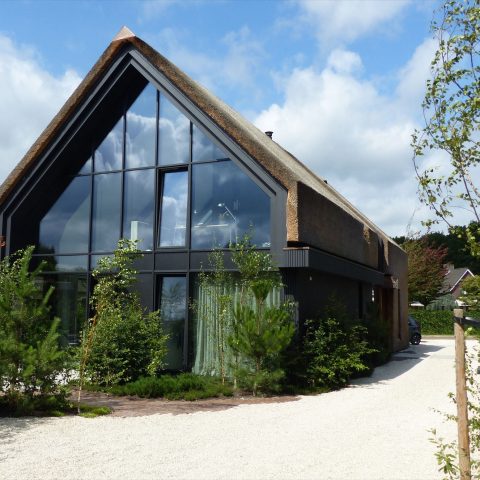







Historic heritage meets a modern garden with a rectangular pond
The rectangular pond sets the tone before anything else. Its low concrete edge, straight sightlines and grey surfaces pull the garden into a clear frame, while the 400 m² layout keeps the space open enough to read the house and the water in one glance. In this modern garden with rectangular pond, the historic character of the site is met with a layout that stays restrained and precise.
Water as the first move in the garden
The pond is not hidden away as a side feature. It sits at the centre of the composition, with clean garden lines running alongside it and gravel paths marking the route around the water. The rectangular shape gives the whole area a strong horizontal line, and the concrete pond edge makes that line visible from several angles. That measured edge is one of the reasons the garden feels grounded rather than decorative.
Seen from the terrace, the water surface is calm and direct. The setting does not rely on dense planting or layered ornament. Instead, the geometry does the work. Half-paving and stone surfaces lead the eye from one zone to the next, and the pond remains the fixed point around which the rest of the garden moves. It is a clear example of a modern garden with rectangular pond built around simple proportions.
Gravel paths and hardscaping set the rhythm
Gravel paths and hardscaping give the garden its structure. The half-hard surface softens the transition between planting and paving, while the more solid tiled areas keep the route legible underfoot. The mix of textures is modest, but it changes how the space is read: loose gravel absorbs the steps, and the slabs hold the edges. Together they create a framework that supports the water feature rather than competing with it.
The straight lines are deliberate. They cut across the garden in a way that makes the pond feel longer and the planting beds more ordered. Nothing swerves for effect. The result is a clear sequence of surfaces: gravel, tile, water, border. That sequence is repeated in a few places, so the eye keeps returning to the same language of line and material. It is this repetition that gives the modern garden with rectangular pond its clarity.
Garden steps and terrace transitions
Steps connect the lower garden to the terrace with a compact, solid presence. Their broad concrete treads do more than solve a level change; they act as a visual hinge between the house and the outdoor space. From the images, the transition feels careful without being formal, with the step geometry echoing the pond’s rectangular shape and the paved areas around it. The move from terrace to garden is direct and easy to follow.
These garden steps and terrace transitions also shift the scale of the project. The pond sits low and open, while the steps give the garden a more vertical moment. That contrast keeps the layout from feeling flat. The stone and concrete surfaces catch the light differently through the day, so the route between house and water changes as you move through it. In a garden of this size, those small level changes carry the whole design.
Seating by the pond
The seating area sits close enough to the water to make the view part of daily use, not just a backdrop. Chairs are placed on a paved terrace that looks back toward the pond edge, with a sheltered element above part of the zone in the images. The arrangement keeps the seating simple and readable. You can see the pond, the planting border and the hard surfaces at once, which makes the area feel tied to the rest of the garden rather than separated from it.
From this point, the pond reads almost like an outdoor room divider. On one side are the straight paths and planted strips; on the other, the terrace and the house connection. The garden steps and terrace transitions bring people to this spot naturally. The seating by the pond is therefore not an add-on but part of the route through the landscape.
Planting borders along water
The planting borders along water are kept low and concentrated at the edges. They frame the pond without closing it in. In the images, reed-like water plants soften the concrete line and add movement where the rest of the garden is static. That shift matters: the pond edge is crisp, but the vegetation introduces a lighter vertical note that moves with wind and season. It is the quietest part of the scheme, yet it changes the whole surface of the water.
Elsewhere, the borders sit beside the gravel and paving in narrow bands, which keeps the composition open. The planting does not spread aggressively across the plan. It stays where it can mark a transition, especially around the water zone and along the main walking lines. This restraint lets the historic heritage and modern landscape design remain legible. The garden reads as one sequence of materials, with plants used to sharpen, not blur, the edges.
A modern garden with rectangular pond in a historic setting
The strongest aspect of the project is the way it connects the building and the landscape through proportion. The outdoor space is substantial at 400 m², yet it avoids excess. Rectangular water, gravel paths, concrete pond edge and tiled surfaces give the garden its order, while the terrace and seating area make that order usable. Historic heritage and modern landscape design is not treated here as a contrast for its own sake, but as a practical way to let old and new sit in the same visual field.
What remains after moving through the garden is the sequence: water first, then path, then step, then seat. The pond holds the centre, the hardscape defines movement, and the planting keeps the edges from feeling rigid. Seen together, the garden feels measured and direct, with each part doing a visible job. That is what gives this modern garden with rectangular pond its presence.
Project photography: Jimke Joling
Want to see more of Architime? View the page of Architime for even more great projects and company information.




NEW 2026 Jubileum Edition The Best Interior Designers Benelux
Order Now €125


NEW 2026 Jubileum Edition The Best Interior Designers Benelux
Order Now €125


NEW 2026 Jubileum Edition The Best Interior Designers Benelux
Order Now €125


NEW 2026 Jubileum Edition The Best Interior Designers Benelux
Order Now €125


NEW 2026 Jubileum Edition The Best Interior Designers Benelux
Order Now €125