










Large-format herringbone floor
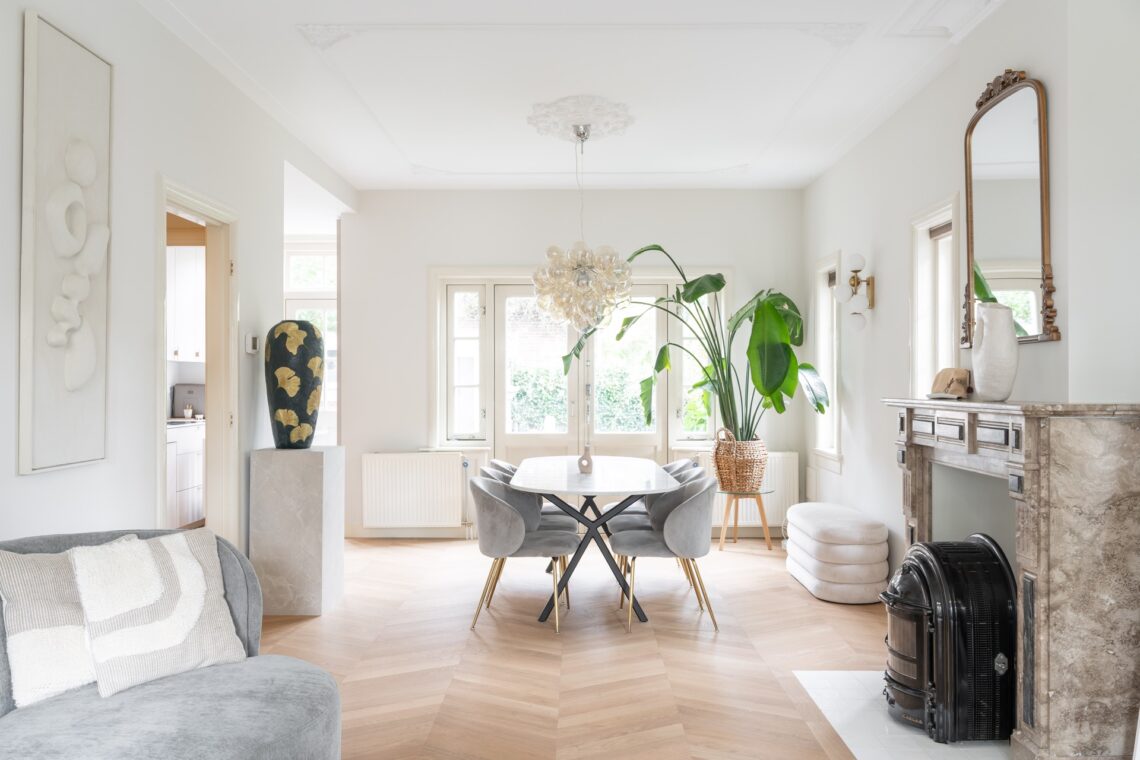
The first thing you notice is the pattern. The large-format herringbone floor pulls the eye across the room in long, angled lines, with a smoked and white-oiled finish that softens the grain without hiding it. In this interior, the timber sits against pale walls, light cabinetry, and wide openings, so the floor does most of the visual work. Its distressed look gives the space a lived-in edge, while the rest of the room stays clean-lined and restrained.
A floor that sets the pace of the room
The herringbone floor runs through the living areas as one continuous surface, and that continuity makes the plan feel larger. The scale of the pattern matters here: the boards read clearly from a distance, but up close the smoked tones and white oil reveal subtle shifts in colour. Against the grey sofa, black lighting, and pale joinery, the wood brings depth without asking for attention in every corner. It is present from the threshold onward, not as a background finish but as the main line that organises the interior.
Large-format herringbone in a modern luxury interior
What makes this large-format herringbone stand out is the contrast around it. The room is finished with smooth plaster surfaces, bright cabinetry, and generous glazing, so the floor becomes the warmest element in the frame. That contrast is strongest in the living space, where the timber pattern meets a low media unit, a grey seating area, and slim pendant lighting. The result is not decorative excess; it is a clear exchange between surface and space, with the parquet carrying the weight of the room.
The smoked distressed look gives the floor a slightly aged surface, which changes how the boards read under daylight. In the wide shots, the pale windows and roller blinds keep the room open, while the darker grain in the timber anchors the seating area and dining zone. The floor does not disappear beneath the furniture. It stays legible between chairs, under the table, and beside the cabinetry, so the pattern remains part of the composition even where the room is furnished simply.
White-oiled parquet with a softened grain
The white oiled parquet has a muted sheen rather than a glossy finish, and that keeps the colour from becoming heavy. The grain remains visible, especially where the light moves across the boards near the windows and in the open kitchen. Here, the finish works with the smoke treatment instead of fighting it: one lightens the tone, the other deepens it. That combination gives the floor a layered surface that feels made for close viewing as well as for the wider room view.
In the dining area, the pattern sits beneath light-upholstered chairs and a simple table, while two gold wire pendants mark the space above. The floor continues underneath without interruption, which makes the furniture read as something placed into an already defined field. A large wall image and the straight edges of the cabinetry keep the setting calm, but the parquet prevents it from becoming flat. The angled boards create movement where the rest of the room stays controlled.
Herringbone with underfloor heating beneath a clear surface
The floor was laid on underfloor heating, a detail that matters because the surface stays visually uninterrupted. No visible transition breaks the rhythm of the boards, and that helps the pattern read as one broad plane across the home. In the kitchen zone, the timber continues beneath dark worktops, light upper cabinets, and tall windows with roller blinds. The same material carries from one function to the next, so the living and cooking areas feel connected by the floor rather than divided by it.
That continuity also suits the modern luxury parquet interior visible throughout the project. The cabinets are crisp and light, the seating is kept low and simple, and the lighting comes in slim pendants and small ceiling spots. Against those straight lines, the herringbone floor introduces a different kind of order. It is more patterned than the joinery, but less rigid than a grid. The result is a room that gains texture from the ground up, without losing the clear layout above it.
Detail shots that show the finish
Close-up views make the surface treatment easier to read. The smoked tones sit in the joints and darker edges of the boards, while the white oil lifts the lighter fibres on top. In the detail images, the floor does not look uniform from board to board, and that variation is part of the appeal. It gives the parquet a worked surface rather than a printed effect. Even under direct light, the texture remains visible, which is exactly where this finish gains its depth.
Seen beside the black pendant shade near the media wall, the timber takes on a quieter role. The lamp reads as a sharp object in the room, while the floor carries tone and texture across a much larger field. In another view, the gold pendants above the dining table reflect a warmer note into the pale interior, but the herringbone floor still sets the baseline. Its large format keeps the pattern readable without becoming busy, which suits the open, uncluttered plan.
A contrast built from timber, light, and clean lines
The strongest feature of this project is the contrast between the aged look of the floor and the crisp finish of the interior around it. Light cabinets, matte walls, black lighting, and large panes of glass all lean toward a restrained palette. The floor answers with texture, grain, and a more tactile surface. Because the boards are laid in a large herringbone pattern, that texture stays visible even where the room is partly furnished or seen from a distance.
From the sitting area to the kitchen edge, the floor keeps the same rhythm. That consistency gives the interior a grounded feel, but the image never turns static because the pattern changes with each angle of view. The white-oiled parquet catches daylight differently at the windows than it does near the darker media wall or under the dining table. It is this movement across the surface, together with the smoked distressed look, that gives the project its character without relying on ornament.
As a portfolio reference, the project shows how a herringbone floor can carry a modern interior without dominating it. The scale, finish, and underfloor heating all support the same idea: a wooden floor that reads clearly, works across open rooms, and sits comfortably beside contemporary joinery and lighting. The result is measured, but not plain. Every view returns to the same surface, and each time the parquet reveals another part of its texture.
Want to see more of Vloerenhuis Amsterdam? View the page of Vloerenhuis Amsterdam for even more great projects and company information.




NEW 2026 Jubileum Edition The Best Interior Designers Benelux
Order Now €125


NEW 2026 Jubileum Edition The Best Interior Designers Benelux
Order Now €125


NEW 2026 Jubileum Edition The Best Interior Designers Benelux
Order Now €125


