





Modern countryside villa with gabled roof and extension with stacked sections
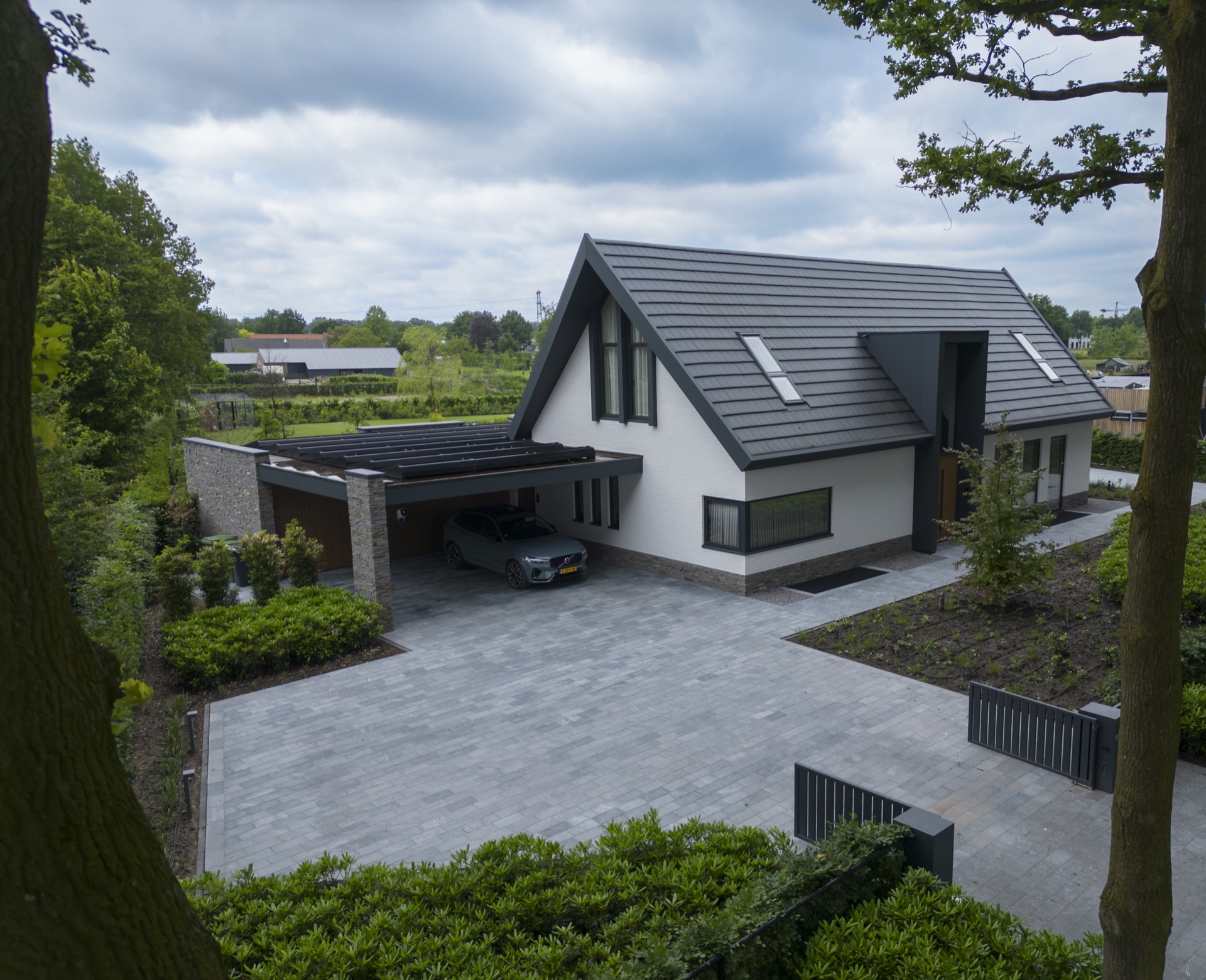
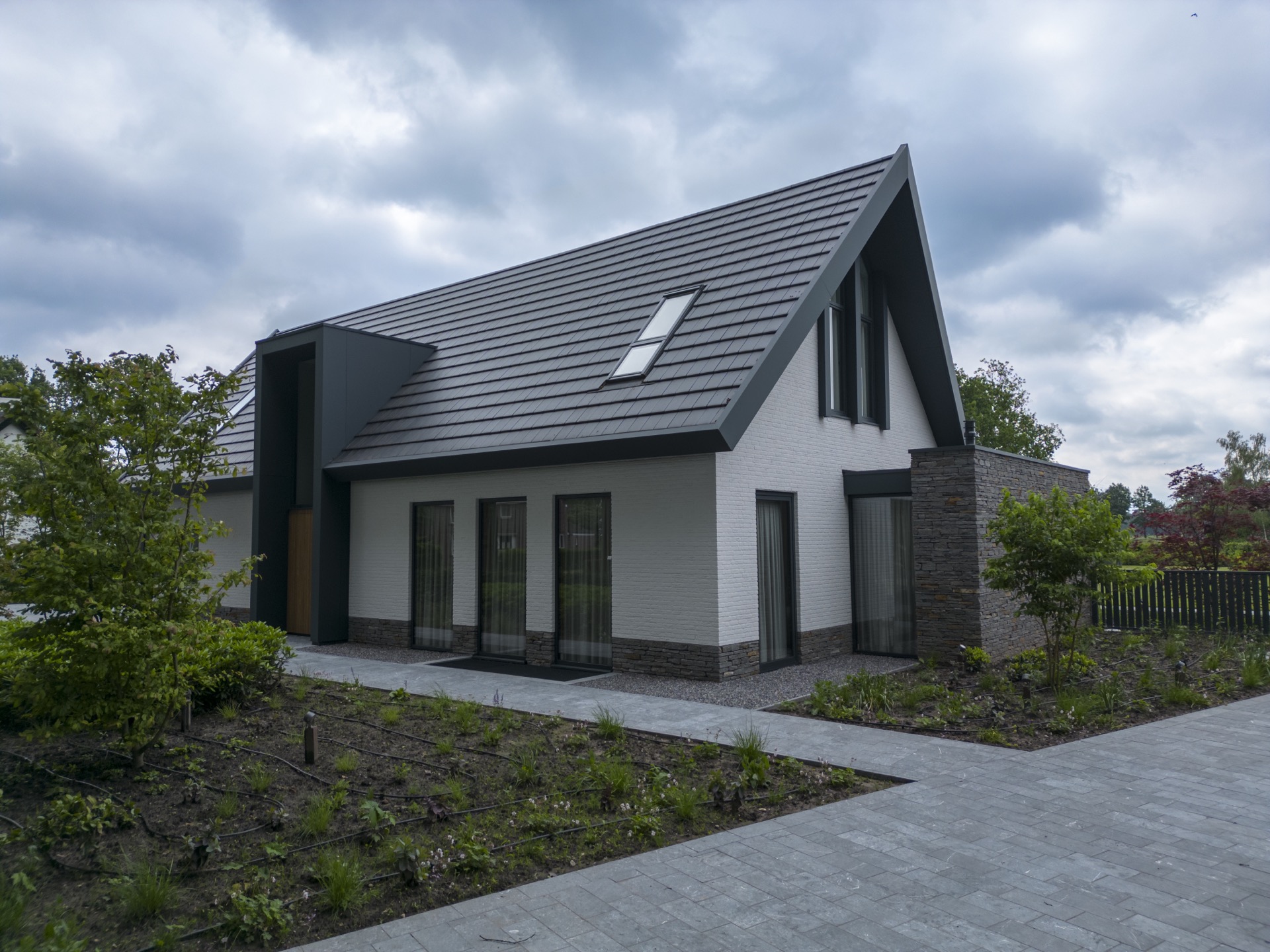
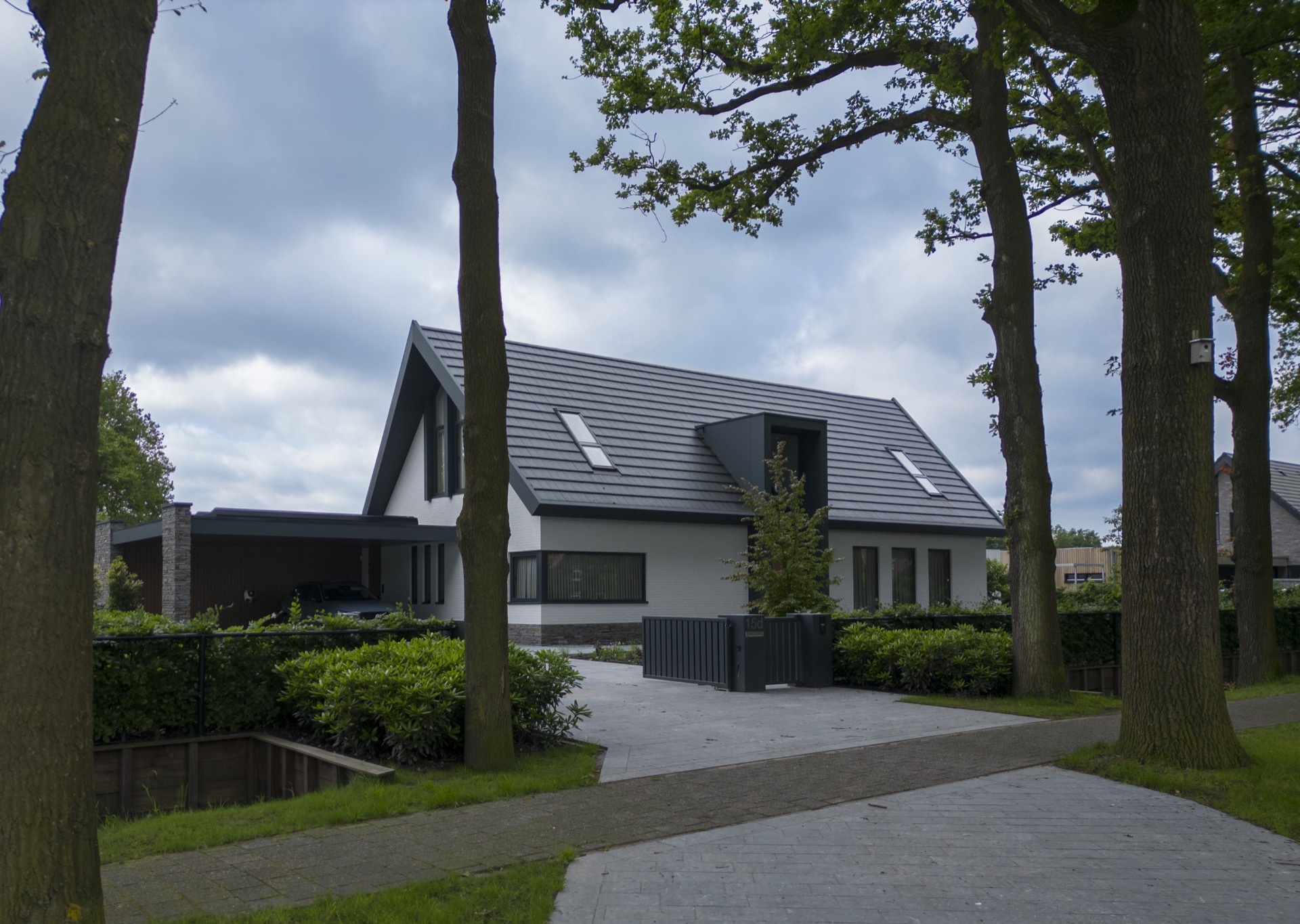
A dark gabled roof settles over white brickwork, while the openings below are framed in a deeper tone that draws the eye across the elevation. The house reads as a modern countryside villa with gabled roof and extension, but the first impression is not about labels. It is about proportion: a clear main volume, restrained detailing, and a rear addition that steps out from the core of the building in separate horizontal and vertical slices.
modern countryside villa with gabled roof and extension as the architectural starting point
The main body of the house stays simple. Its shape recalls the long, narrow farm buildings found in the area, yet the expression is pared back, with straight lines and little ornament. White masonry sets the tone, then dark window surrounds and roof edges sharpen the outline. That contrast is strongest where the roof meets the wall, and again around the larger openings that cut into the façade. It gives the country villa with modern look a calm, controlled presence without flattening the volume.
Seen from the approach, the roofline sits as one continuous plane, interrupted by a few well-placed roof windows. They sit low in the dark covering and keep the upper part of the house visually quiet. The stone base elements near the entrance add another texture, but they do not compete with the brick and the dark frames. The result is a composition that relies on line, mass and shadow rather than decoration.
Rear extension with stacked slice-like panels
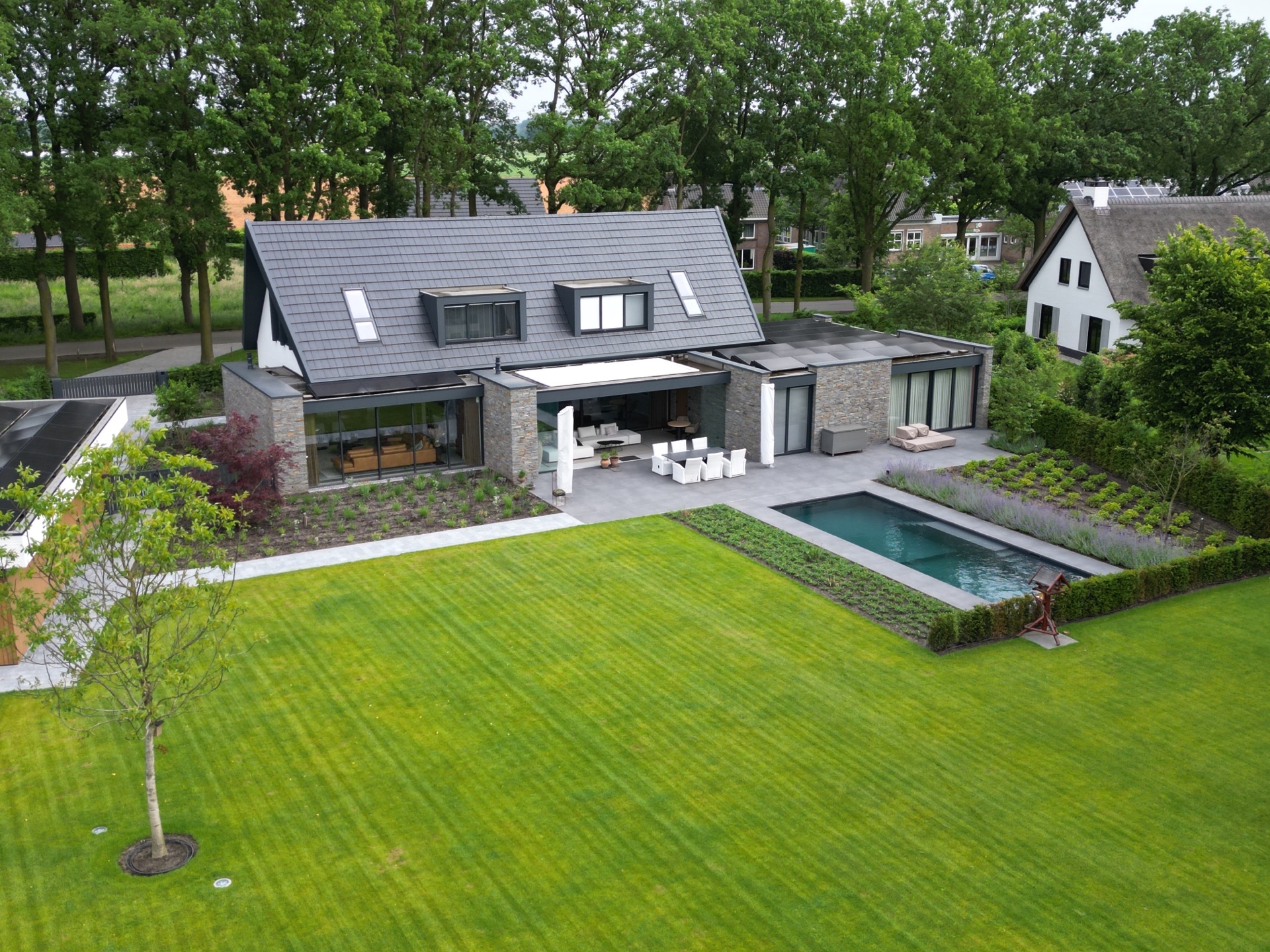
At the back, the house opens into a larger ground-floor extension with stacked slice-like panels. These horizontal and vertical elements are not treated as a single block. Instead, they are shifted in a stepped arrangement, which makes the extension read as a series of measured moves. The overhanging roof edge reinforces that layered appearance, and the change in depth gives the rear elevation more rhythm than the main volume.
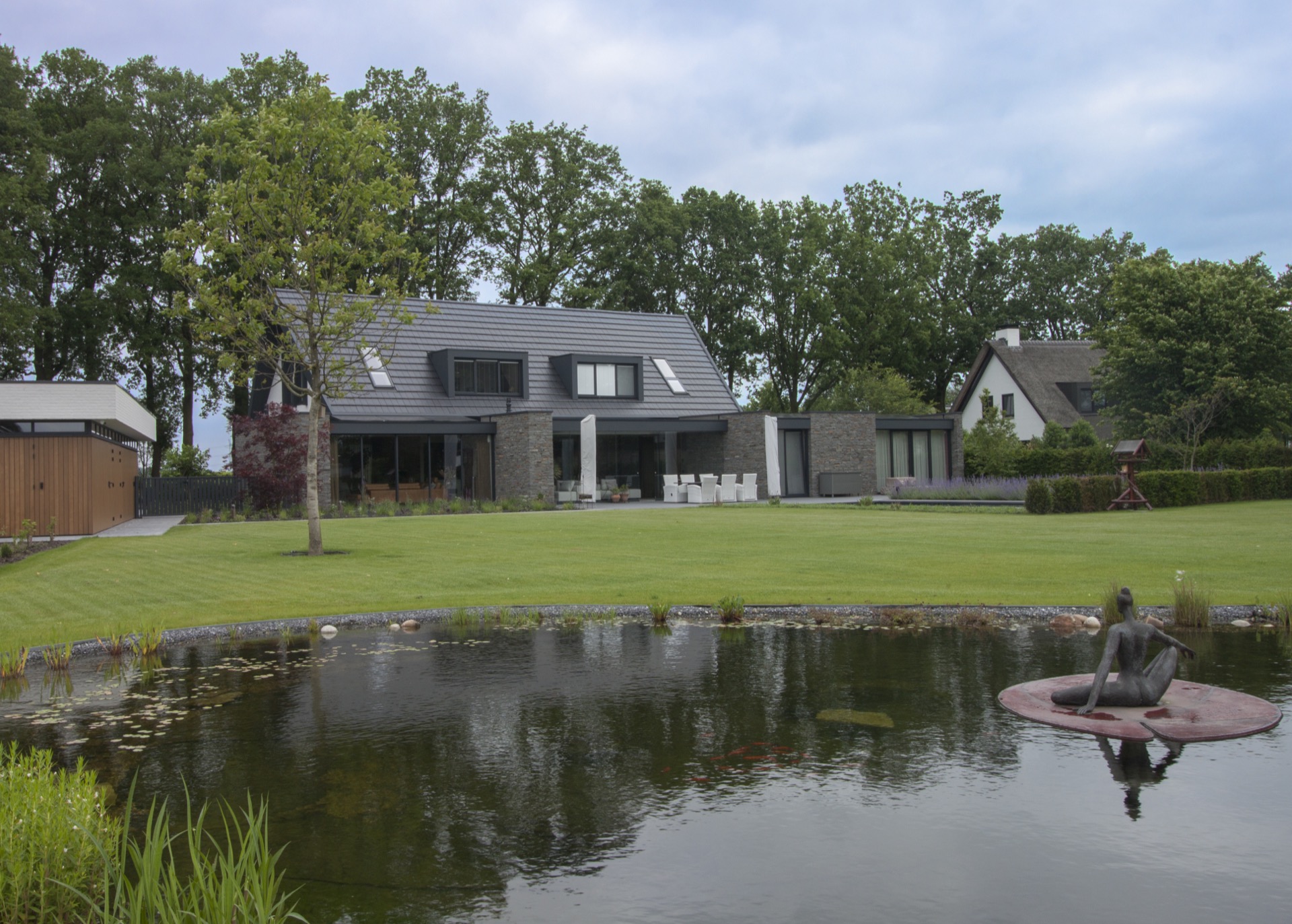
The stepped facade composition also directs the way the building meets the garden. Rather than closing off the back of the house, the new volume breaks down the mass and points the eye outward. In the exterior images, the extension sits beside paved terraces and a narrow water edge, so the added depth does more than create floor area. It also shapes the transition between inside, terrace and lawn.
modern countryside villa with gabled roof and extension as the architectural starting point
Large windows facing the garden are set into the rear elevation, and they are the element that most clearly changes the experience of the ground floor. The openings are generous enough to pull daylight deep into the rooms, while the dark frames keep the glass sharply defined. From inside, the view extends straight to the lawn, the terrace and the water feature, which gives the interior a fixed relation to the outside rather than a vague connection to it.
The glazing is paired with open sightlines through the living spaces, so the rear of the house feels oriented rather than enclosed. A circular pendant over the dining zone marks one of those central moments, but the stronger gesture is the width of the openings beside it. They sit low against the floor finish and make the garden visible at table height, along the edge of the seating area and from the circulation path beside it.
modern countryside villa with gabled roof and extension as the architectural starting point
Outside, the modern garden with pond/water feature brings a still surface into the composition. The water sits close to the house and reflects the volumes above it, including the dark roof and the bright masonry. Around it, the lawn is cut into clean strips and the paving runs in straight lines, which keeps the ground plane aligned with the building rather than standing apart from it. The terrace is not a separate stage set; it is tied to the rear rooms by the broad glass openings. That makes the modern countryside villa with gabled roof and extension part of the architectural character rather than a loose finish.
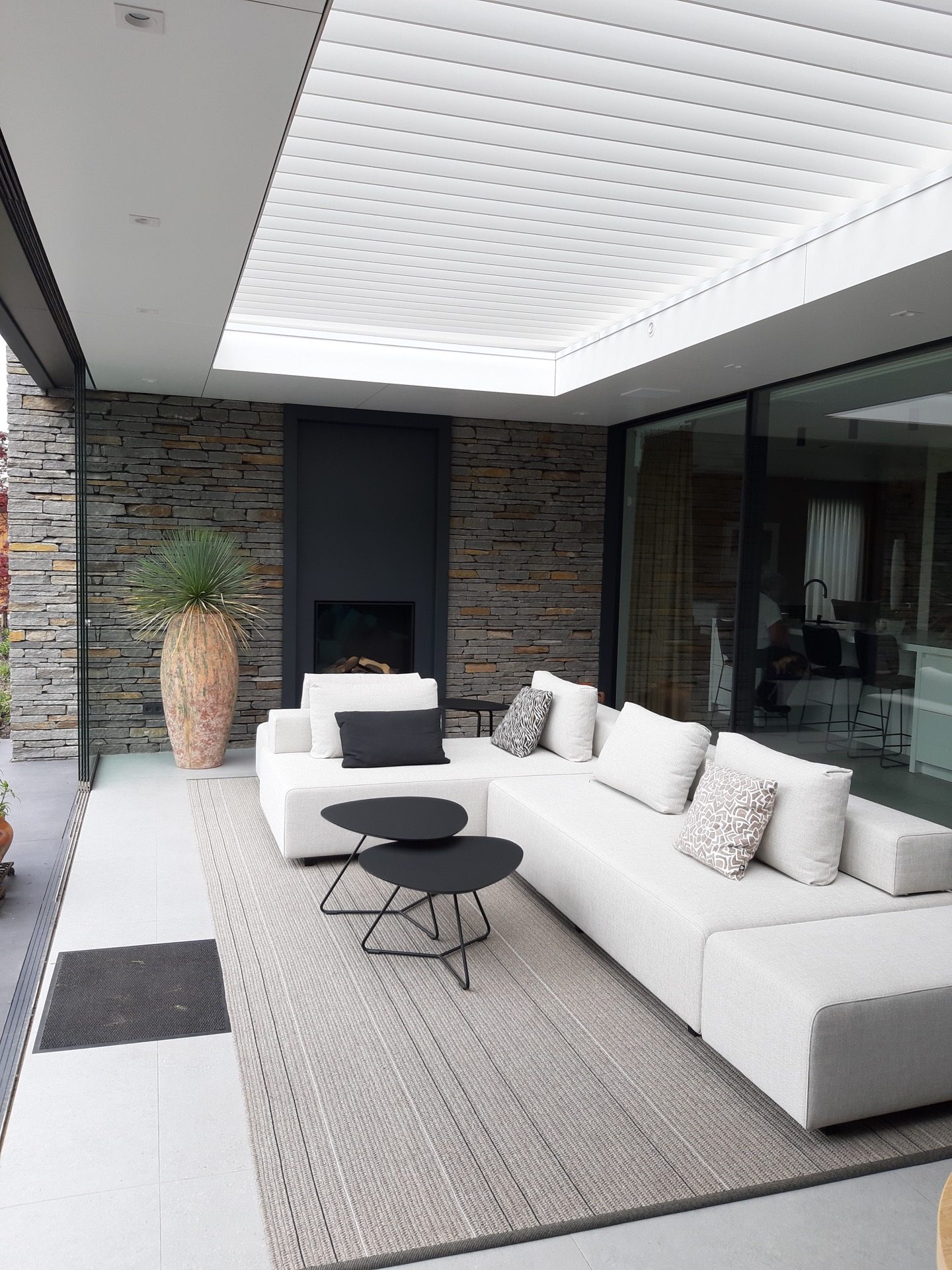
Another image shows a longer outdoor strip with a pool beside the terrace and planting bands along the edge. Here, the hard and soft surfaces are clearly divided: stone, water, lawn and narrow planting zones. The house sits alongside these layers with a glass wall and a shallow overhang above the patio. That overhang gives shade and marks the threshold, while the terrace becomes a usable strip between the rooms and the garden.
Brick, dark frames and a quiet contrast
The material palette stays limited, but the way it is assembled matters. White masonry carries most of the wall surface, while dark frames and roof covering outline the openings and upper volume. In several exterior views, a natural stone finish appears near the entrance and at low wall sections, adding a rougher surface against the smooth brickwork. None of these elements is loud on its own. Together, they keep the house legible from a distance and close up.
The stepped rear addition follows the same logic. Its white planes and overhanging lines echo the main house, yet the change in depth makes it clearly read as an addition rather than a copy. That distinction is important to the project. The modern countryside villa with gabled roof does not rely on a single gesture; it uses repetition, offset and opening to tie the older reference to a contemporary extension.
Inside, the openings do most of the work
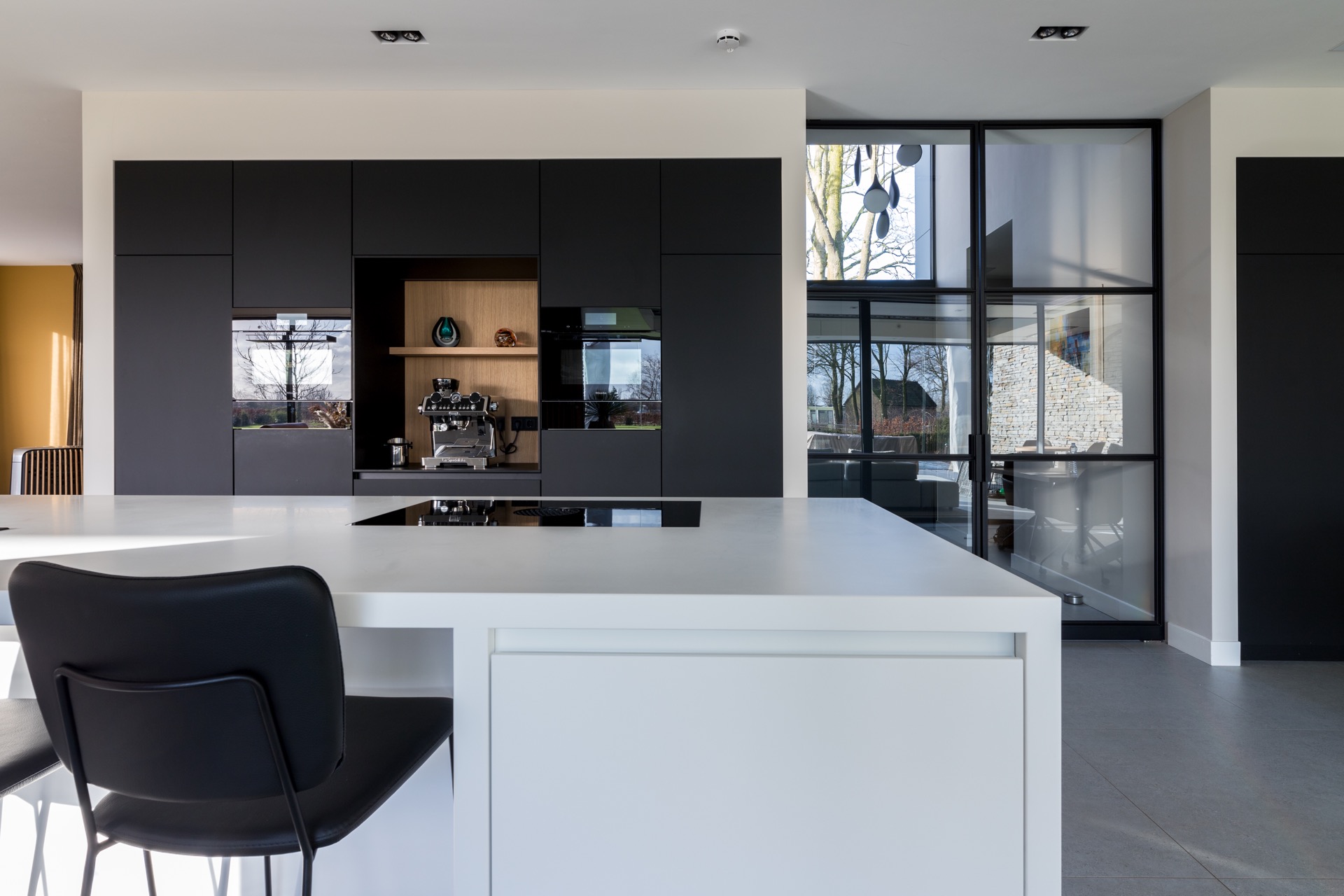
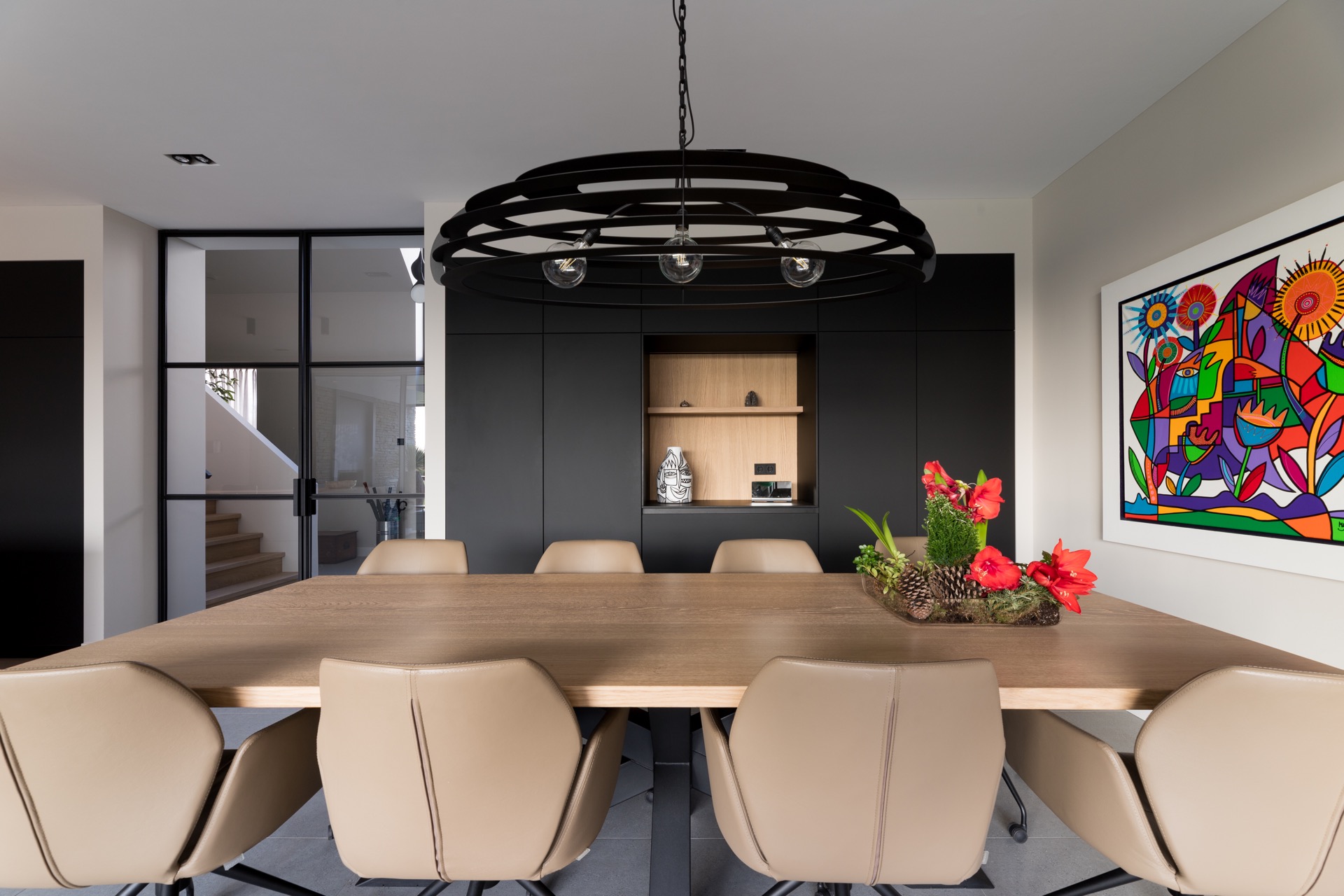
Inside the house, the glazing remains the strongest architectural feature. A dark fitted wall with handle-free panels sits beside a tall opening, and a wood-lined niche softens the darker surfaces without breaking the overall restraint. The interior is organized around long views and controlled light, so the rooms feel shaped by their edges rather than by decoration. A ring-shaped pendant hangs over the dining area and becomes a simple marker in the space, not a focal object in itself.
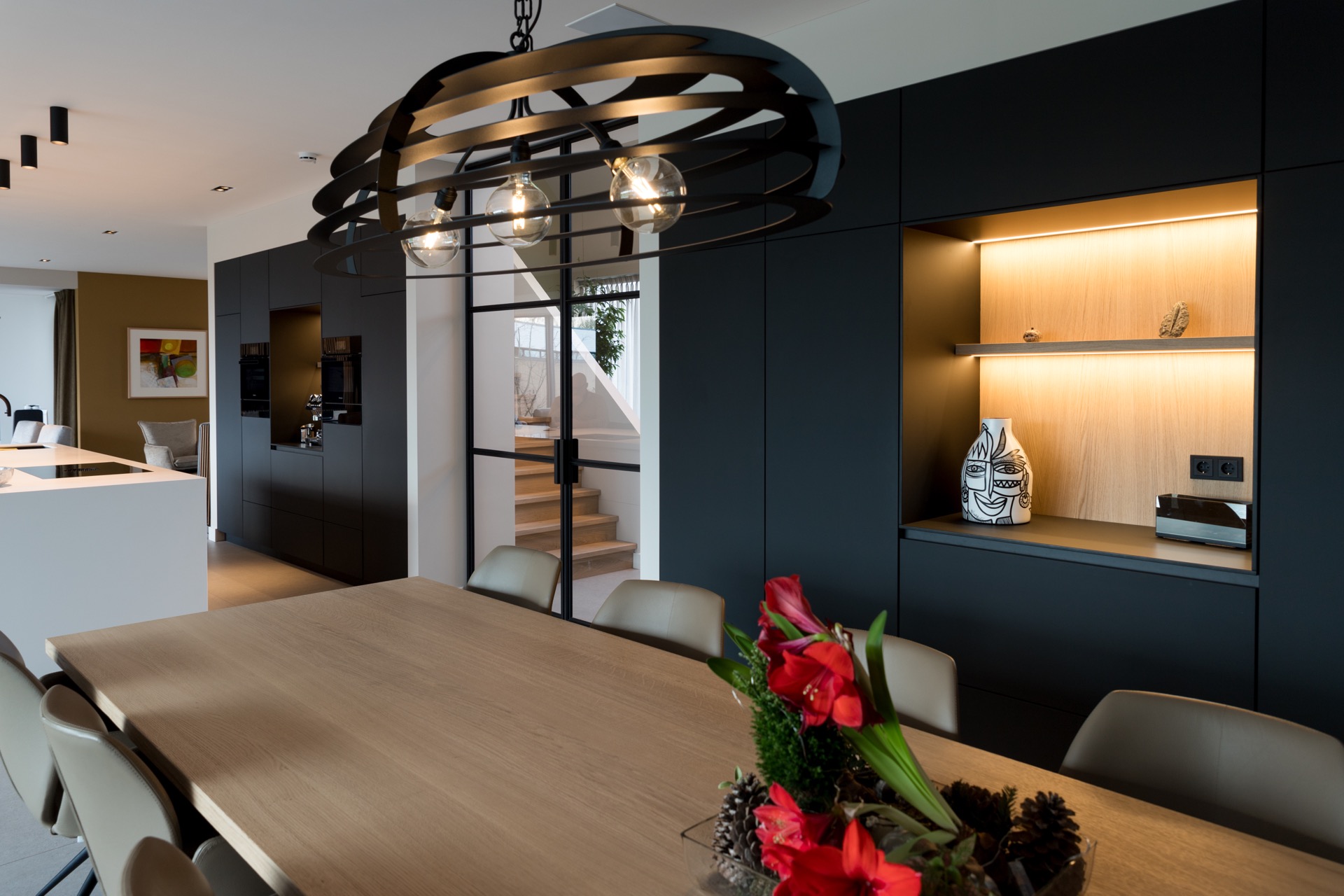
Another interior view shows the same approach in a different register: black-framed glass, a bright opening, and a built-in storage wall that keeps the surfaces flush. The composition is useful because it clears the room for movement and lets the windows stay visible from more than one angle. As a result, the large windows facing the garden are not only an exterior feature. They determine how the rooms are arranged and how the house is read from within.
A villa shaped by steps, depth and view lines
What stays with the viewer is not a decorative theme but the sequence of decisions: a simple main volume, a dark gabled roof, a rear extension with stacked slice-like panels, and a garden edge drawn close to the glazing. The stepped facade composition gives the back of the house depth, while the front remains compact and measured. Between those two conditions, the project finds its character through proportion and the way the openings frame the ground outside.
The overall effect is measured and specific. White brick, dark outlines, stepped additions and broad glass surfaces work together to keep the house connected to the landscape without dissolving into it. The modern countryside villa with gabled roof and extension reads clearly from every angle shown: as a rural house with a contemporary profile, and as a building that uses light, depth and carefully placed openings to turn toward the garden.
Want to see more of Spanjers Architect? View the page of Spanjers Architect for even more great projects and company information.

.png)