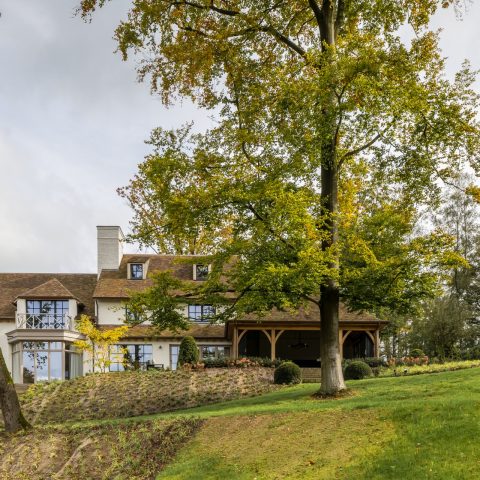







Modern garden with pond and terraces
The first thing that holds the eye is the water. A reflective pond sits close to the house, edged in stone and concrete, while the surrounding terraces step away in clear layers. It is a modern garden with pond in the most literal sense: water, hardscape and planting all stay legible, without visual noise. The result is quiet, but not static. Level changes, broad paving and the dark surface of the water keep the view moving from one plane to the next.
Water as the main line through the garden
The garden with water features is built around several visible edges rather than one single focal point. Narrow basins and longer water lines catch light beside the terrace and along the house, so the reflections change with every step. In one view the water sits tightly against a wall; in another it opens out beside lawn and planting. Those shifts give the garden depth. They also keep the planting low and controlled, so the surface of the pond remains easy to read.
Stone and concrete define the water line, and the materials do most of the talking. Their straight edges make the pond feel measured, while the dark reflections soften the whole composition. The contrast is subtle: pale paving, darker masonry and the glass of the house all meet at the water. That meeting point is where the modern garden with pond becomes most convincing, because the garden is not separated from the building. It grows out of it in planes and pauses.
Terraces with levels that guide the route
Several terraces are set at different heights, and the transitions between them are carefully visible. One platform leads into another with a short drop, a step or a widened edge, so the garden reads as a sequence rather than a single flat surface. This is a terraced garden with levels in the clearest sense: movement is built into the layout. From the terrace, the eye looks across paving, planting and lawn before reaching the water again.
Close to the house, the hard surfaces are clean and restrained. Broad concrete slabs and straight joints create a steady base for the outdoor rooms, while a curved route appears elsewhere to loosen the geometry. That shift matters. It keeps the plan from feeling rigid, especially where the terrace turns toward planting beds and the pond. The garden with water features gains rhythm from those turns, and the level changes make the journey between them visible rather than hidden.
A modern garden terrace under the overhang
Under the deep roof edge, the terrace becomes a sheltered strip with a strong horizontal line. The overhang frames the space without closing it off, and large glazed openings keep the interior and garden in view at the same time. From there, the pond and planted borders can be seen as part of the daily route around the house. The modern garden terrace works because it is neither detached nor overdesigned; it is a practical pause between building and landscape.
Planting kept clear at the edges
The planting is controlled, but not sparse. Clean planting borders run along the water and beside the terraces, planted with grasses and perennials that stay in defined bands. Their loose texture softens the stone and concrete, yet the beds remain readable from a distance. That clarity is important in a garden with water features, because it leaves space for reflections and for the strong lines of the house. The borders do not compete with the layout. They underline it.
Seen up close, the planting has a simple rhythm. Repeated grasses rise beside the pond edge, and lower perennials fill the spaces between stronger lines. The beds are not heavily mixed or crowded. Instead, they sketch out the garden’s structure and let the lawn do its work. A lawn and pond design depends on that restraint: open green surfaces need a counterweight, and here the counterweight is the exact line of the water, the terrace edge and the narrow planting strip.
Lawn as open ground between hard surfaces
Large stretches of lawn sit beside the terraces and water, giving the garden a wider pause between the built parts. The grass does not act as filler; it frames the pond and the paving, and it makes the darker materials around it feel sharper. In the side views, the lawn runs toward the planting beds and then bends back toward the house, so the eye keeps finding new edges. That open ground is one reason the plan feels spacious without becoming empty.
The contrast between lawn and hardscape is strongest where the paving turns toward the pond. There, the green area acts like a buffer, keeping the terraces from feeling too heavy and allowing the water to sit in its own zone. In several views, the house, the glass and the water form a layered composition, with the lawn filling the space between them. It is a simple move, but it carries the whole garden. The modern garden with pond reads clearly because every surface has a defined role.
Edges, reflections and the house in one view
Across the project, the most telling moments are the ones where material, water and planting meet in a single frame. A dark masonry wall meets a narrow water channel; a planted strip sits against a straight terrace edge; a glass opening catches the garden at the same time as the pond. These are small scenes, but they define the mood of the place. The garden does not rely on spectacle. It relies on proportion, on the way each line meets the next, and on the quiet movement of reflections across the water.
Because the plan changes level, those scenes are never exactly repeated. A pond edge appears close and tight in one image, then opens wider beside a lawn in the next. The terraces hold the whole arrangement together, while the planting keeps the lines from feeling severe. What remains after moving through the garden is a clear sequence of surfaces: water, paving, grass and border planting. In that sequence, the modern garden with pond keeps its calm structure and its visual tension at the same time.
Want to see more of Buytengewoon? View the page of Buytengewoon for even more great projects and company information.




NEW 2026 Jubileum Edition The Best Interior Designers Benelux
Order Now €125


NEW 2026 Jubileum Edition The Best Interior Designers Benelux
Order Now €125


NEW 2026 Jubileum Edition The Best Interior Designers Benelux
Order Now €125