








Modern villa garden with garden lighting and planned sightlines
A shallow line of light follows the edge of the planting, then disappears under the terrace roof before it reaches the water. That movement gives this modern villa garden with garden lighting its structure. The villa and garden are read as one composition, with the transitions between paving, borders and covered space carrying as much weight as the buildings themselves. In the evening images, the path lights, low spots and wall accents do not compete; they mark the route and leave the planting to do the rest.
modern villa garden with garden lighting as the architectural starting point
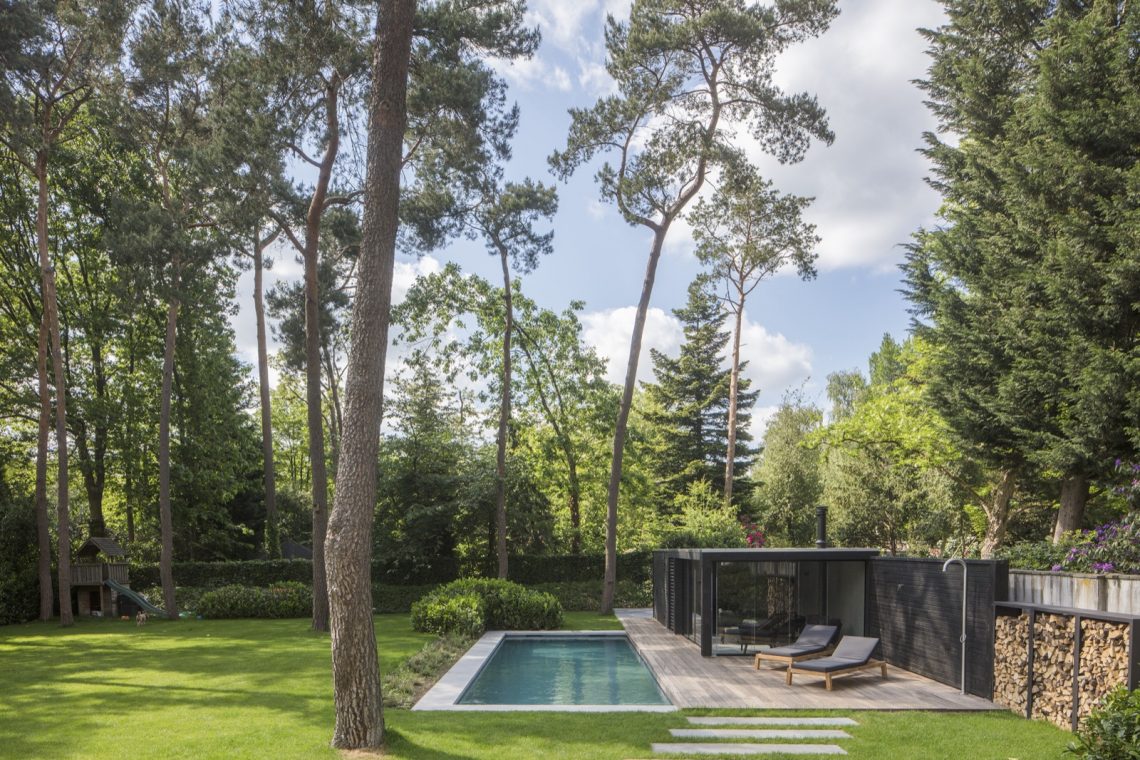
The strongest connection sits at the covered terrace. Its linear lights draw a clear line beneath the roof, while the opening beyond keeps the view moving toward the lawn and the rectangular pond in the garden. Brick piers, dark profiles and the roof edge frame that threshold, so the inside-out relation is visible rather than implied. The seating zone is placed close to the water, which lets the eye shift from hard surfaces to reflections and back again.
That shift matters throughout the project. Straight paving runs beside grass and planting beds, and the edges are kept crisp so the garden reads in layers. Nothing feels crowded. The routes are legible at a glance, yet the composition still has depth because the water, terrace and planting beds sit on slightly different levels of attention. The result is a modern villa garden with garden lighting that works in daylight and after dark.
Lines that guide the eye
The plan is built around clear sightlines. From above, the garden reads almost like a grid: paths, lawn panels and borders are set out with firm geometry, then softened by planting. On the ground, the same logic becomes more tactile. Stone paving, narrow borders and strips of grass keep the movement steady, while the curves are limited and deliberate. This is where the garden earns its name: the lines are visible, but the overall effect stays calm.
Across the site, clean paving and borders give the plants room to sit in distinct beds. The masonry edges around the pond sharpen the composition, and the straight walkways keep the house present at every turn. In one view, a paved strip carries the eye along the lawn; in another, a border of low planting pulls the view back toward the terrace. The garden does not rely on decorative gesture. It uses proportion, edge and direction.
modern villa garden with garden lighting as the architectural starting point
At night, the lighting plan becomes the quiet framework of the garden. Pathway garden lighting traces the main routes so the walk between terrace, lawn and house remains readable. In the planting beds, ambient lighting in planting gives depth to the borders without flattening them. Small points of light pick out leaf shapes, stems and the edges of mulch beds, while the darker areas between them keep the scene from becoming overexposed. The garden stays legible because the lighting is used sparingly.
The effect is strongest where the lights meet the built elements. Accents on the brick walls and around the openings of the house add a second layer, while the covered terrace with linear lights creates a clear underside to the roof. Those lines are especially visible in the evening shots, where the roof plane, columns and brickwork are read almost like a diagram. The garden lighting is not an overlay; it follows the composition already set by the architecture.
Water as a pause in the sequence
The rectangular pond in the garden interrupts the straight lines just enough to give the layout a pause. Its long edges reflect the light and widen the space visually, especially when seen from the terrace side. The water sits as a clean, contained shape rather than a decorative flourish, and that makes it useful in the composition. It catches the evening light, echoes the paving geometry, and sets up a second horizon line beside the lawn.
Because the pond is framed by masonry and planting, it reads as part of the route instead of a separate destination. From one angle, it anchors the seating area; from another, it opens the view toward the rest of the garden. The surrounding beds and low edges keep that shape precise, which is why the water feature feels integrated into the plan rather than inserted into it. It gives the project depth without breaking the discipline of the layout. That makes the modern villa garden with garden lighting part of the architectural character rather than a loose finish.
Planting that changes the scene through the year
The planting is used as a moving layer between the hard surfaces and the architecture. Daytime images show low borders, fuller beds and clipped lawn panels, while the night photographs turn those same beds into dark masses with points of light. That change is part of the project’s rhythm. Seasonal planting does the work of softening the straight paving and the brick edges, but it never blurs them. The structure remains visible behind the growth.
Seen from the air, the garden beds and lawn shapes are arranged with enough spacing to let each element read on its own. Seen from the terrace, the planting carries the view toward the far side of the plot. The project’s strength lies in that double reading: close up, the leaves and groundcover matter; from a distance, the geometry takes over. In both cases, the modern villa garden with garden lighting stays coherent because the planting follows the same line logic as the paving.
Materials that hold the composition together
Brick, thatch and stone form the visible palette. The raked roof line of the thatched volumes softens the profile of the house, while the brick walls and piers keep the garden edges grounded. Underfoot, the stone and gravel paving gives the routes a firm texture, especially where the path bends around a lawn or runs beside a border. None of the materials is showy on its own. They work by framing light, water and planting.
That material contrast is clearest in the evening. Warm light sits against the brick, sinks into the planting beds and picks up the edges of the paving without washing them out. The covered terrace, the path lighting and the pond all depend on those surfaces to register properly. Even the roof surfaces matter here, because the thatch pulls the house away from a hard silhouette and lets the garden lights take over after dark. The whole project holds to one rule: the details should be visible, not loud.
Why the project reads so clearly after dark
At night, the site is organized by small decisions rather than one dramatic gesture. Lights sit low along the routes, spots pick out planting and the terrace roof carries a straight line of illumination. That combination keeps the garden readable from the house and from the path. It also explains why the project feels so resolved in photographs: the geometry of the paving, the reflection on the water and the points of light in the borders all point in the same direction.
The final impression comes from restraint. The villa, terrace, pond and planting beds each hold their own outline, and the lighting respects those edges. What remains is a clear modern villa garden with garden lighting, where movement, view and material all reinforce each other. The lines are visible from the first frame to the last, but the garden never turns rigid. It simply shows how much can be done with edge, light and measured spacing.
Photography and video: In-lite
Contributors: lighting, covered terrace, furniture, swimming pool and pond, house architecture. That makes the modern villa garden with garden lighting part of the architectural character rather than a loose finish.
Want to see more of Heart for Gardens? View the page of Heart for Gardens for even more great projects and company information.



.png)


