









Natural garden with waterfront access and rural character
The first thing you notice is the planting: repeated groups of grasses and flowering perennials rising from gravel, brick paving and stone edges. The borders do not read as isolated beds but as broad bands that guide the eye toward the water and back to the house. It is a natural garden with a clear rural rhythm, shaped by material choices as much as by planting.
Lush mixed borders with ornamental grasses
The borders are built up in layers. Tall stems, airy seed heads and rounded flowering clusters sit in front of the lawn and along the paths, so the planting carries movement without becoming restless. In the images, lilac, pink and red tones repeat across the beds, while the grasses give height and a lighter top edge. That structure keeps the natural garden readable from a distance.
What stands out is the repetition. Plants are grouped in larger blocks of the same kind, which gives the borders a measured look and keeps maintenance in check. The result is not a dense plant collection but a rural garden with clear edges and open pockets of space. From one viewpoint you see the water; from another, the planting closes in around the terrace and softens the transitions between the different zones.
Planting that lets the view breathe
Rather than filling every corner, the garden leaves room between the massed planting and the harder surfaces. Those gaps matter. They let the brick paving, the gravel strip and the stone edging stay visible, so the materials can do part of the work. The beech hedge adds a green line behind the borders, while the broken river gravel gives the ground plane a looser, more rural finish.
Terraces, paving and the edge of the house
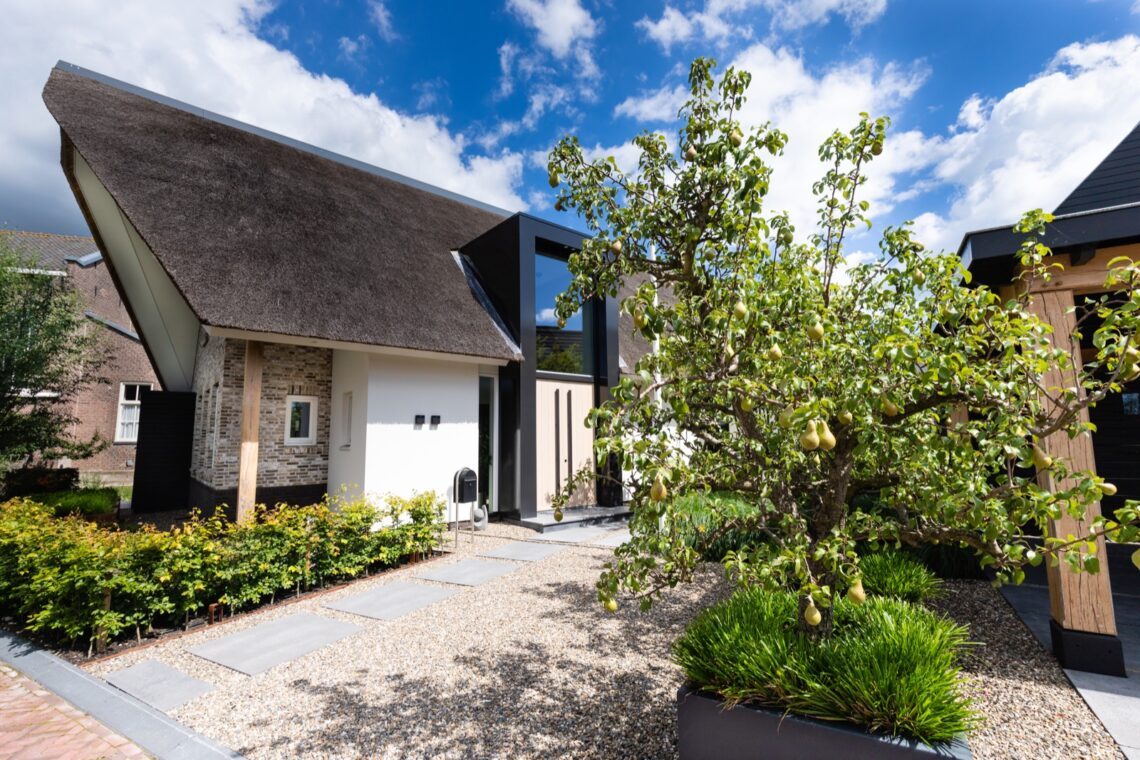
The house has a thatched roof and dark timber cladding, and the garden follows that tone with brick paving, natural stone terraces and older stone bands used as bumpers near the parking places. The palette is restrained, but not flat. Brick, weathered stone and gravel each have their own texture, and those differences keep the hardscape from becoming one large surface. The stone paving is especially effective where it meets the planting, because the border can then start almost at ground level.
The terrace surfaces alternate between natural stone and Oud Hollandse tiles, giving the sitting areas a quiet weight. In the photographs, the paving reads as a series of large, practical planes rather than a decorative floor. That makes sense in a waterfront garden where movement matters: you walk out, pause, turn toward the water, and follow the line of the planting again. The material changes mark those shifts without breaking the composition.
Brick, stone and gravel in one route
The route through the garden is built from familiar materials used with restraint. Brick paving brings warmth through its colour and joint pattern. Natural stone appears on the terraces and in the edging. Gravel fills the spaces where a softer, more open surface is needed. Together they support the same idea: a garden that feels rooted in the landscape, but still gives enough room for access, parking and sitting outdoors.
A jetty for mooring along the water
Along the water runs a long jetty for mooring, drawn out in a straight line that contrasts with the looser planting on land. It answers a practical demand without taking over the scene. The length of the platform lets several boats come alongside, but visually it remains part of the edge rather than a separate object. That is important in a waterfront garden, where the border between garden and river needs to stay legible.
From the planting side, the jetty is framed by soft growth and reed-like movement. From the water side, it reads as a simple, usable line. The surrounding garden does not crowd it. Instead, the beds and gravel leave the river edge open enough for the platform to do its job. This is where the project becomes especially clear: use is present, but the surface of the garden stays calm.
Parking folded into the landscape
The parking area had to provide enough space without turning into a broad paved forecourt. That requirement shaped the whole layout. Older stone bands act as bumpers near the parking places, breaking up the surface and giving the edge a more considered finish. The eye moves from stone band to gravel, then to planting, instead of meeting one uninterrupted slab. In that sense, the parking belongs to the garden rather than standing apart from it.
The land gates in real oak reinforce that same rural reading. Their material matches the setting and sits comfortably beside the brick paving and the beech hedge. Nothing feels introduced only for effect. Each element has a clear role, from the gates to the surface changes, and together they keep the practical parts of the plot from looking overbuilt.
Details that keep the rural character in place
It is the small shifts in texture that hold the whole project together: the rougher river gravel beside smoother terrace stone, the clipped beech hedge against open planting, the darker timber of the house against the lighter tones of brick and paving. Even the flower colours feel part of that logic. They repeat in bands and clusters, never scattered randomly, so the border keeps its structure as the season changes.
Seen as a whole, the garden is less about grand gestures than about measured links between water, house and ground. The planting, hard surfaces and access routes all stay visible. That clarity gives the project its pace. You can move from terrace to jetty, from parking to border, without ever leaving the same carefully edited rural setting.
The result is a natural garden with enough variation to keep each part distinct, but with materials and planting that continue the same story. Grasses soften the edges, stone grounds the terraces, and gravel lightens the transitions. Near the water, the jetty for mooring becomes the practical line that completes the picture.
Want to see more of Groenregie, your translator of garden wishes? View the page of Groenregie, your translator of garden wishes for even more great projects and company information.




NEW 2026 Jubileum Edition The Best Interior Designers Benelux
Order Now €125


NEW 2026 Jubileum Edition The Best Interior Designers Benelux
Order Now €125


NEW 2026 Jubileum Edition The Best Interior Designers Benelux
Order Now €125


