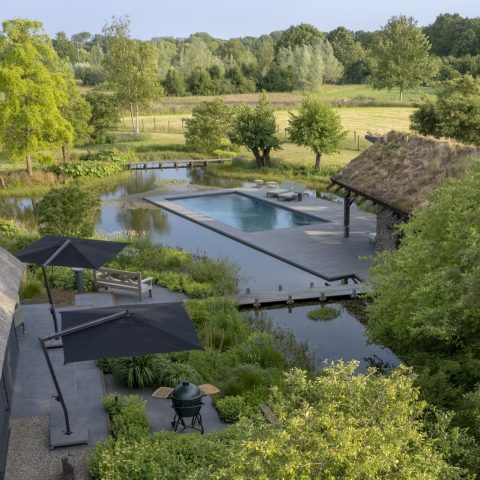









Natural garden with a winding water feature
A winding water feature cuts through the garden and immediately sets the tone. It slips past stone edges, gravel bands and pockets of planting, then opens and narrows again as it moves onward. The water is connected to the river, which gives the whole composition a direct, living movement. Small fish, crayfish and mussels are mentioned in the project text, and that sense of activity is visible in the water’s edges and the way the planting is allowed to meet it.
Stone banks, moving water and planted edges
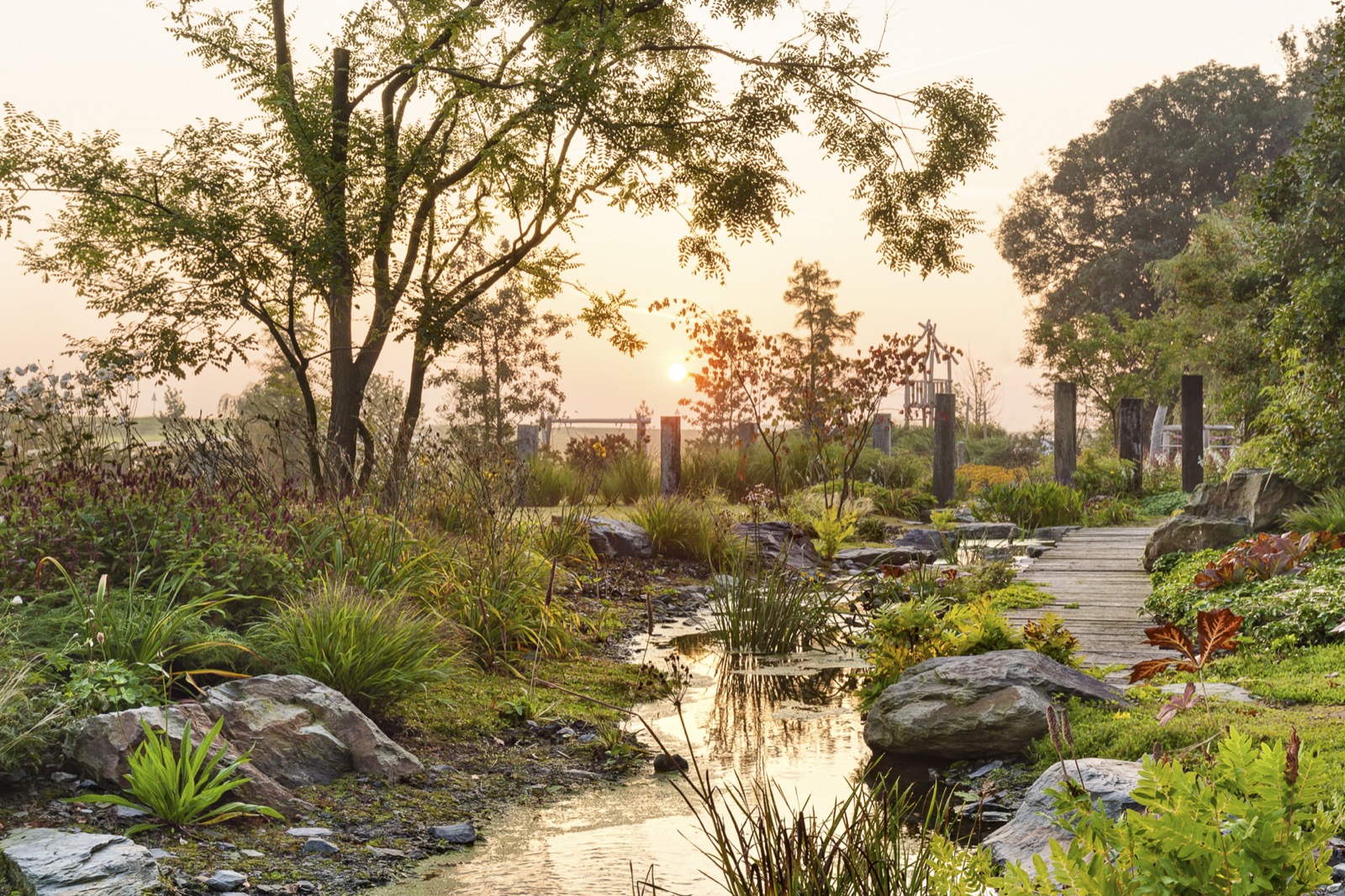
The most striking view is the one where water, stone and planting meet without a hard boundary. Rocks line parts of the bank, while lighter gravel strips and stepping stones guide the eye along the curve. This is where the natural garden with a winding water feature feels most grounded: not as a decorative pond, but as a water route that belongs to the larger garden layout. The bank planting softens the edges and keeps the route readable even when the water narrows.
Seen from another angle, the water takes on the role of a small landscape in itself. It bends around larger stones, passes under the shadow of trees and picks up reflections from the sky. The image set shows layers of grasses, flowering perennials and low shoreline planting, so the water does not sit apart from the garden. It is threaded through it. That is also where the idea of a natural stone riverbank becomes more than a surface detail; it shapes how the garden is experienced step by step.
Pond edge planting that holds the line
Along the water’s edge, the planting is dense enough to make the transition feel deliberate, yet open enough to keep the bank visible. Some areas carry taller grasses, while others show lower planting close to the gravel and stone. In a few images the water surface is broken by visible vegetation, which gives the whole section the character of a living water habitat in garden rather than a static basin. The planting does not try to hide the water. It frames it and leaves room for movement.
This part of the garden is also where the project leans into a more natural garden layout. Routes run beside the water instead of cutting across it. Stone stepping points, rougher edges and small changes in level keep the circulation informal. The result is easy to read, but not rigid. There is always a next turn, a next patch of planting or a different bank texture to look at. That slow unfolding gives the water feature its own pace.
Paths that move through the planting
Beyond the water, paths run through layered borders and past broader planted zones. The surfaces shift from gravel to tighter paving and back again, which helps separate the more open parts of the garden from the private areas near the house. The flower borders along paths are not treated as a thin edge. They thicken at bends, widen near seating spots and pull colour into the route. In the summer images, purple, blue and pink tones sit against the muted stone and pale path materials.
These routes do more than connect spaces. They change the way the garden is read. A path can reveal the water in one moment and conceal it the next, depending on how the planting leans over the edge. In several views, trees create filtered openings that let light through without flattening the composition. The garden keeps its depth because the path never travels in a straight, open line for long. It breaks, turns and pauses.
Rocks, gravel and small changes in level
Rocks do useful work here. They hold the bank, mark edges and give the water a heavier frame where needed. Gravel takes over in other places, especially where the route needs to feel lighter or more informal. Together they create a winding water feature garden that reads as carefully put together without losing its natural character. The surfaces also help with the transition from wet to dry ground, from planted edge to walking route, from open view to enclosed pocket.
Several images suggest a playful dimension as well. The accessible part of the garden invites children to move close to the water and jump over rocks, which says something about the scale of the stonework and the way the route is set up. It is not a fenced-off display. The stones, steps and open edges give people a reason to linger by the water and move along it. That sense of use is built into the layout.
A private garden that opens in layers
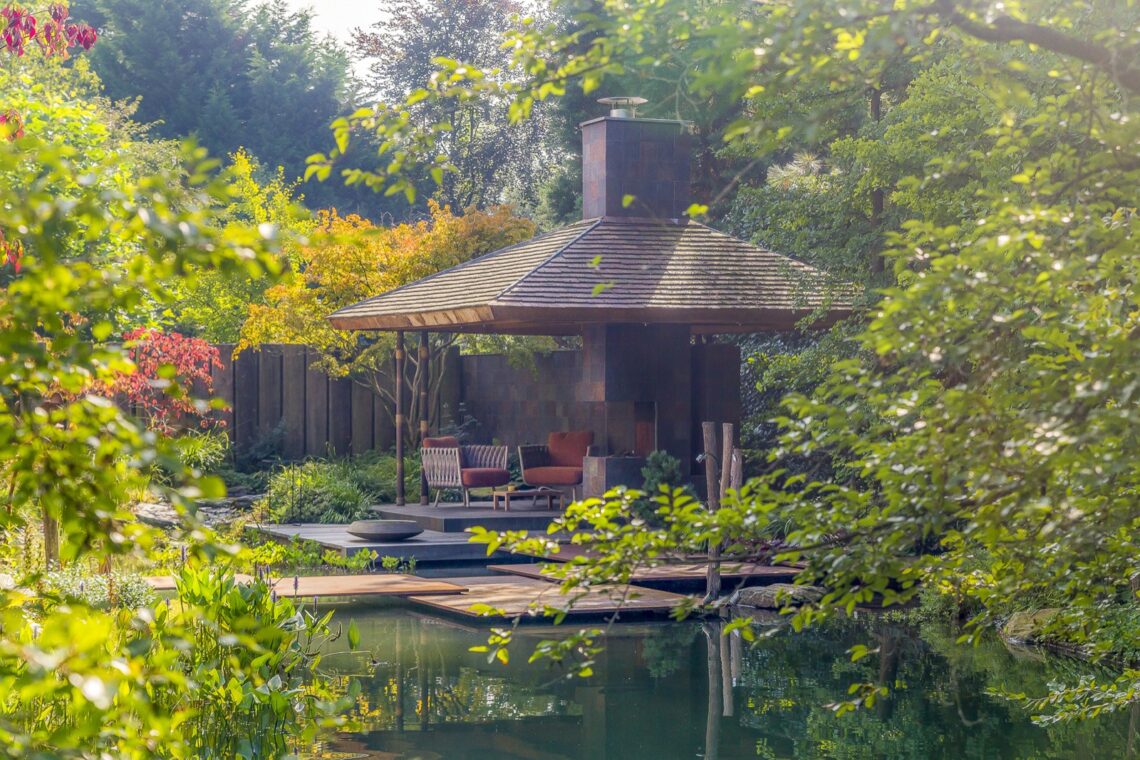
Near the house, the atmosphere shifts. Here the planting becomes more intimate, with flower borders gathered around the private garden area and paths that rise and fall gently through the beds. The project text describes daily walks through the garden, and the imagery supports that idea: there are repeated views, small turns and changing openings rather than one fixed focal point. The garden is made for return visits, not for a single front-on view. Each pass reveals a different angle on the water, the borders or the trees.
Light plays an important part in that experience. Morning sun reaches the horizon, while later views show warmer evening tones across the water and paving. The reported shift from summer into autumn is visible in the change of foliage and the way the garden begins to soften at the edges. In this setting, the planting is never just background. It marks the season, catches the light and gives the private part of the garden its slower rhythm.
Where visitors and residents share the same landscape
The garden is partly open to visitors, and that changes how it is read. The accessible areas need to hold up under movement, while the private side still needs enough calm for daily use. The layout answers both conditions through clear routing, sturdy stone edges and planting that can absorb movement without losing structure. Children near the water, residents walking the paths and the river connection beyond the garden all belong to the same composition. The project never feels split into separate scenes; it moves between them.
That is what makes this natural garden with a winding water feature memorable. It is not only the water itself, but the way the route, the banks, the planting and the open stone surfaces work together. The garden sits between observation and use. You can look across it, walk beside it or pause at the edge, and each position changes the reading. Human movement and the water’s course follow one another, which is why the garden feels inhabited without ever becoming crowded.
The final effect is quiet rather than polished. Stacked stones, planted banks, gravel strips and the changing line of the water do most of the work. In summer the borders carry more colour; later the same routes will read more softly in autumn light. The garden holds both states well. It offers a clear natural garden layout, a strong water presence and enough variation in path, edge and planting to keep the view active from one season to the next.
More than anything, the project shows how a natural garden with a winding water feature can connect play, pause and movement in one landscape. The water invites attention. The paths keep the garden legible. The planting gives each edge a season and a texture. Together they shape a place where the river connection, the stone banks and the flower borders all remain visible, without one element overpowering the others.
Want to see more of Van Mierlo Tuinen – Experience your Nature? View the page of Van Mierlo Tuinen – Experience your Nature for even more great projects and company information.




NEW 2026 Jubileum Edition The Best Interior Designers Benelux
Order Now €125


NEW 2026 Jubileum Edition The Best Interior Designers Benelux
Order Now €125


NEW 2026 Jubileum Edition The Best Interior Designers Benelux
Order Now €125


NEW 2026 Jubileum Edition The Best Interior Designers Benelux
Order Now €125


NEW 2026 Jubileum Edition The Best Interior Designers Benelux
Order Now €125