





Organic garden design at a country house with thatched, covered terraces
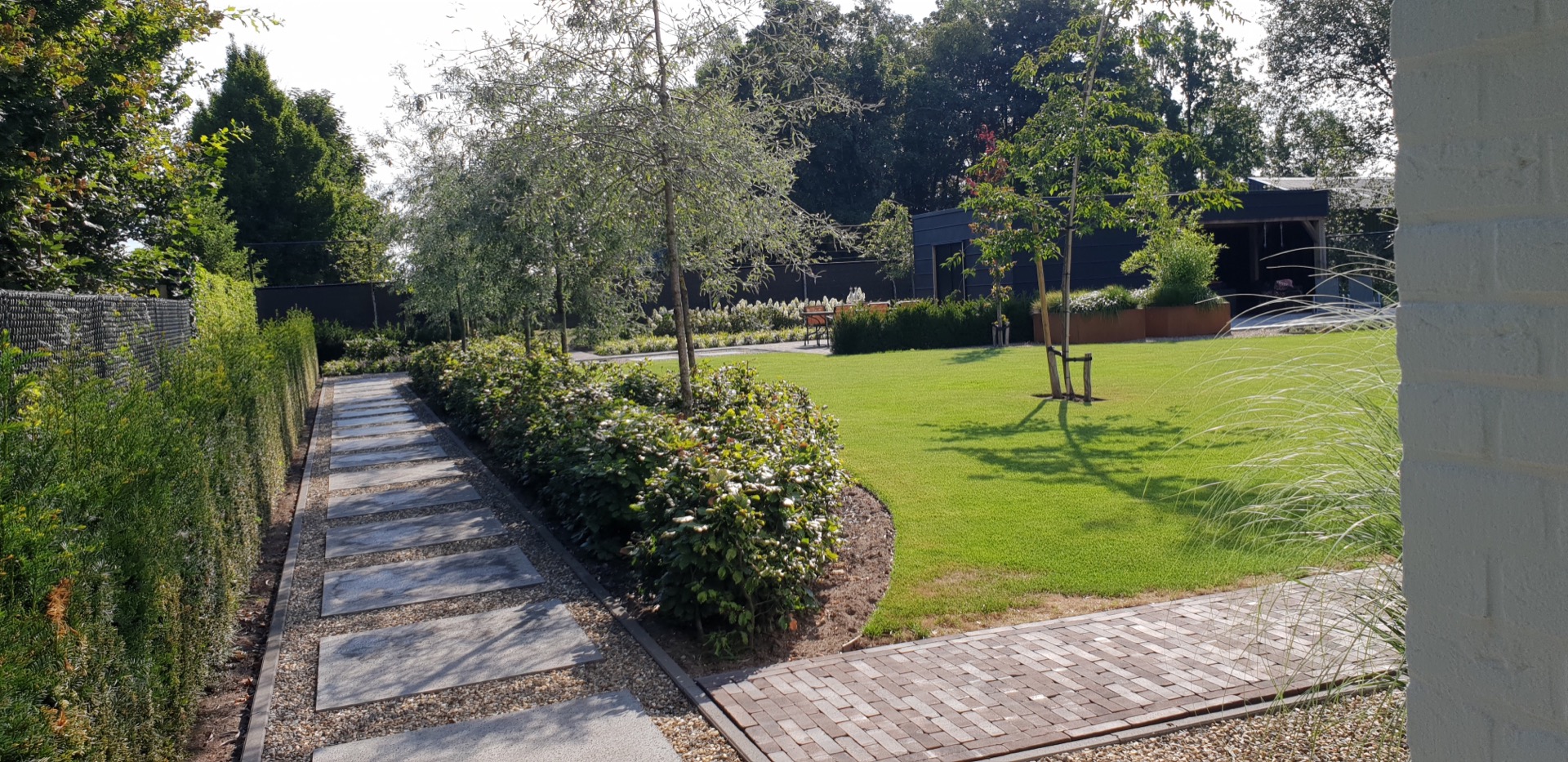
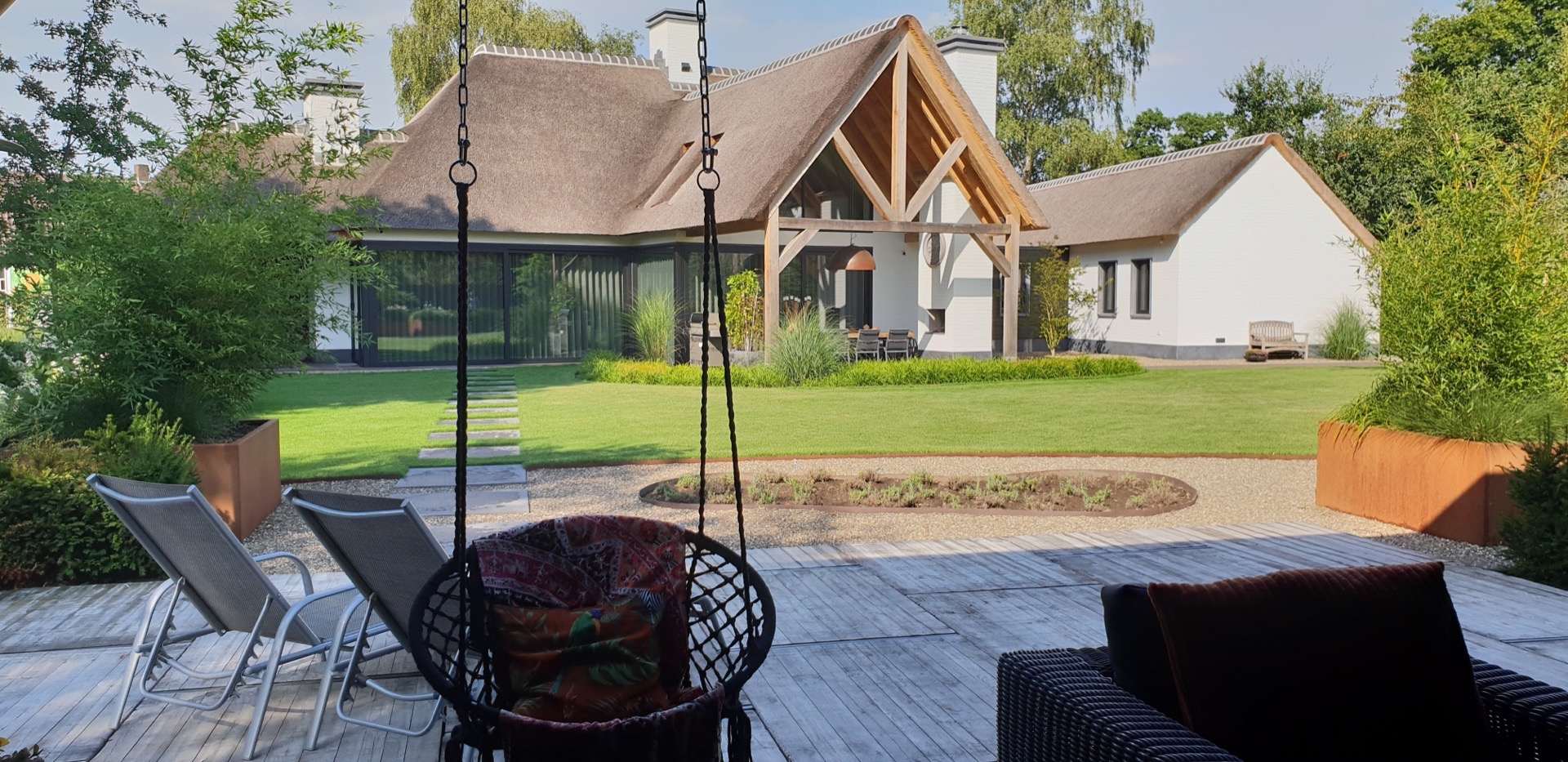
Organic garden design at a country house starts here with a line that keeps bending rather than insisting on straight edges. The planting follows that movement too, with sculptural beech cloud planting set against the thatched roof garden terrace. Gravel and grit circles break up the lawn and bring the rainwater absorption element into the composition without stealing attention from the rest of the garden.
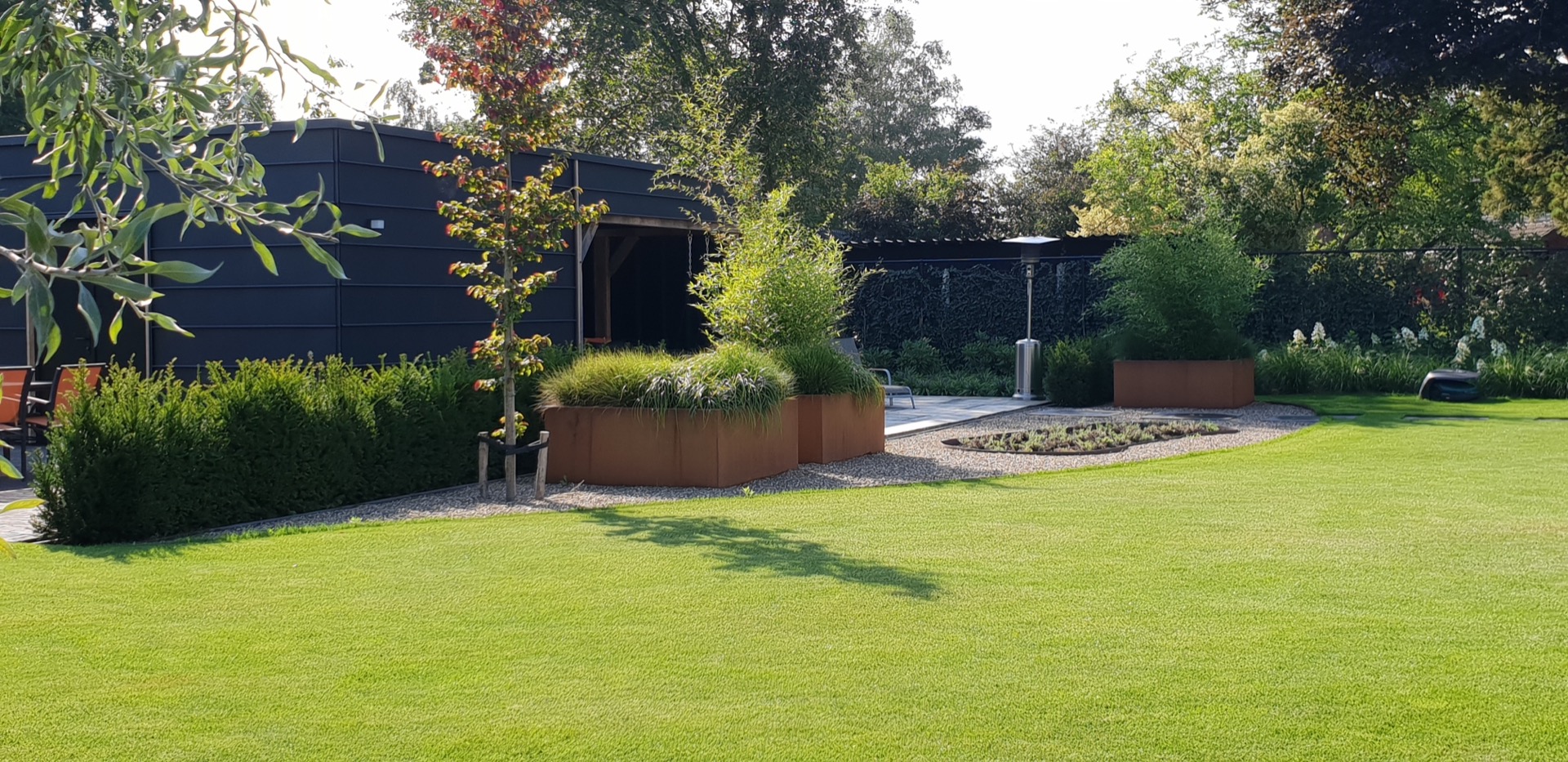
What makes the plan readable is the contrast between the open lawn and the curved gravel features. The circles sit low in the grass, almost like drawn marks, and they give the garden a clear rhythm. Around them, the country house garden with organic lines shifts between paved routes, planted borders, and wider green surfaces, so the eye never stays fixed on one point for long.
organic garden design at a country house as the architectural starting point
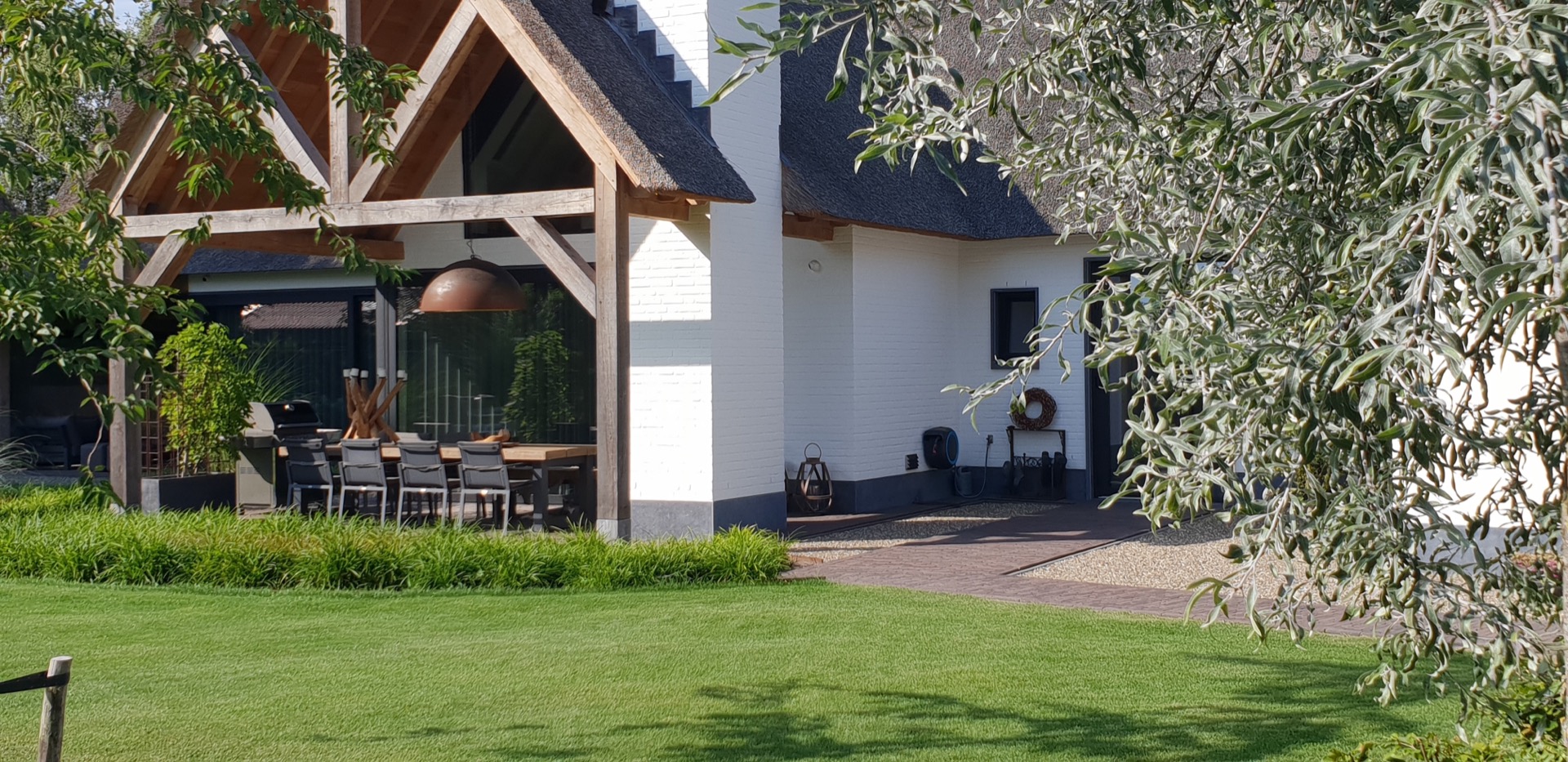
The sculptural beech cloud planting does more than soften the edge of the house. It gives shape to the space and picks up the profile of the thatched roof garden terrace beside it. The roofline reads as a dense, textured band above the seating areas, while the clipped clouds hold their own as separate forms in the planting. That relationship between roof and planting is repeated in the garden rather than explained by it.
Seen from the terrace, the materials stay grounded and direct: thatch overhead, timber structure below, gravel underfoot, and planted mass around the lawn. The result is not about decoration alone. It is about how each surface changes the pace of the garden. The roof gives shelter, the beech clouds create pause, and the curved gravel features keep the layout moving.
Gravel circles that shape the lawn
The gravel/grit circles for rainwater absorption are one of the clearest signatures in the project. They sit within the lawn as circular fields of mineral texture, creating a pattern that reads immediately even from a distance. Because their edges are rounded, they avoid the rigid feel of a hard court or a straight border. Instead, they act as quiet interruptions that bring structure to the green expanse.
These areas also give the garden its most graphic moments. A long strip of paving can disappear into the background, but a circle of grit holds the eye. The repetition of round forms ties the garden together and supports the broader country house garden with organic lines. It is a simple move, yet it changes how the lawn, borders, and paths relate to each other.
A surface that does more than fill space
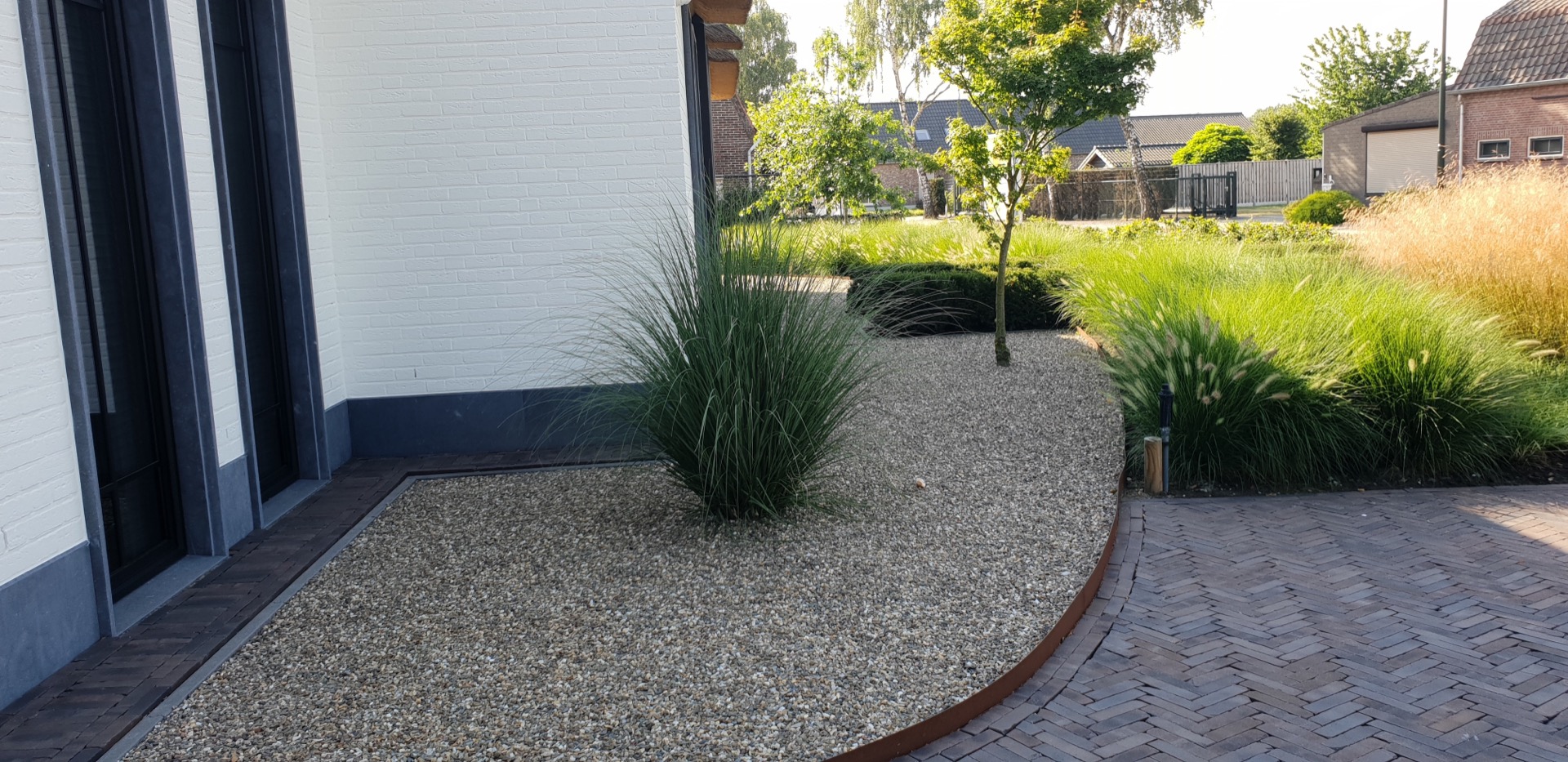
Gravel is used here as part of the composition rather than as a leftover material. It sits beside the lawn, around planting, and in separate circular fields, so the garden gains texture without becoming busy. The curved gravel features also connect the house to the deeper planting zones, where ornamental grasses planting adds movement and a looser edge. The whole route from terrace to lawn feels shaped by these small shifts in surface.
Ornamental grasses planting as the main backdrop
Large masses of ornamental grasses planting carry much of the atmosphere in the garden. They are not used as small accents at the border; they occupy broad areas and give the garden a soft, upright texture. In the wind, they would move against the firmer outlines of the gravel circles and the clipped beech forms. Even when still, they create depth through their repeated stems and layered blades. That makes the organic garden design at a country house part of the architectural character rather than a loose finish.
This planting choice supports the organic garden design at a country house by keeping the scene open and legible. The grasses do not block views to the terraces or the lawn. Instead, they frame them. Their scale matters: wide enough to register as a plane, but light enough to sit beside paving and mineral surfaces without overwhelming them. That balance makes the garden feel drawn rather than simply planted.
From clipped form to loose texture
There is a deliberate shift between the clipped beech cloud planting and the more fluid grasses. One has a sculpted outline, the other a looser movement. Together they prevent the garden from settling into a single note. The beech cloud reflects the sharper geometry of the terrace edges, while the grasses pull the eye outward toward the broader garden and its layered planting beds.
Three covered terraces, three different reasons to stay outside
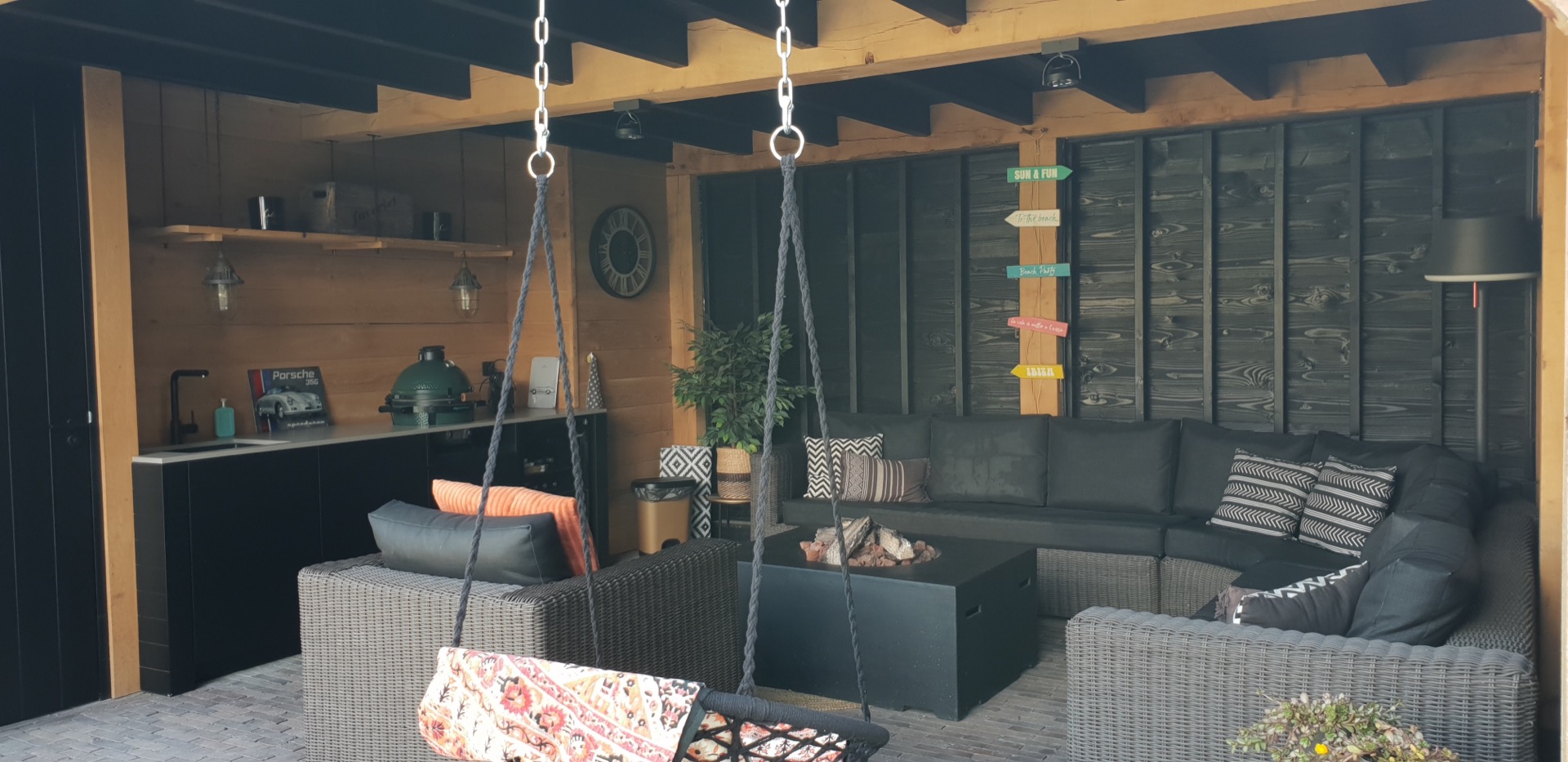
The garden holds three covered terraces, which changes the way the outdoor space is used. Rather than one central sitting area, there are several covered outdoor seating places spread across the layout. That means the garden offers shade, shelter, and a reason to linger at different points in the day. The phrase “always somewhere to enjoy” fits the plan because the seating zones are not isolated; they are woven into the garden’s movement.
One terrace sits close to the thatched roof and timber structure, another opens toward the lawn, and a third gives the garden more depth in use. The visual effect is practical but also spatial: the covered areas break the scale of the plot and create pauses between the planted zones. Each seating place has its own relation to gravel, paving, and grass, so the garden does not rely on one fixed viewpoint.
Where paving, gravel and planting meet
The transitions between materials are one of the project’s quiet strengths. Paving meets gravel in clean edges, gravel turns into a round form inside the lawn, and planting takes over where the hard surfaces end. The paths do not compete with the garden; they guide it. Along the borders, the larger plant masses soften the straight run of slabs and give the route a slower pace.
That makes the country house garden with organic lines feel coherent without becoming repetitive. The layout is built from a few clear moves: circle, curve, strip, and field. Each one is visible in the pictures, especially where the garden path runs beside the planting and the rounded gravel zones sit within the grass. The materials stay calm, but the composition keeps changing as you move.
Read together, the lawn, the curved gravel features, the ornamental grasses planting, and the beech clouds create a garden that is easy to read from the terrace and equally clear from the path. The thatched roof garden terrace gives the ensemble its sheltering edge, while the multiple covered outdoor seating areas make the garden useful in more than one place. Nothing is overstated. The shapes do the work.
Photography: Jack van Haperen That makes the organic garden design at a country house part of the architectural character rather than a loose finish.
Want to see more of Forma Verde? View the page of Forma Verde for even more great projects and company information.


.png)