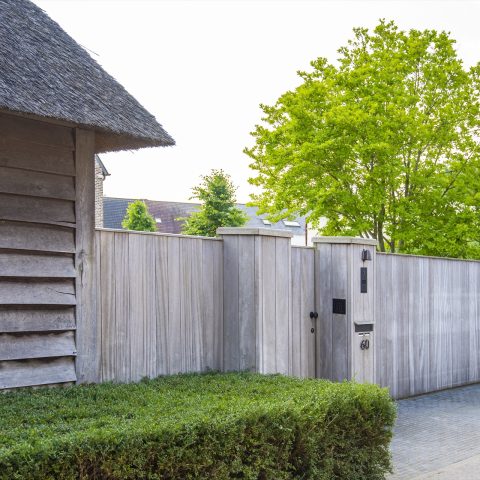









Sliding gate in padoek with variable vertical slats
Vertical slats in padoek set the tone immediately. From one angle the sliding gate reads as a tight wooden screen; from another, the gaps open up and the line of the slats starts to move in light and shadow. That shifting view is what gives this padoek sliding gate with variable slats its presence, whether the gate is open or closed.
A slat pattern that changes as you pass
The rhythm of the variable vertical slats is not uniform, and that is exactly what draws the eye. Some slats sit closer together, others leave a wider pause, so the surface never feels flat. In the open position, the structure becomes more legible and the spacing is easier to read. Closed, the same gate becomes a denser wooden plane, with narrow strips of daylight still slipping between the lines. It is a wooden sliding gate design built around movement rather than a fixed front.
The result is not only visual. The pattern gives the gate a clear direction, guiding the eye along the length of the sliding panel and toward the adjoining fencing. The repeated verticals also echo the straight lines of the paving and the rectangular openings in the background masonry. That connection keeps the gate grounded in its surroundings without disappearing into them.
Padoek as a visible surface, not just a material
Padoek brings a strong grain and a colour that sits comfortably beside the lighter brick and stone around it. In close-up, the wood shows subtle shifts in tone, from grey-brown to warmer notes, depending on the light. Those variations matter because the gate is seen up close as well as from the street. The wood grain gate does not rely on decoration; the texture itself carries the detail.
The edges of the boards stay clean, and the long vertical format lets the material read in full strips. That gives the gate a calm surface that still holds movement. Even when the panel is still, the grain and the changing spacing between slats keep it from becoming a solid block. The material and the layout work together, but the padoek remains the first thing the viewer notices.
Light, shadow and the narrow spaces between the slats
The most active part of the composition sits in the gaps. Light and shadow slats create a thin pattern across the surface, especially where the sun catches the open intervals. These shadows sharpen the differences between the slats and make the wall of wood feel lighter than it is. In the wider view, that effect is visible across the full gate; in close-up, it becomes a finer study of line, texture and spacing.
Because the slats vary, the shadows do too. Some bands are crisp, others fade into the wood, and that variation gives the gate a changing face as you move past it. This is where the project becomes most architectural: the gate is not simply a closure, but a screen that edits what you see beyond it. The exterior view changes with the angle, and the padoek sliding gate with variable slats keeps that change visible.
Hardware that stays readable in the frame
Up close, the metal details are clear and direct. A rounded handle with a rosette sits on the wood, and another image shows the cylinder and strike plate set against the padoek surface. These are not hidden elements; they belong to the look of the gate. The brushed metal contrasts with the grain of the wood, adding a cooler note to the warm, fibrous surface. It is a small but important part of the sliding gate hardware detail.
The visible screws and the neat edges around the fittings add another layer of precision. They break the long vertical field just enough to keep the eye moving. In a project like this, the closing components are part of the composition, not an afterthought. They sit where the hand meets the gate and where the gate meets its lock, tying function to the visual order of the panel.
Open access, closed screen
Seen open, the gate reveals its construction more clearly. The vertical members line up in a way that lets the viewer understand the sliding panel as a separate moving plane, not just a fence extension. Seen closed, the same panel reads as a controlled surface with a measured amount of transparency. That shift between open and shut is where the project becomes interesting: one form gives access, the other gives privacy, and both remain visually resolved.
The surrounding setting reinforces that reading. Light paving runs beside the gate, and the nearby brickwork stays pale enough to let the wood stand out without shouting for attention. Metal fencing appears at the side in one image, adding a darker line that frames the timber. The outdoor context is straightforward, with driveway surfaces, masonry, and planting all kept secondary to the gate itself.
A gate shaped by line, not ornament
What stays with you after the first look is the clarity of the verticals. The pattern is simple, but the variation gives it depth. Each board contributes to the larger rhythm, and each gap changes how the surface behaves in daylight. That is why this padoek sliding gate with variable slats feels more dynamic than a flat timber screen: it uses spacing, shadow and grain to do the work of expression.
The project also shows how a wood sliding gate design can stay restrained while still having a clear identity. Nothing here depends on excess. The material, the spacing, the hardware and the surrounding stone all do a specific job. Together they create a gate that works as an entrance, a screen and a visible piece of joinery, with the padoek and its moving slat pattern holding the image together.
Want to see more of De Sutter Naturally? View the page of De Sutter Naturally for even more great projects and company information.



NEW 2026 Jubileum Edition The Best Interior Designers Benelux
Order Now €125