










Woodland Garden with Terraces Around a Rural Home
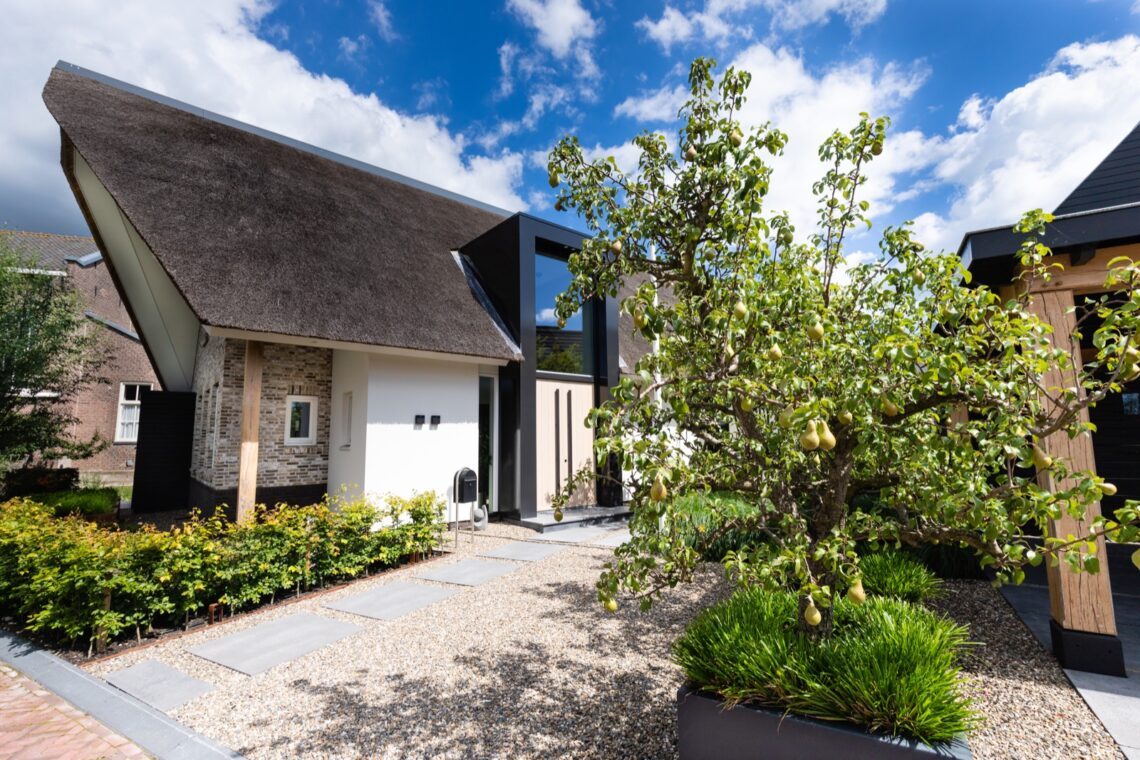
From the gravel path to the house, the garden opens in layers: lawn, terrace, meadow planting, and the tree line beyond. The rural home sits in a wooded setting with large windows facing outward, so the outdoor rooms are visible from inside as much as they are used outside. In this woodland garden with terraces, the route, the surfaces, and the planting all pull the eye deeper into the plot rather than closing it off.
A house that looks out onto the garden
The plan keeps a generous amount of space around the dwelling. That openness is not only felt at ground level; it also reads through the glass, where the garden stays present from room to room. The house, the coach house, and the outdoor areas sit within the same wooded frame, with paths and planting guiding movement between them. The result is a rural home garden that does not rely on one central axis, but on a series of small shifts in level, texture, and view.
Close to the house, the terraces act as places to stop rather than pass through. One is paved in brick, another in poured concrete with a tinted finish. The difference in material gives each area its own pace. At the edge of the terrace, the lawn begins almost immediately, and the boundary softens again where flowers and meadow planting take over. This is where the woodland garden terraces become part of daily use, not just part of the view.
Multiple terraces with different surfaces
The terrace paving project is built on contrast. Brickwork brings a denser, more patterned surface, while the concrete terrace sits flatter and calmer against the house. Both are large enough for sitting and dining, and both are placed close to the glass so that the outside space extends the living areas. A sloping gravel path leads you in, then the hard surfaces open out beside the building, giving the garden a clear sequence from arrival to pause.
Image-wise, the terraces do a lot of the work. In one view, a parasol marks an outdoor dining area; in another, wooden chairs and a long table sit on brick paving, with planting close by rather than pushed to the edge of the plot. The surfaces also connect to the lawn, so the transition from the house to the garden remains easy to read. That measured shift is what gives the woodland garden terraces their strength: each zone has a use, but none of them stands apart from the rest.
Places to sit, not just to pass by
Seating areas in the greenery are scattered through the garden, and they change the way the plot is experienced. There are lounge benches at the edge of the lawn, a dining table under the parasol, and quieter corners further into the planting. Each spot takes in a different part of the landscape. One looks back to the house, another toward the meadow, and another into the shade of the trees. The seating is modest in itself, but it gives the garden its pauses and makes the larger site feel usable in smaller pieces.
These seating areas in the greenery are placed where the planting does something specific. Near the house, the view stays open. Further out, shrubs and borders close in a little and the tree canopy begins to filter the light. The benches and tables are not isolated objects; they are part of a route through the outdoor space, with each stop framed by grass, flowers, or bark. That movement between exposure and enclosure is one of the clearest themes in the project.
Flower meadow and vegetable plot in the same garden
The flower meadow and vegetable plot sit alongside one another, but they do not compete for attention. The meadow brings movement and seasonal change, while the vegetable plot adds a more working rhythm to the garden. Around them, borders are planted with mixed flowering species that shift from one bloom period to the next. The text makes clear that a meadow like this is not accidental; it depends on the right mixtures and on knowing how plants behave across the seasons.
Perennials are woven through the planting, so the garden does not rely on a single peak. Instead, different species take turns. That approach keeps the woodland garden terraces connected to the rest of the site, because the areas nearest the house are echoed by fuller planting further away. In summer, the insects hover above the meadow. In other months, the borders hold the structure, especially where the grass meets the planted edges and the paths open between them.
Shade, berries, and autumn colour
In the shaded part of the garden, the planting changes character. Ferns and blueberries sit under the trees, joined by shrubs that pick up strong autumn colour. The shift is visible in the texture as much as in the palette: finer foliage near the ground, denser branches above, and the deeper shadow of mature trees around them. This is the quieter side of the rural home garden, where the light filters differently and the planting takes on a more woodland rhythm.
Fruit trees in the garden add another layer to that sequence. They appear among the other planted zones rather than being isolated in a separate orchard-like corner. The effect is a garden that moves from open terrace to meadow, then into shade and fruiting plants without a hard break. Even the sitting places follow that logic. A bench under an old oak can look out across the meadow, while another spot feels tucked into the trees. The garden invites longer pauses because each part offers a different amount of light and enclosure.
A garden shaped by views and routes
What ties the whole plan together is not one single gesture, but the way the spaces line up. From the house, the lawn reads as a broad middle ground, then the meadow and tree belt beyond. From the path, the terraces appear as clear landings beside the building. From a seat in the shade, the garden opens back toward the brighter parts of the site. The woodland garden terraces, the flower meadow and vegetable plot, and the seating areas in the greenery all depend on those sightlines.
That layered arrangement gives the plot a measured pace. A guest arrives by gravel, steps onto brick or concrete, and then moves toward planting, shade, or open lawn. The materials remain simple, but they are placed with enough separation to let each garden room speak on its own. What stays with you is the sequence: house, terrace, meadow, shade, fruit trees. In a wooded setting like this, that sequence does more than connect spaces. It gives the whole garden its shape.
Want to see more of Groenregie, your translator of garden wishes? View the page of Groenregie, your translator of garden wishes for even more great projects and company information.




NEW 2026 Jubileum Edition The Best Interior Designers Benelux
Order Now €125


NEW 2026 Jubileum Edition The Best Interior Designers Benelux
Order Now €125


