







Woven daybed with all weather look
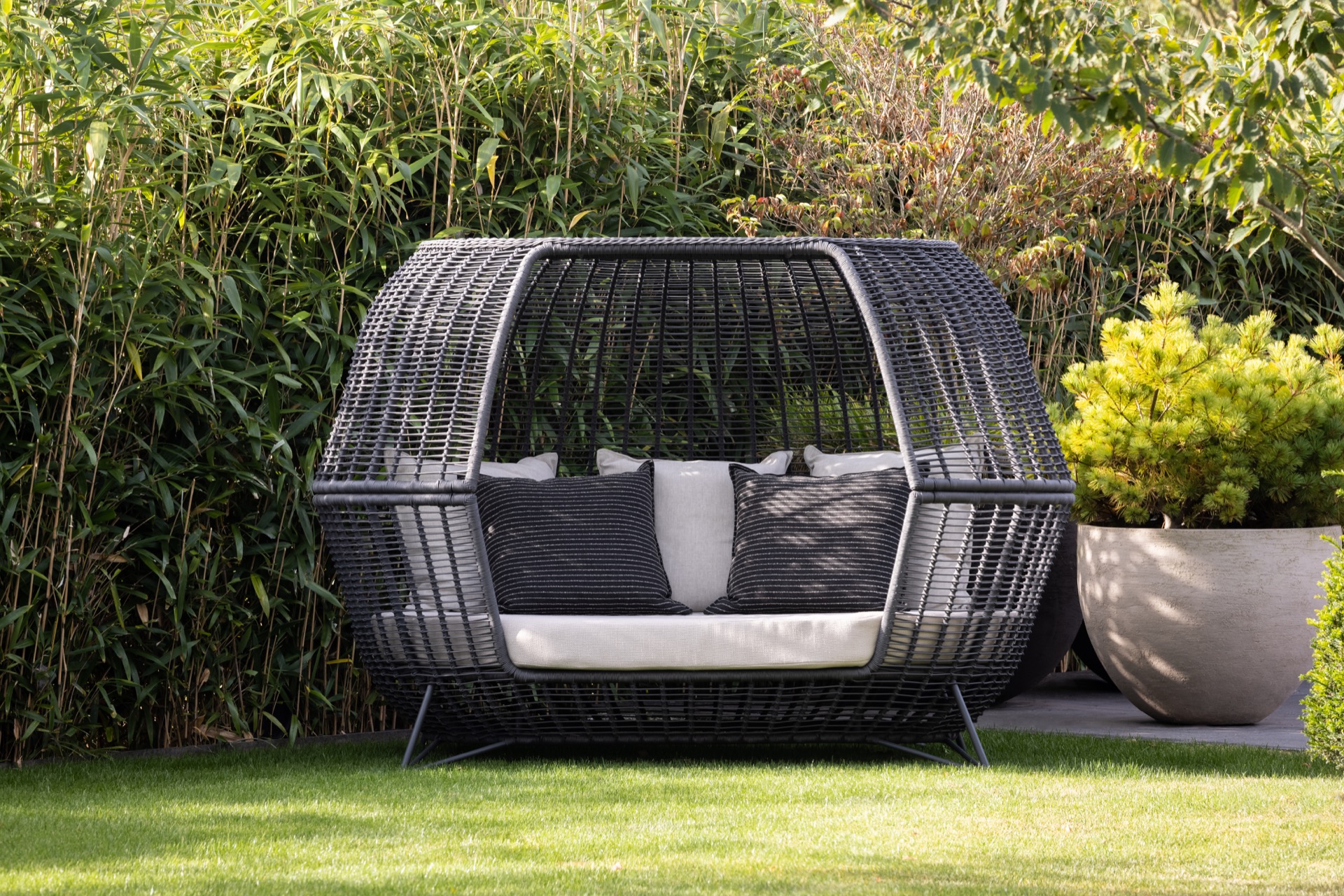
The woven daybed sits low and open, with a round profile that reads clearly against the straight lines of the terrace and the clipped garden behind it. Dark rope pulls the frame into a tight pattern, while the aluminium structure keeps the form crisp. Light cushions soften the surface without hiding the weave, and the dune-coloured seat cushion gives the piece a quiet centre. In this setting, the woven daybed feels made for long pauses beside water, gravel, or a sheltered patch of green.
Rope, frame and the shape of the seat
Seen up close, the rope daybed is all about tension between line and curve. The dark grey rope wraps the frame in a regular rhythm, leaving small openings that catch the light. A sturdy aluminium frame daybed underpins the woven shell, so the circular outline stays firm instead of collapsing into something soft or loose. The height of the back and sides gives the seat a protected shape, but the open weave keeps it visually light on the terrace.
The material mix is limited and deliberate. Aluminium, rope and fabric do the work here, each one visible in the images. The rope is not hidden under upholstery; it stays on show and draws attention to the hand-finished look of the piece. That detail gives the luxury outdoor daybed its character without resorting to ornament. Even the cushion edges are straight and measured, which makes the round form read more clearly from a distance.
Light cushions against dark weaving
The cushion in dune colour changes the tone of the whole piece. Against the dark rope, it looks pale and dry, almost like sand set into the frame. Additional darker accent cushions sharpen the contrast and keep the seat from turning visually flat. In the close-up images, the textile surfaces sit neatly inside the woven rim, so the eye moves from texture to texture: rope, cloth, then the smooth line of the aluminium edge.
Placed as a garden daybed, not just a product
The garden setting matters as much as the seat itself. The daybed stands on a paved surface near trimmed planting, where gravel paths and lawn edges give the scene a measured order. Brick and stone appear in the background, grounding the furniture in a lived outdoor room rather than a decorative display. That context helps the garden daybed read as part of a broader outdoor arrangement, one that can hold a chair, a dining table, or a pause in the shade.
From different angles, the woven daybed shifts between object and place. In one view it is cropped tight, showing only the rope shell and the curved arm line. In another, it sits farther back among greenery, where the round shape becomes easier to read against the rectangular paving. The result is a furniture piece that works as a focal point without demanding the scene around it be emptied out. It holds its own beside a path, a planter or a wall.
An outdoor lounge daybed with a clear profile
The round form gives the outdoor lounge daybed a stronger presence than a standard bench or sun lounger. It creates a defined seat, one that reads almost like a small room made from rope and fabric. The high rim frames the cushions and gives the piece a contained silhouette. In the images, that profile is what stands out first: a circular outline, a dark woven skin and a pale seat surface that catches light across the middle.
Because the construction stays visually open, the piece never looks heavy. Air moves through the weave, and the dark rope pattern breaks the mass into a series of small lines. That openness suits the formal garden around it, where straight paths and trimmed planting already set a restrained rhythm. The woven daybed answers that order with its own geometry, but in a softer, more tactile language.
All weather use with a restrained material palette
The source describes the piece as all weather, and that reading matches the material set shown here. An all weather outdoor daybed needs surfaces that can sit confidently outside, and the combination of aluminium and rope gives the frame that practical base. Nothing about the design is overstated. Instead of visible mechanisms or bulky joints, the construction is kept clean and legible, which suits a piece intended for daily outdoor use through changing conditions.
What makes the luxury outdoor daybed work is not excess detail but control of proportion. The width of the ring, the depth of the cushion and the height of the woven back are all tuned to each other. That makes the seat look settled on the terrace without becoming bulky. It also explains why the same object reads well in different images: close-up, in the garden, or from a wider angle that includes paving, planting and nearby outdoor furniture.
How the setting broadens the story
Other images show the daybed alongside a long outdoor table and multiple chairs, which shifts the project from a single-seat study to part of a larger outdoor living area. The table is simple and straight, the chairs are arranged in a clear line, and the surrounding garden keeps the composition calm. In another frame, rust-toned arching steel elements cross a courtyard-like space with brick walls and a sequence of openings, adding a stronger architectural note to the same outdoor language.
That wider context gives the woven daybed a second role. It is not only a place to recline; it also anchors the visual rhythm of the garden. The rope daybed, the long table, the paved paths and the clipped edges all speak the same material vocabulary, even when they serve different uses. The page therefore reads less like a product sheet and more like a study of how an outdoor seat can sit within a composed landscape.
Why the woven daybed reads so clearly in the images
The strongest close-ups focus on texture. Rope crossings, rounded corners and the smooth line of the aluminium frame are shown without distraction, so the shape is easy to understand at a glance. That clarity carries into the wider garden shots, where the daybed keeps its identity even when surrounded by paving, planting and nearby structures. The open weave, the dune cushion and the dark framing together give the piece a defined look that holds up in both detail and distance.
As a garden daybed, it sits between lounging furniture and sculptural object. The form is practical enough for outdoor use, yet the woven shell gives it a more measured presence than a standard recliner. In the final images, that presence is exactly what stands out: a round, rope-wrapped seat with a pale cushion, placed where architecture, paving and planting can frame it without overpowering it.
Want to see more of Borek parasols | outdoor furniture? View the page of Borek parasols | outdoor furniture for even more great projects and company information.





NEW 2026 Jubileum Edition The Best Interior Designers Benelux
Order Now €125