






Concrete garden path in a modern villa garden
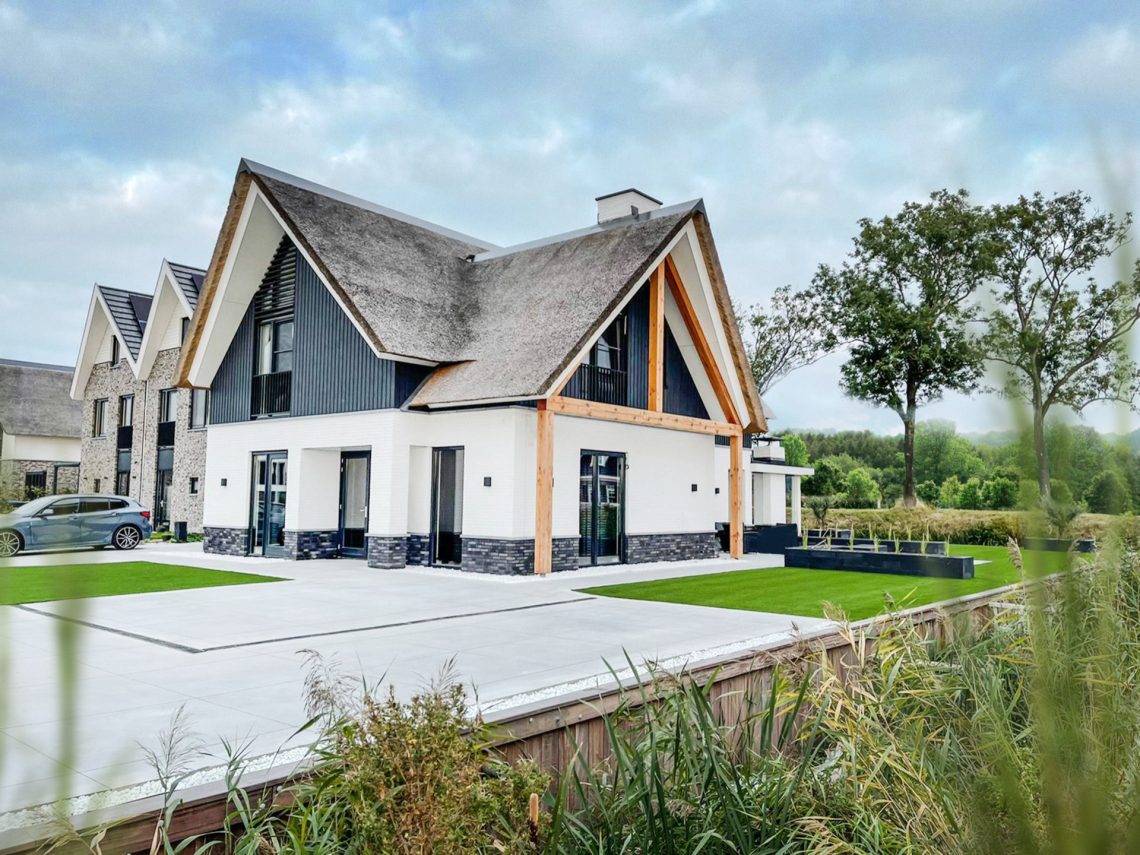
A concrete garden path draws the eye before anything else. It runs through gravel and grass with a measured line, then meets the house in a way that makes the route from outside to inside feel direct and readable. In this modern villa setting, the concrete does more than connect points on a plan. It sets up the whole outdoor composition, from the broad terrace-like surfaces to the smaller steps and edges that sit close to the planting.
The path as the main line through the garden
The concrete garden path works like a guide line across the site. Its pale grey surface contrasts with the darker gravel around it and the green edge of the lawn. The slabs and stepped levels visible in the garden keep the route low and calm, while the straight runs prevent the scene from becoming busy. What stands out is the way the path remains visually clear even when it bends or breaks into separate elements, giving the garden a strong structure without adding ornament.
From one angle, the concrete reads as a terrace; from another, it becomes a walkway that pulls the garden toward the house. That shift is part of the appeal. The surface does not try to hide itself. It is present as a material and as a shape, with clean concrete edges that sharpen the boundary between paved area, gravel fill, and planting. The result is a sequence of zones rather than a single flat expanse, which gives the outdoor space a more deliberate rhythm.
Clean edges between concrete, gravel, and grass
Along the sides of the path, the concrete to gravel transition is one of the most visible details. Gravel loosens the edge of the composition, while the concrete keeps the layout precise. Grass meets both materials in narrow strips, softening the hard line without taking away its clarity. The contrast is simple, but it does a lot of work: it shows where people can move, where the garden can breathe, and where the outdoor surfaces are meant to stop.
Close up, the material has a matte finish with a light texture that catches daylight without shine. That surface quality suits the restrained geometry of the garden. It also makes the stepped elements feel grounded rather than decorative. The clean concrete edges appear intentionally set against the more irregular texture of the gravel, and that difference is what gives the project its visual tension. Nothing has been overworked; the language of the materials stays direct and legible.
A concrete terrace that extends the route
The concrete terrace sits within the same visual language as the path. It shares the same grey tone, the same sharp boundaries, and the same low profile, so the garden reads as one continuous outdoor sequence even when the surfaces change function. The terrace is not separated from the path by a dramatic step or a heavy frame. Instead, it seems to extend the movement of the route and widen it where needed, which keeps attention on the lines rather than on the transition.
Seen against the house, the terrace also takes on a quieter role. Large glass surfaces and black frames open the interior toward the outside, and the concrete sits in front of them as a measured foreground. The rietgedekte dakrand adds a different texture above, but the strongest impression still comes from the ground plane. Concrete, gravel, and glass each hold their own place, yet the whole scene remains focused on how the garden is organized around that concrete garden path.
Modern villa exterior framed by glass and thatch
The modern villa exterior gives the path its context. Large windows reflect the garden and expose the interior edge, so the outdoor paving is not seen in isolation. Black frames cut the openings into neat rectangles, and the thatched roof edge softens the upper line of the building. Against that backdrop, the concrete terrace and walkway feel even more grounded. They hold the lower part of the composition together and keep the eye moving horizontally across the site.
There is a clear contrast between the natural roof material, the dark joinery, and the concrete at ground level. Brick appears in parts of the building envelope, but it is the concrete that carries the route outside. The material choice is restrained rather than decorative. It leaves space for the garden to show through, especially where the lawn meets the paving and where the gravel breaks the hard surface into smaller fields. The scene depends on those edges as much as on the broader shapes.
Stepped levels and a matte surface in close view
The stepped concrete elements visible in the garden add depth without becoming dominant. Their low rise and rectangular outline give the composition a measured cadence, almost like a series of pauses in the route. In the close-up views, the surface appears lightly structured and matte, with enough variation to keep it from looking flat. That subtle texture is important because it lets the light sit on the material instead of sliding across it too quickly.
These details also make the garden feel more tactile. A concrete garden path can be read as a simple circulation line, but here the finish and the level changes turn it into part of the overall setting. The path, the terrace, and the adjacent gravel zone all share the same visual discipline, yet each one behaves differently under the light. That difference keeps the outdoor space from feeling static. It changes as you move around it, which is exactly what gives the project its strength.
Materials that keep the composition grounded
Concrete is the main material, but it does not work alone. Gravel gives the path a looser border, grass softens the perimeter, and the roof edge in thatch adds a natural counterpoint above. Together they keep the garden from becoming too rigid. The concrete garden path remains the clearest line in the scene, but it is the surrounding material contrast that allows it to stand out. Without the gravel and planting, the paving would read as a flat surface. With them, it becomes a shaped part of the garden.
That is where the project earns its presence. The concrete is used as both route and frame, as a terrace and as a line of movement. Clean concrete edges define the boundary, while the concrete to gravel transition keeps the composition precise and readable. In a modern villa garden like this, the strongest moments are often the quietest ones: a narrow strip of grass, a sharp line against gravel, a matte slab catching soft daylight. Here, those details carry the entire scene.
Want to see more of RoKeGa Exclusive Floors? View the page of RoKeGa Exclusive Floors for even more great projects and company information.