







Floating steps in a modern garden
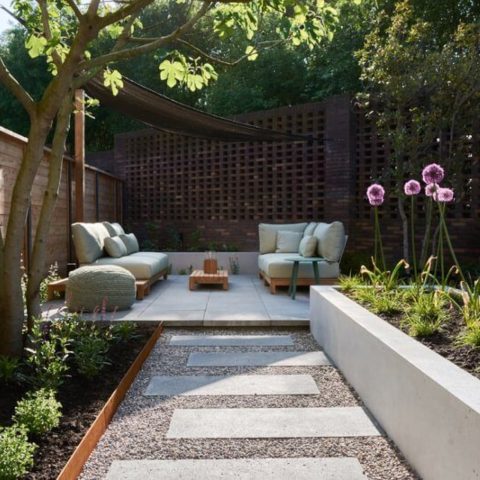
The level change is the first thing you read in this garden. Two terraces sit apart, with a clear drop between them, and the route from one to the other is handled by floating steps garden construction that keeps the movement open rather than heavy. Grey paving sets the tone at both levels, while planting beds along the edges soften the straight lines and bring the eye back to the surfaces.
Two terraces, linked by a visible step in the ground
The project turns a garden level change into the main spatial move. Instead of trying to hide the difference in height, the layout uses it to create layered terraces with distinct zones. From one level, you see the other terrace above or below it, which gives the garden a strong sectional quality. The floating steps garden element sits right in that gap, acting as the connector between the platforms without closing the space underneath.
That open underside gives the steps a lighter profile. The treads appear to hover between the terraces, and the dark concrete edging beneath them reinforces the clean cut of the structure. Around that hard edge, planting beds along the edges introduce a looser line of leaves and stems, so the transition between paving and greenery feels measured rather than abrupt.
Grey paving and layered terraces in one composition
The paving does more than cover the ground. Different sizes and shades of grey create a surface that changes subtly as you move through the garden. Some areas read as broad plates, others as smaller segments that break up the expanse and keep the terrace from feeling flat. The result is a modern layered garden in which the paving shifts between calm planes and sharper joints.
Close up, the material has a granular texture and clear joint lines. Those details matter because they keep the large paved areas from becoming visually dull. The grey paving also carries through the steps, so the connection between the levels feels like part of one system rather than a separate insert. In the wider view, the repetition of tone ties the two terraces together while the changing formats prevent monotony.
What the step detail does
The floating steps do not just bridge the height difference; they shape how the garden is read. Because the structure sits lightly between the terraces, the eye moves across the open space beneath it before landing on the next level. That pause makes the change in height more legible. It also gives the planting room to press in around the hard edges, which keeps the step line from becoming too rigid.
Planting beds along the edges frame the hardscape
Vegetation is concentrated where the hard surfaces need relief. Planting beds along the edges run beside the paving and around the steps, so the garden does not rely on broad lawn areas to feel full. The green shapes are dense enough to interrupt the straight run of the terrace, yet they stay low enough to leave the level change visible. This makes the planting part of the composition, not a backdrop.
The contrast between the soft planting and the concrete edges is strongest at the corners of the terraces, where the beds tuck into the geometry of the paving. Leaves spill slightly over the borders, but the lines remain controlled. In a modern layered garden like this, that is what keeps the spaces readable: the surfaces stay clear, while the planting brings movement at the perimeter.
Dark concrete edging and a wood fence garden backdrop
Dark concrete edging defines the steps and the terrace edges with a heavier line than the paving itself. It gives the garden a grounded base, especially where the height change is most visible. Behind that, the wood fence garden backdrop adds a quieter horizontal rhythm. The timber boards run across the rear boundary and keep the composition from feeling too hard, even when the paving and retaining elements dominate the foreground.
The fence is not treated as a separate feature. It sits in the background, where its horizontal boards echo the long lines of the terraces. That repetition helps the whole scene hold together without drawing attention away from the steps. Seen with the planting beds and grey paving, it closes the garden in a way that still leaves the levels and their connections clearly in view.
A garden that is read in layers
What stays with you is the way the garden is organised vertically. The two terraces, the floating steps garden connection, the grey paving and the planted edges all work with the same height difference instead of flattening it out. As a result, the garden feels composed in layers: first the foreground surface, then the step, then the upper or lower terrace, and finally the timber boundary behind it. It is a restrained arrangement, but one with clear movement through the space.
The strongest details are also the simplest ones: the open space beneath the steps, the varied paving formats, the dark edges that hold the levels in place, and the planting that breaks the outline along the perimeter. Together they turn a difficult garden level change into a legible sequence of terraces. The project shows how a floating steps garden can do its best work when the materials stay quiet and the structure carries the scene.
Want to see more of Schellevis? View the page of Schellevis for even more great projects and company information.




NEW 2026 Jubileum Edition The Best Interior Designers Benelux
Order Now €125


NEW 2026 Jubileum Edition The Best Interior Designers Benelux
Order Now €125