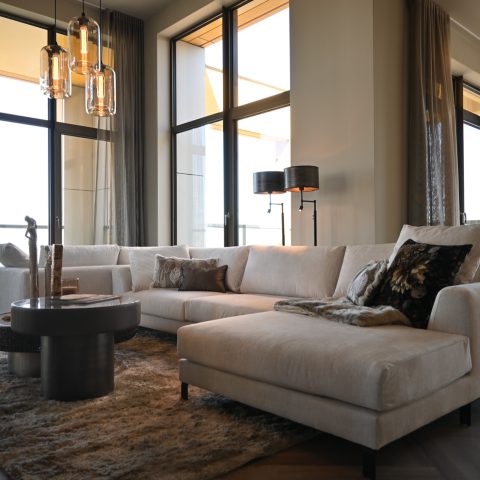








A formal garden with romantic, contemporary touches
A clipped lawn, a pond set close to the house and a path of small pavers in herringbone pattern set the tone at once. The layout is formal, but the planting does not stay rigid for long. Green masses rise and fall around the edges, and the older trees remain in place as quiet markers of time. Their trunks give the garden weight, while denser planting screens less attractive parts of the plot from view.
Pond and stepping stones near the house
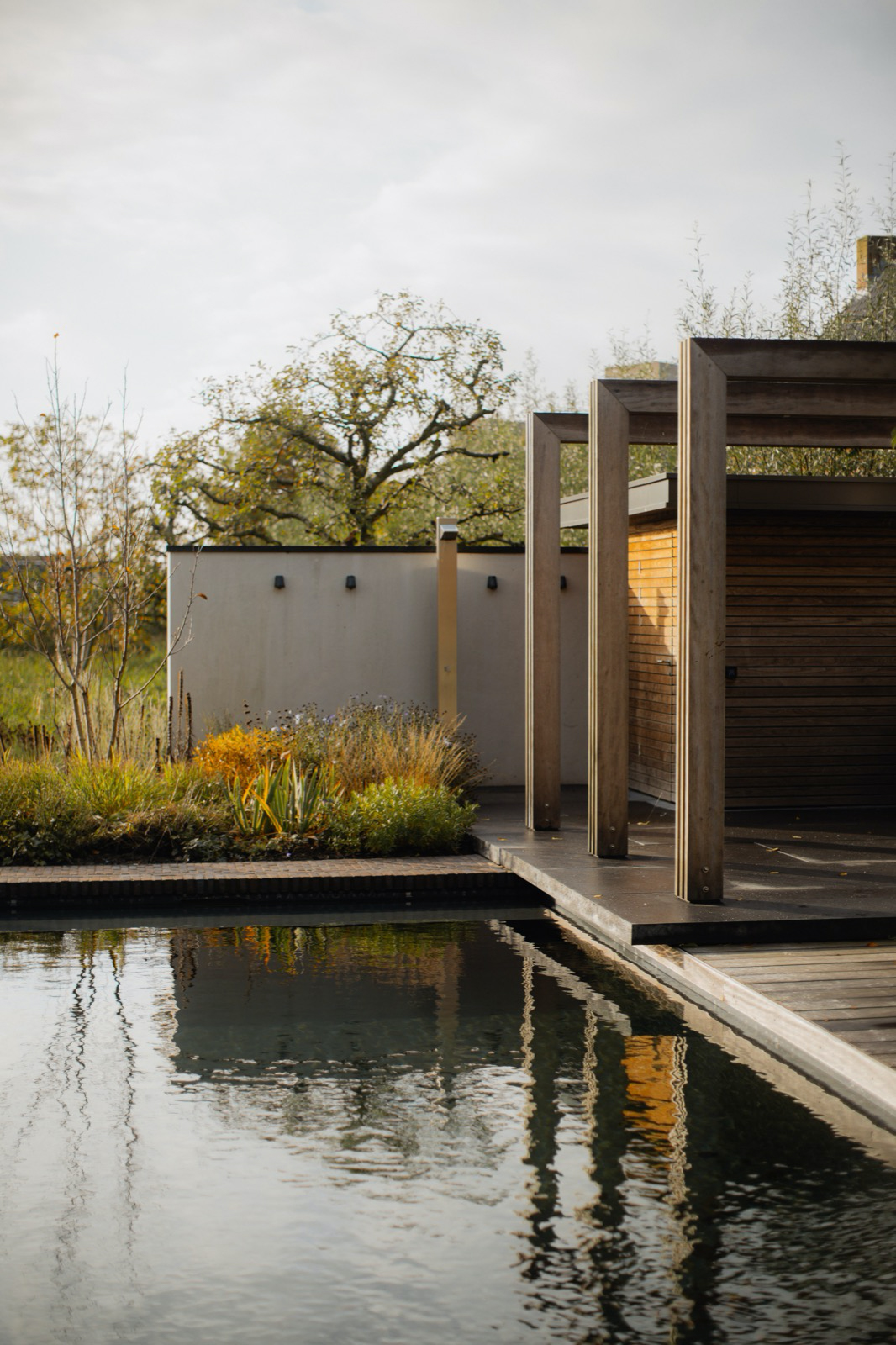
The pond sits close enough to the house to catch the eye from inside, where the water surface reflects light and movement. Stepping stones cross the pond in measured intervals, turning a simple view into a route. The gesture is restrained, yet it changes how the garden is read: the water becomes both focal point and passage. In the image set, the pond edge is kept crisp, with stone borders and planted layers holding the composition together.
This is where the formal garden with pond shows its clearest line. Rather than pushing water to the far end of the plot, the design brings it forward. That decision gives the garden a stronger center and pulls the surrounding borders into relation with it. The result is not decorative in a loose sense; it is structured, with each edge, reflection and stone crossing doing a specific job.
A pergola terrace framed by planting
A pergola terrace offers a second pause point. Seating sits beneath the overhead frame, and climbing roses are allowed to work across the structure. The terrace is not isolated from the rest of the garden. It is set against planting that softens the transition between paved ground and lawn, so the move from house to garden feels gradual rather than abrupt. Wood, masonry and foliage each hold their place without competing for attention.
Seen from different angles, the pergola terrace also helps anchor the layout. It marks one of the clearest places to sit, but it does so within a larger rhythm of path, water and planting. The formal garden with pond uses this shift carefully: a hard surface underfoot, then a planted edge, then the open reflection of the water. That sequence gives the garden a pace the eye can follow.
Material shifts that stay visible
The pavers in herringbone pattern are a small detail, yet they carry the circulation through the garden with clarity. Their repeated angle creates direction, especially where the path runs between beds and toward the rear of the plot. The pattern also contrasts with the flat lawn and the softer movement of mixed planting. It is one of those elements that looks simple at first and then reveals how much of the garden depends on it.
Along those routes, structured garden borders keep the planting from spreading loosely. Low growth sits beside taller forms, and the changes in height are easy to read. That contrast matters here. It tempers the strictness of the plan without dissolving it. The borders hold color, texture and seasonal variation in a defined line, which helps the whole garden stay legible from the house and from the terrace.
Old trees, new layers
The retained mature trees are not treated as background only. They stand as part of the garden’s identity, and the planting around them is arranged to respect their presence. Their canopies add depth above the borders, while the lower layers stay busy with mixed planting and ornamental grasses. In the photos, grasses lean into the light and break up the heavier forms beside them, creating small shifts in density across the borders.
There is also a play area with old fruit trees, which extends the garden’s layered character into a more open zone. This part of the plot uses the same idea of contrast, but with a looser touch. Tall and low planting alternate, and the space opens and closes as you move through it. That rhythm keeps the formal garden with pond from feeling sealed off. It allows the eye to move from the pond, across the lawn, and toward the deeper planting at the back.
View, shelter and screened edges
Strategic planting does more than fill space. It screens the garage and other less attractive elements, and that makes the garden read more clearly from the main viewpoints. Dense greenery is placed where it has a job to do, while more open zones are kept near the lawn and terrace. The effect is subtle but direct: you notice the pond, the path and the seating first, not the service parts behind them.
Across the project, the mix of low and high planting, together with the mature trees, keeps the scene varied through the seasons. The garden never relies on one gesture alone. Water, path, terrace and border each take their place in relation to the others. That is what gives the formal garden with pond its shape: a clear plan, softened by layers of planting, with enough openness for the stepping stones, the lawn and the pergola terrace to stay visually connected.
From the house, the route is easy to read. The herringbone path leads the way, the pond sits within sight, and the seating areas are placed where the garden can be watched rather than passed through quickly. Even the most restrained parts of the design carry texture: stone edges, clipped lawn lines, rose growth along the pergola, and the repeated forms of grasses in the borders. Together they keep the garden steady, but never static.
What remains after a first look is a sequence of clear moments rather than one broad gesture. Water near the house, a terrace under a pergola, mature trees held in place, and planting that shifts from low to high across the borders. The project’s strength lies in that ordering. Each part can be read on its own, yet the garden only settles into focus when those parts are seen together.
Want to see more of Peter van der Velden Exclusieve Buitenruimtes? View the page of Peter van der Velden Exclusieve Buitenruimtes for even more great projects and company information.




NEW 2026 Jubileum Edition The Best Interior Designers Benelux
Order Now €125


NEW 2026 Jubileum Edition The Best Interior Designers Benelux
Order Now €125


NEW 2026 Jubileum Edition The Best Interior Designers Benelux
Order Now €125


NEW 2026 Jubileum Edition The Best Interior Designers Benelux
Order Now €125