








Frosted glass island kitchen with black aluminium frame details
Light catches the frosted glass fronts first. Their platin metallic tone sits inside black aluminium frame details, and the contrast gives the room a clear, measured rhythm. On the island, the cooktop zone is set into a 2 cm Calacatta Gold composite top, where the pale surface and fine gold veining run against black plinths and a dark side panel. The result is restrained, but not flat: every line seems to have been drawn to show where one material ends and the next begins.
Where the island becomes the centre
The island cooktop zone anchors the kitchen. Its light composite surface extends across the working area, while the darker edge treatment keeps the block visually grounded. Around it, the black corpus, plinths and the Quooker create a low, continuous line that holds the island together. The framing around the frosted fronts makes the units read more like a sequence of panels than a single run of cupboards, which suits the calm geometry of the room.
Seen from across the space, the island works as both preparation surface and visual pause. The top is thin enough to feel precise, yet the Calacatta Gold pattern is still visible from a distance. That small grain of movement in the composite softens the stronger black elements without turning the kitchen pale or glossy. It keeps the centre of the room active, especially where the cooktop sits flush within the island.
Wall cabinets with clear lines and hidden volume
Along the wall, the cabinetry is arranged as a broad set of large surfaces rather than a busy composition. The frosted glass fronts in Platin Metallic carry the same framed look as the island, so the wall run reads as a continuation of the same language. Tall cabinet volumes stand behind the working zone, and the integrated oven is tucked into one of the modules, leaving the outer surfaces visually quiet. The black side of the tall cabinet pushes the whole composition into sharper relief.
Black aluminium frame details in close view
The black aluminium frame details do more than outline the fronts. They set a narrow border around each panel, which makes the metallic glass look even more defined. In close-up, the fronts appear smooth and slightly reflective, but never mirror-like. The frames interrupt the surface just enough to show the cabinet structure underneath. That small shift in depth is what keeps the kitchen from becoming one continuous sheen of colour.
The same dark vocabulary returns in the corpus and plinths, where the black finish pulls the units back toward the floor. It also appears in the side of the tall cabinet and around the Quooker, so the eye keeps moving between matte, glass and metal. Nothing is overworked. The room depends on these repeated lines, and that repetition is what gives the kitchen its discipline.
Calacatta Gold on the working surface
The 2 cm Calacatta Gold composite top is the lightest element in the kitchen, but it is not plain white. Its warm marble-look surface carries a fine golden vein that becomes more visible where daylight lands near the edge. That slight movement is enough to break up the larger dark blocks beneath it. In the photographs, the top reads as a practical work surface first, then as a visual counterweight to the black framing and cabinetry.
Because the top is composed as a slim slab, it sharpens the profile of the island and the wall run. The kitchen feels drawn rather than built up. Even the transitions stay tight: black below, pale stone-look above, frosted glass in between. This is where the frosted glass island kitchen gains its strongest contrast, not from a single statement piece, but from the way each surface keeps its own edge.
A soft green back panel changes the tone
Behind the main working area, the soft green back panel shifts the mood of the room without taking attention away from the fronts and worktop. The colour sits quietly behind the pale composite and the dark frames, and that distance matters. It gives the kitchen a cooler note than the Calacatta Gold, while also softening the hard line of the cabinetry. In the images, the green reads best where light falls across the wall and catches the matte finish.
The back panel is one of the few places where colour is allowed to speak more openly. It does so in a restrained way, which keeps the whole kitchen from becoming too stark. With the black aluminium frame details in front and the frosted glass island kitchen elements around it, the green works as a background surface that lifts the scene rather than filling it with decoration.
Light, reflection and the edge of the room
Daylight reaching the worktop adds another layer to the surfaces. The pale composite picks up the light, while the frosted fronts hold it more softly and spread it across the cabinet faces. Ceiling spots and linear lighting above the island sharpen the geometry at night, tracing the island edge and the wall surfaces in a more direct way. The hanging lamps above the work area mark the centre of the room without crowding it.
Large windows in the background bring in a wider, calmer light that lets the materials stay readable. You can see the difference between the matte glass, the black framing and the polished sheen of the worktop more clearly under natural light. That makes the frosted glass island kitchen feel exact in its details, but not sterile. The room is built on contrasts that remain easy to follow: dark and light, smooth and framed, open surface and enclosed volume.
What stays visible when the appliances are built in
Integrated appliances keep the wall run compact, so the cabinet surfaces remain the main gesture. The oven is visible, but it sits inside the larger plane of the tall units rather than interrupting them. That decision keeps the eye on the proportions of the cabinetry, the vertical break of the tall module and the horizontal line of the worktop. Around those lines, the black plinths and the side of the tall cabinet keep the composition low and grounded.
This kitchen does not rely on excess detailing. It uses surface, frame and colour to set the pace. The frosted glass island kitchen format gives the room its structure, while the platin metallic fronts, black aluminium frame details and soft green back panel define its character. The materials are few, but each one has a clear role, from the island cooktop zone to the slim composite top that draws the whole scheme into focus.
Designed by Henning Reineke. Photography by Franz Frieling.
Suppliers / materials mentioned in the source: next125, Prantil, Siemens, Quooker, Blanco, Bora, Naber.
Want to see more of DJS Hekwerken? View the page of DJS Hekwerken for even more great projects and company information.



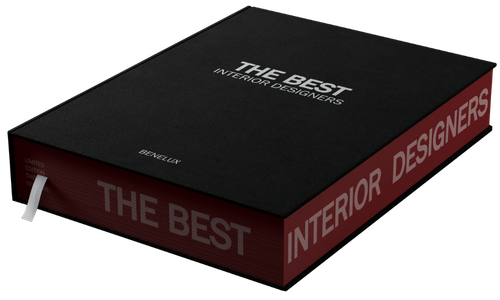
NEW 2026 Jubileum Edition The Best Interior Designers Benelux
Order Now €125