







Luxury minimal bathroom
Matte white surfaces set the tone at once, but the room is never only white. Dark wall panels, a deep mirror surface and the grain of the wood console cut across the lighter plaster, giving the luxury minimal bathroom its strongest lines. Daylight comes in through large windows and lands on stone-look flooring, where the pale surface picks up every shift in tone. The result is quiet, but not flat.
Matte white and dark contrast across the room
The palette works through contrast rather than decoration. A lime plaster wall softens the background with a matte, hand-finished look, while darker sections around the basin zone and mirror pull the eye inward. In some views the white sink fittings stand out sharply against the wall; in others, the darker console and surround take over. That push and pull gives the bathroom a defined structure without filling it with extra elements.
The stone-look floor keeps the composition grounded. It sits between the light wall finish and the darker furniture pieces, so the room reads in layers instead of blocks. Warm wood appears as a console and lower cabinet line, breaking up the cooler greys and black accents. The surfaces are restrained, but each material has a clear role in the way the room is read from one angle to the next.
Vessel sink details in close view
The basin area is built around a vessel sink, and the photos make that choice visible from several angles. One rounded bowl sits dark against a lighter wall; another reads as a stone-look form beside a slim white tap. The profile is simple, but the curves change the rhythm of the whole vanity wall. Straight edges frame the composition, while the bowl sink brings a softer shape to the centre.
Tap details are part of the story here. A white arched mixer rises cleanly over the basin in one image, while another view shows a wall-mounted fitting with a long, slender spout and round rosettes. These pieces do not compete with the room; they sit with the same quiet precision as the plaster and the console. Even in close-up, the effect depends on restraint rather than ornament.
Wood vanity console and the dark mirror niche
The wood vanity console adds a warmer note without shifting the room away from its minimal base. In one composition, the lower paneling is almost architectural, with a strong horizontal line under the basin. In another, the console runs beneath a dark mirror niche that is built into the wall, making the basin zone feel more layered than a standard run of cabinetry. The combination of dark surfaces and timber gives the wall depth.
That mirror or niche element appears repeatedly and does important work. It breaks the wall plane, catches light differently from the plaster around it and gives the basin a clear focal point. When the darker surface sits beside the lighter wall, the dark light contrast bathroom becomes more than a colour idea; it becomes a spatial device. The room uses shadow, reflection and flat planes to keep the composition controlled.
Freestanding bathtub under beams and windows
At the bathing end, the room opens out. A freestanding bathtub stands away from the wall, shown both as a dark rounded tub and as a lighter white unit with a standing bath-shower set. The bath is placed under architectural beams and near a window line, so the shape is read against structure rather than decoration. This is where the room feels most spacious, with empty floor space around the tub and daylight moving across the surfaces.
The bath area does not repeat the basin setup. Instead of cabinetry and taps set close to a wall, the tub is given room to breathe. The nearby wooden structure and the window frame create a clear upper line in the composition, while the floor remains calm and open beneath. That contrast between a solid, rounded tub and the linear ceiling elements gives the area its own pace.
Natural light and the way it lands on the finishes
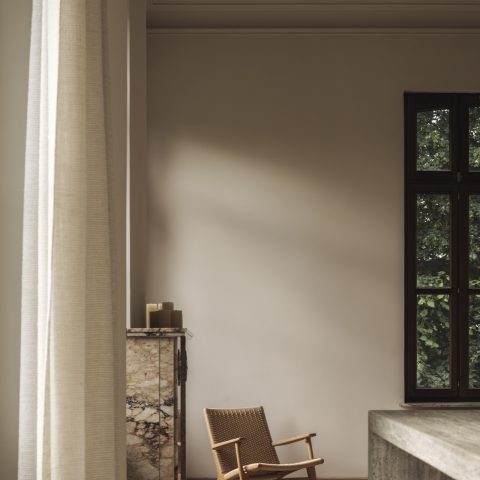
Large windows do more than brighten the room. They reveal the texture of the lime plaster wall, pick out the subtle sheen of the stone-look flooring and sharpen the edges of the basin furniture. In one view, the window frames sit close to the console, making the daylight feel almost architectural. In another, a shaped arched window softens the geometry of the room without breaking the clean layout. Light here is part of the material palette.
The same applies to the darker elements. A black or deep-toned mirror surface can look almost flat in one angle, then catch a faint reflection from the window in the next. The room depends on that shift. Because the surfaces stay simple, the changing daylight becomes visible on them. That is what gives the project its calm movement: not decoration, but reflection, edge and shadow.
Seen as a whole, the luxury minimal bathroom is built from a few exact moves: matte white surfaces, a lime plaster wall, a wood vanity console, a vessel sink and a freestanding bathtub placed in open view. Nothing is overworked. The bathroom holds together through proportion, surface and contrast, with each detail taking a clear position in the room. It reads as an interior where materials are allowed to stay visible and the light does the rest.
Want to see more of VOLA? View the page of VOLA for even more great projects and company information.




NEW 2026 Jubileum Edition The Best Interior Designers Benelux
Order Now €125


NEW 2026 Jubileum Edition The Best Interior Designers Benelux
Order Now €125