








Modern garden with natural planting
A straight line of stone paving meets soft planting at the edge of the water. That shift sets the tone for this modern garden: crisp geometry close to the house, looser shapes farther out, and a reflective pond running through the composition. The result is not a garden that tries to hide its structure. It shows it, then lets evergreen planting and grasses break up the hard edges.
House and garden read as one composition
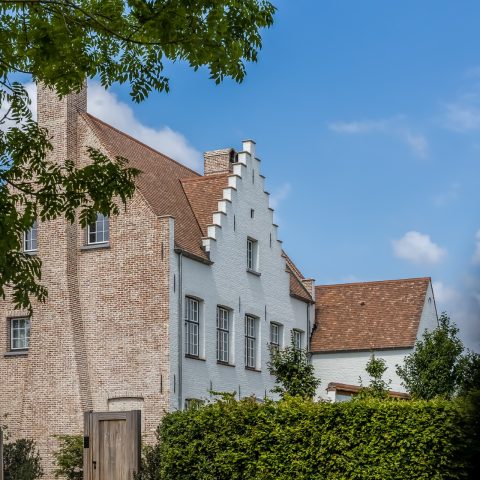
The villa provides the frame. Its rectilinear form, warm masonry tones and timber accents are echoed outside in the terraces, the path layout and the gate. This makes the modern garden feel tied to the architecture rather than placed around it. From the living room, the view runs past clipped Taxus blocks toward the trees beyond, so the garden does more than border the house. It pulls the eye outward in a controlled sequence, with every line reinforcing the next.
That same approach is visible at the poolhouse, which follows the style of the home. The repetition of materials and proportions keeps the garden legible from different angles. Stone, gravel and planting beds alternate without becoming busy. Even the entry feels measured: a gate in the same language as the house opens onto gravel and sculpted planting forms, so the first step inside already belongs to the rest of the layout.
Geometric planting blocks and gravel bands
Close up, the planting is shaped with a clear hand. Clipped evergreen masses sit in gravel, and the contrast between the pale mineral surface and the dark green foliage gives the garden its neat garden character. Taxus appears in several forms: blocks, mounds and cloud-like shapes that shift the eye from hard line to soft curve. The transition is deliberate. Square forms near the house give way to rounder silhouettes as the planting moves deeper into the site.
Carex grasses, Taxus balls and Allium spheres add another layer of rhythm. Their forms are smaller and more dispersed, which keeps the planting from reading as a single block. In the images, these rounded shapes sit against darker paving and gravel strips, so the garden keeps its order even where the planting becomes more playful. The visible result is a natural garden that still holds its edges.
Evergreen planting that keeps the structure in view
Evergreen planting carries the project through the seasons. Taxus is the main recurring plant, chosen here for its clipped profile and its ability to stay present when the rest of the planting softens. Laurier clouds, also shaped into broad, rolling volumes, extend that effect further into the garden. They do not erase the geometry. They temper it. From the terrace and the interior view, the garden remains readable because the planting keeps its outline even when it grows fuller.
This is where the modern garden becomes especially effective. It relies on repetition rather than spectacle. The same green masses appear in different scales: blocks, clouds, balls and low bands. That makes the planting feel considered without becoming rigid. The gravel between them does important work too. It leaves space around each form, so the shapes can be seen individually instead of blending into one continuous mass.
A pond that replaces the usual pool
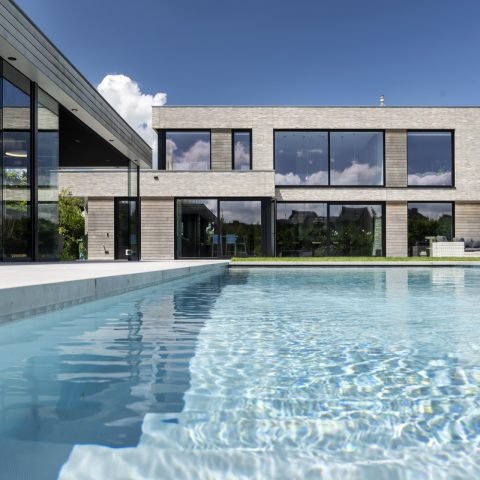
Water is treated as part of the landscape, not as an isolated feature. Instead of a standard swimming pool, the garden includes a pond-like water feature with a long, clean edge and a clear reflective surface. In the photographs, the water catches the villa and the evening light, so the project gains a second layer of architecture in the reflection. The pond also stretches the garden visually, making the space feel longer and quieter without adding decorative noise.
The same water edge links the terrace to the planting around it. Broad paving slabs lead up to the pond, while clipped shrubs and grass panels frame the perimeter. In daylight the surface is calm and precise; at dusk it becomes darker and mirrors the illuminated openings of the house. That change of mood is subtle, but it gives the garden with water feature a different presence after sunset.
The terrace, path and gate set the movement
Movement through the garden is guided by the hard surfaces. Wide stone slabs create the main terrace, and darker paving marks the approach routes near the house and gate. These bands are not only practical. They set up the sequence between arrival, pause and view. On one side, the driveway is laid in dark paving; on the other, gravel and planting soften the edge before the water starts. The garden never loses its structure because the ground plane keeps changing in clear steps.
At the gate, the composition opens with a sharper gesture. Taxus shapes rise from the gravel like a planted sculpture, and the effect is strongest where the surface is most spare. That contrast between open mineral ground and dense evergreen mass gives the entrance its own identity. Further along, Pennisetum grasses bring movement with their plumes, especially where wind catches them near the exit route. They are lighter than the clipped forms and make the departure point feel less fixed than the entrance.
Light, reflection and the evening garden
In the evening images, the garden changes without losing its clarity. Window light, small exterior lights and the reflection in the water make the surfaces easier to read. The stone paths appear darker, the planting blocks deeper in tone, and the pond becomes a mirror rather than a boundary. This is one of the strengths of the project: the layout works in daylight, but it also holds together after dark because the lines remain visible.
Seen together, the house, poolhouse, pond and planting form a garden that is carefully controlled but never cold. Warm masonry, timber details, gravel, clipped evergreens and grasses each have a visible role. Nothing is decorative for its own sake. The modern garden is strongest where the materials are plain and the planting is shaped with discipline, then loosened just enough to let the natural garden side of the project come through.
Details that stay visible from inside and out
From the living room, the clipped Taxus blocks create a long sightline toward the trees. Outside, the same sequence is broken into smaller moments: mounded shrubs, rounded topiary forms, grass tufts and the still water of the pond. That change in scale keeps the view active as you move through the site. It also explains why the project reads as a neat garden rather than a fully formal one. The structure is clear, but the planting is allowed to soften the transition between house and landscape.
The final impression comes from those repeated shifts: stone to gravel, block to cloud, terrace to water, house to planting. Each move is visible in the images and in the way the garden is composed. The project does not rely on a single feature. It works because the lines, the evergreen planting and the pond all support one another, giving the residence a modern garden that feels anchored, legible and quietly alive.
Want to see more of Heart for Gardens? View the page of Heart for Gardens for even more great projects and company information.




NEW 2026 Jubileum Edition The Best Interior Designers Benelux
Order Now €125


NEW 2026 Jubileum Edition The Best Interior Designers Benelux
Order Now €125