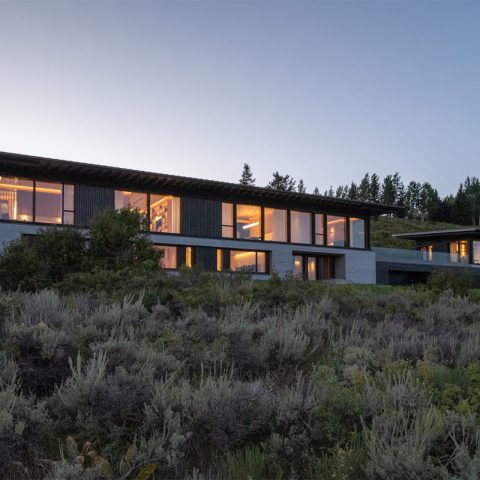








Modern residential lighting in a contemporary private residence
Dark panels set the tone before the light does. In the kitchen and adjoining living zones, linear runs pick out the edges of cabinetry and ceiling planes, while hanging fixtures mark the center of the room with a clearer, more vertical note. The result is modern residential lighting that reads as part of the architecture, not something added after the fact.
Light running along dark cabinetry
The strongest contrast comes from the black and deep-toned joinery. A slim light line follows the cabinet fronts and open edges, catching the gloss of glass doors and the stone-like work surfaces nearby. That restrained strip of illumination gives the dark cabinetry accent lighting its role: it separates one plane from another and makes the storage wall easier to read at a glance.
Several scenes show how the same approach shifts across the house. In one area, the light sits low and long against shelving and recessed openings. In another, it tucks into a profile and leaves the surface almost untouched. The effect is quiet, but never flat. Every edge, recess, and return gains a clearer outline through the light.
Recesses that hold the glow
Open niches and built-in compartments do more than store objects. Their hidden LED lines draw attention to depth, especially where the surrounding finishes stay dark or muted. This warm niche LED lighting turns a simple opening into a layered surface, with the back of the niche reading differently from the frame around it. The image of the open storage wall shows this especially well: light sits at the base of each compartment and keeps the voids from disappearing into shadow.
That same principle appears in the bathroom. There, the lighter stone-look surfaces meet a smaller amount of light, but the placement is exact. Aplis in-line 40 and aplis in-line 80 were used in that zone, and the arrangement keeps the room legible without making the fittings dominate the material palette.
Hanging fixtures that shape the room
Above the working surfaces, the composition changes from linear to suspended. A row of hanging fixtures, some with cylindrical light bodies, introduces a stricter rhythm over the long counter. They sit against pale walls and a darker cabinet run, so the lights become easy to read as objects in space. These linear hanging lights pull the eye across the room and give the central zone a measured, almost drawn quality.
The project text also refers to the oran pendant stones, suspended at different heights. Seen as a group, they work differently from the linear runs. Their staggered positions create movement in the room, and the spacing between them matters as much as the lamps themselves. Rather than forming a single cluster, they step through the air and keep the ceiling plane visually active.
Single and double forms in the ceiling line
The ceiling carries more than one lighting language. The ato 80 appears in single and double configurations, adding a repetitive note that supports the wider composition. Nearby, the nuit profiles appear both recessed and surface-mounted, which lets the lighting follow different construction layers without changing the visual rhythm. This is where modern residential lighting becomes architectural: the fittings trace lines, joints, and transitions instead of competing with them.
In the hallway and stair zone, the same restraint continues. Small spotlights punctuate the ceiling, and vertical slats on the wall catch a softer spread of light. The white stair surfaces and wood treads sharpen the contrast further, so the route through the house is defined by light as much as by structure.
Walls, art, and the quiet work of wash light
Some of the most useful lighting in the house is barely noticeable until it is needed. Stripe wallwashers were used to bring out the surface of artworks on the walls, and they do exactly what the name suggests: they spread light evenly across a vertical plane. Instead of creating a bright hotspot, they keep the wall readable and let the framed pieces sit within a controlled field of light.
That approach suits the darker interiors. On a surface of black paneling or deep cabinetry, a wash of light can do more than a decorative fixture. It reduces heaviness without flattening the room. The wall stays dark, but it no longer disappears. Corners, joins, and frames remain visible, which matters in a house built from clean lines and strong material contrast.
A facade that glows after dark
The exterior carries the same measured approach. Wood slats, darker cladding, and rectangular openings form a compact composition, while warm wall lights place small points of emphasis across the facade. In the evening images, the light does not flood the building. It settles into the architecture, highlighting the edges of the facade and the rhythm of the wall surfaces.
One view shows two wall luminaires set into a long vertical surface of timber slats and darker panels. Another frames a broader corner where the exterior lighting repeats along the wall plane. The effect of the wood slat facade warm light is subtle but effective: the timber reads more clearly, and the building’s outer surfaces gain depth without losing their calm, linear character.
Why the lighting holds the house together
What stays with you is not a single lamp, but the way different types of light take over different tasks. Linear profiles define surfaces. Hanging fixtures gather attention above the work zone. Spotlights keep circulation clear. Washers protect the walls from going flat. Together they form a coherent lighting structure for a private residence that relies on contrast, not ornament, to shape the mood of each room.
The project moves comfortably between rooms with white walls, dark joinery, stone-look surfaces, and timber details, yet the lighting never becomes repetitive. It adjusts to each setting: a bathroom wall, a storage niche, a kitchen run, a stair landing, a facade panel. That flexibility is what gives the house its clarity. Every light source is doing a specific job, and the composition stays readable from one space to the next.
Selected links for related projects
Explore more projects in residential lighting, architectural lighting, linear lighting, and interior lighting projects.
Want to see more of Kreon? View the page of Kreon for even more great projects and company information.



NEW 2026 Jubileum Edition The Best Interior Designers Benelux
Order Now €125


NEW 2026 Jubileum Edition The Best Interior Designers Benelux
Order Now €125


NEW 2026 Jubileum Edition The Best Interior Designers Benelux
Order Now €125


NEW 2026 Jubileum Edition The Best Interior Designers Benelux
Order Now €125