










Steel pivot door with glass
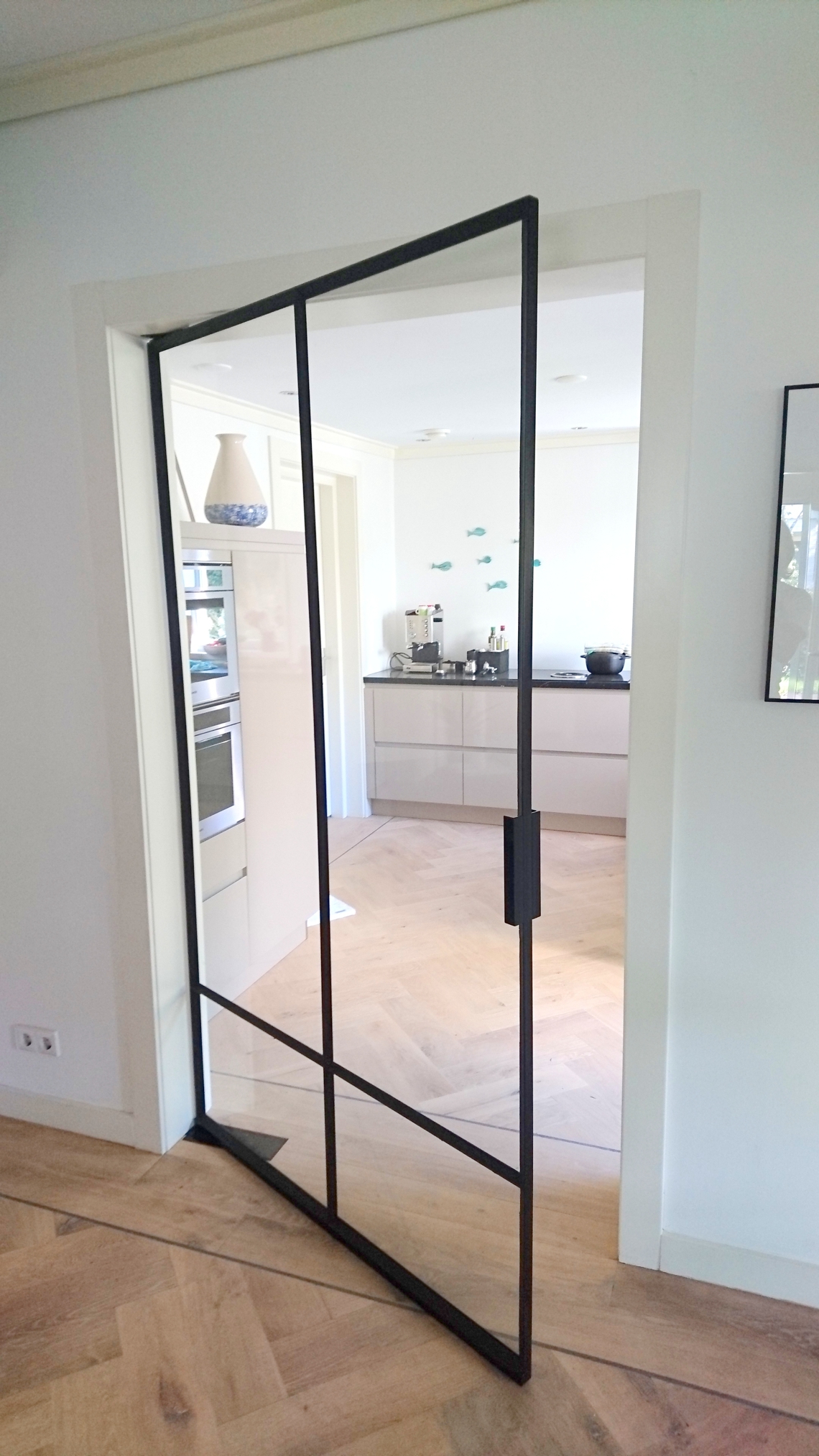
A dark steel frame sets the tone before the rest of the room comes into view. Thin profiles divide the glass into clear rectangles, and the door sits lightly in the opening, letting the sightline continue into the next space. The handle is reduced to a narrow line, so the geometry stays intact. In this interior, the steel pivot door with glass does not compete with the walls or floor; it draws a clean route between them.
Thin profiles, clear lines
The first thing you notice is the grid. Horizontal and vertical bars carve the glass into measured panels, giving the door a firm rhythm without making it feel heavy. The black steel frame sharpens the contrast against the pale walls around it, while the light wood floor softens that contrast just enough. Seen from the side, the interior pivot door reads almost like a framed opening, with the pivot point hidden in the floor and the movement kept visually quiet.
That hidden mechanism changes how the door behaves in the room. Because there is no visible hinge line along one edge, the leaf can turn with a different kind of movement, one that feels open rather than directional. The opening remains free of a slot for a lock case, which leaves room for the glass layout to take its own shape. That is why the pivot door can be arranged with a more open division, letting the panels align with the architecture around it.
Glass panels between light rooms
Across the opening, the glass keeps the next room present. You do not lose the adjoining space; you read it through reflections, pale cabinetry and the clean run of the floor. The glass pivot door allows light to travel while still marking the passage between rooms. In the images, the dark frame stands against white walls, so even a narrow profile has enough presence to anchor the transition.
The visual effect is precise rather than decorative. Rectangles repeat across the leaf, and the open area around the door remains uncluttered, so the grid can do its work. That gives the steel pivot door a calm outline in the middle of a bright interior. The door does not close off the route. It edits it, keeping the view intact and defining the threshold with a few exact lines.
A minimal handle that stays out of the way
The handle follows the same logic. It is slim, straight and deliberately understated, so the line of the frame is never interrupted by a bulky gesture. In a door this clear, any extra detail would show immediately. Here, the handle sits close to the surface and keeps the focus on the glass divisions and the black steel frame. It is a small part of the composition, but it makes the whole leaf read as one measured surface.
Because the handle does not pull attention, the door can hold a stronger graphic role in the room. You read the verticals, the horizontals and the open transparency before you read the hardware. That order matters in an interior like this, where every surface is visible from more than one angle. The result is a pivot door with glass that feels drawn rather than assembled, with each part placed where the eye expects it.
How the pivot movement shapes the passage
There is something notably direct about a pivot door in a house like this. The leaf turns from a point in the floor, so the movement stays centered in the opening instead of clinging to one side. That creates a different kind of threshold. When the door is open, the route feels wider and the view extends; when it is closed, the glass still lets the adjacent room remain visible. The door keeps both rooms in conversation.
The source material describes pivot doors as opening quietly and closing automatically. In practice, that means the movement is not the main event here. The motion happens in the background while the visual structure remains in front. That is why the door can be read both as an interior pivot door and as a glass pivot door: it is a passage element, but it is also a framed surface, with the mechanics kept below the line of sight.
A steel door that works with the room around it
The surrounding interior is light and spare, which gives the dark frame extra clarity. White walls press the opening into a neat rectangle, and the pale floor runs through the frame without interruption. Against that backdrop, the steel pivot door does not need ornament. Its structure comes from proportion, from the spacing of the bars, and from the way the glass holds the reflection of the room. The door’s presence is strongest where it is least thick.
This kind of door also leaves room for different glass divisions. Because there is no lock case to work around, the layout can be chosen more freely, and that freedom is visible in the balanced grid across the leaf. The effect is especially clear in a house where sightlines matter. You can stand in one room and still read the next through the pane, with the black steel frame acting as a measured pause rather than a barrier.
Why the black frame feels so clear in this interior
The black steel frame has a sharp outline, but it does not overwhelm the room. It works because the rest of the interior stays quiet: pale walls, a light timber floor, and surfaces that reflect rather than absorb light. In that setting, the frame becomes a line drawing in space. The rectilinear division of the glass adds structure, while the narrow sightlines keep the opening from feeling closed in.
What remains after a few moments is not a dramatic statement but a precise interior gesture. The steel pivot door with glass connects spaces while preserving their separate character. It shows how a door can do more than divide: it can direct the eye, hold light, and give the transition its own shape. The narrow handle, the floor-based pivot, and the clear grid all work toward the same effect, leaving the passage crisp and legible from both sides.
Want to see more of StalenDeurenHuys? View the page of StalenDeurenHuys for even more great projects and company information.





NEW 2026 Jubileum Edition The Best Interior Designers Benelux
Order Now €125


