










Swimming pond with natural filtering
The waterline does not follow the house’s straight edges. It bends, widens and then opens around a rectangular swimming area that sits inside an organic pond shape. Planted margins soften the transition, and the mix of vegetation and stone keeps the garden from reading as one flat surface. The result is a swimming pond that looks measured but not rigid, with the deck and paving taking their cues from the curves around the water.
Planted edges around the swimming pond
Dense pond planting gathers along the rim, breaking up the outline and drawing the eye away from hard edges. That soft perimeter is what gives the water its calmer reading from the terrace. The natural filtering zone works together with a separate filter system, as described in the project, while the planting adds volume at the water’s edge. From the garden, the shift from open grass to water feels gradual rather than abrupt, which suits the pond’s organic pond shape.
Inside that softer outline, the rectangular swimming area brings a clear counterpoint. Its straight geometry is easy to read from the deck and from the lawn, especially when set against the irregular line of the surrounding pond. The contrast is not decorative for its own sake; it structures the water feature so the swimming zone remains legible. That mix of curves and squares gives the swimming pond its particular rhythm.
A wooden deck at the water
A deck of planed hardwood boards runs beside the swimming water and gives the project a place to pause. The surface is close to the waterline, so it works as a spot to sit before and after a swim, but it also acts as a visual break between planted edges and open water. The timber tone sits quietly beside the stonework and the greenery, and the linear boards echo the more ordered parts of the garden without flattening the overall layout.
Seen from the terrace, the deck marks one of the few places where the garden is allowed to slow down. Metal handrails at the entry point reinforce that practical edge. Nearby planting reaches toward the water, so the timber does not stand alone; it is framed by foliage, moorland-style planting and low growth at the border. In the wider composition, the wooden deck reads as the closest place to the swimming pond and the easiest point from which to watch the water.
Large paving slabs and a clear route through the garden
The most dominant paving material in the garden is a large-format concrete slab used across the driveway and terrace. Their scale gives the ground plane a firm, orderly look, and the broad joints keep the surface from feeling static. On the terrace, the slabs stretch out under the lounge seating and umbrella, giving the sitting area a fixed base. The same material reappears elsewhere, tying the main paved areas together without forcing the planting into the same straight logic.
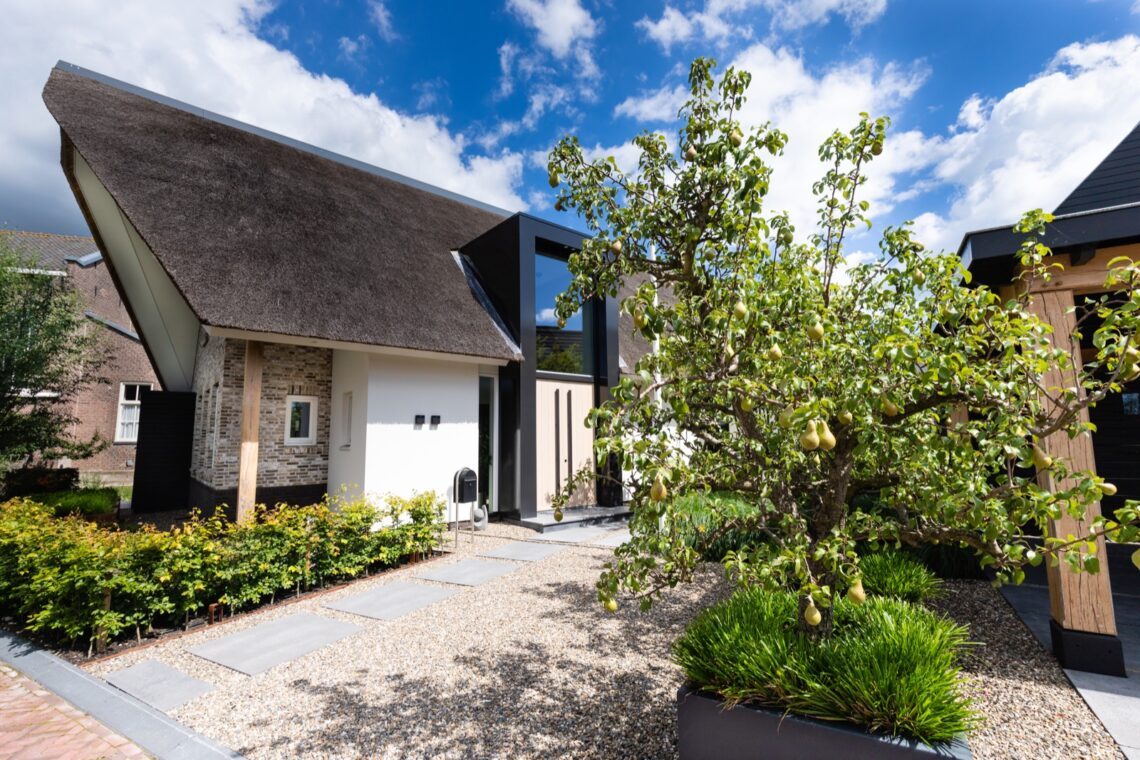
Other surfaces soften that precision. Stepping stones cross the lawn, offering a slower route through the garden, while brick paving and a fine gravel-like surface add texture between the harder areas. Those changes in ground material matter because they let the garden move from one zone to another without a sharp break. The stepping stones, in particular, keep the route through the grass light on its feet and make the lawn part of the composition instead of a leftover space.
From hard lines to looser textures
The contrast between the clean paving and the more irregular surface underfoot is one of the garden’s strongest moves. The modern paving gives the terrace and driveway their clarity, while the more granular material tempers the edges of the built parts. That shift is visible around the house, where the straight lines of the slabs meet planting beds and the open lawn. The garden never becomes fully formal, but it does hold its shape.
The terrace area reflects that same approach. Large plates define the sitting zone, yet the border planting nearby pushes in with flowers and clipped shrubs, so the space does not feel sealed off. The umbrella and lounge seating sit on top of a ground plane that is practical first, but the view out from the chairs is dominated by green and flowering edges. In that sense, the paving works as a frame for the planting as much as a route across the garden.
Flower borders that pull in insects and birds
The flower borders are not treated as filler. Echinacea, drop plant, Lavatera and butterfly bush bring repeated bursts of bloom across the planting beds, and their colour appears most vividly in the close views along the lawn. These borders do more than mark the edge of a path or terrace. They attract butterflies and bees, and they also sit alongside existing trees and shrubs that have been kept in the garden. The layered planting gives the whole plot more depth when seen from the house or the terrace.
Grown shrubs and shaped evergreens sit lower in the composition, helping the border hold its line beside the lawn. In the same frames, the planting catches birds as well, with the larger trees and newer additions providing resting places within the garden structure. The effect is not theatrical. It is visible in the way the beds thicken at the edges, and in the way the flowers punctuate the green around the swimming pond and the terrace.
Keeping the lawn green through dry spells
A fully automatic irrigation system was installed for the 650-square-metre lawn, so the grass can be watered without manual attention during dry periods. That technical layer sits quietly behind the more visible parts of the garden, but it matters to the overall reading of the space. The lawn remains a broad green field between the paved areas, the planted borders and the swimming pond, and the irrigation system helps keep that surface present in the composition.
From the lounge chairs to the stepping stones, the garden is arranged in clear parts rather than one continuous carpet of planting. Water, paving, deck and flower borders each have their own role, yet they touch one another closely enough to keep the route through the garden legible. The swimming pond remains the centre of gravity, but it is the edges — the timber deck, the paving slabs, the flower borders and the watered lawn — that make the project easy to read.
Want to see more of Groenregie, your translator of garden wishes? View the page of Groenregie, your translator of garden wishes for even more great projects and company information.




NEW 2026 Jubileum Edition The Best Interior Designers Benelux
Order Now €125


NEW 2026 Jubileum Edition The Best Interior Designers Benelux
Order Now €125


