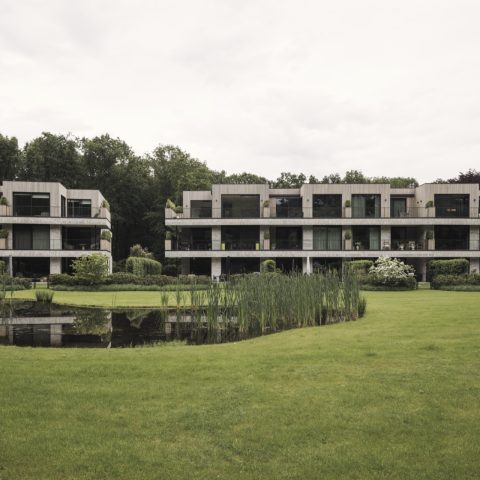









Waterfront country garden
The wooden deck sits low to the water, with a lounge set pulled close to the edge and the view left open. Here, the waterfront country garden begins with boards, reflections and planting that does not try to hide the setting. Purple flowering edges and loose clumps of ornamental grasses soften the straight line of the terrace, while the nearby house, with its thatched roof and white walls, anchors the whole composition in a rural register. The result is lived-in rather than staged: a garden that gives the water room to speak.
Lines, hedges and trees hold the garden together
The house already suggested a country garden, and the planting follows that cue without copying it literally. Existing trees were kept for shade and privacy, which gives the garden an immediate sense of maturity. Among them, a few robust pollarded willows stand out as clear markers in the landscape. Hedges and pleached trees bring sharper lines into the scheme, especially where clipped Ilex crenata keeps the borders tight. That contrast between full crowns and trimmed edges keeps the waterfront country garden legible from one zone to the next.
English garden style influence shows up in the way abundance is controlled. Instead of one broad sweep, the garden is layered: hedge, tree trunk, border, grass, then water. The eye moves through those bands naturally. Even when the planting feels loose, the structure underneath is precise. It is this frame of trunks and hedges that allows the softer planting to spill forward without losing the plan. In a garden so close to open water, that structure matters as much as the view.
Flower borders with colour, texture and shade planting
The flower borders carry the liveliest part of the planting. Lavender, pink loosestrife, irises and large panicle hydrangeas bring clear blocks of colour among the greens. Their stems and flower heads shift the garden away from a flat lawn edge and into a border that reads in layers. Around the transition from front to back garden, shade-tolerant planting takes over: rhododendron, clouds of Portuguese laurel, autumn anemones and astilbe. These plants handle the lower light while keeping the rhythm of the country garden intact.
What makes the borders work is the mixture of leaf shapes and textures. Broad hydrangea heads sit near finer grasses, and clipped hedging sits beside more relaxed perennials. The palette stays close to the ground and the materials around it: green, purple, pale pink, occasional white. Nothing is overdrawn. The planting is dense enough to screen, but still open enough to let light catch the leaves. That gives the waterfront country garden its depth, especially when seen from the terrace or across the lawn.
Natural paving that suits the planting
The hard surfaces stay in the same register as the garden beds. Natural stone, wooden decking, clay pavers and semi-paved areas in gravel stabilisation plates and Japanese gravel give each route a different feel underfoot. The choice is practical, but it also changes how the garden is read. The deck sits close to the water, the pavers guide movement around the house, and the looser gravel areas slow the pace. In a country garden, that variation matters. It lets the planting remain dominant without the circulation feeling improvised.
Along the gravel path, the border planting can be read at close range. Purple flowering plants sit beside the wall and the path edge, so the transition from building to garden is not abrupt. The materials help with that transition too: pale gravel, darker pavers and timber boards each mark a different zone. Because the surfaces are natural rather than glossy or reflective, they keep the focus on the planting and on the water beyond. The whole waterfront country garden feels grounded by those quieter choices.
Wooden deck living at the water’s edge
The large wooden deck is the social centre of the garden. A hand-built lounge set sits there with a fire table, and a parasol gives the seating area a clear vertical accent against the low horizontal boards. From this point the water is never far away. The deck is close enough to feel connected to the edge, but broad enough to hold a proper seating arrangement. That balance of reach and room makes the waterfront country garden usable throughout the day, from a quick pause to a longer evening stay.
There is also a practical sequence to the water side of the garden. A boathouse gives direct access to the water, and after a swim the outdoor shower offers a simple place to rinse off. The shower is tucked between ornamental grasses and an old mooring post, which gives it a degree of shelter without turning it into a separate room. It is one of the clearest signs that this country garden is designed around everyday movement, not just around its view.
Outdoor kitchen and dining under the trees
The outdoor kitchen sits within a screened zone of hedges and planting, so the cooking area feels settled into the garden rather than added to it. The barbecue unit has a built-up form, and the nearby wooden table with its chairs creates a dining spot that can hold a full meal outdoors. Water remains visible in the background, but the kitchen itself is enclosed enough to feel focused. This is where the waterfront country garden shifts from lounging to gathering, with stone, timber and planting all sharing the frame.
Privacy is handled through planting rather than walls. Tall hedges gather around the kitchen and dining area, while trees and layered borders soften the edges beyond. The visual effect is calm, but the practical effect is just as important: the family can cook, eat and sit outside without feeling exposed. From this angle, the English garden style influence is less about decoration than about proportion. The planting is generous, but it never blocks the use of the space.
A garden designed to be used, not just seen
There is enough open space here for children to play, and enough structure to keep the garden from feeling empty. The lawn areas are broad, the routes are clear, and the planting holds the edges. Automatic garden lighting extends the use of the terraces after dark, while the robot mower and garden irrigation take over the repetitive work. Those systems stay in the background, but they change how the garden functions day to day. The lawn remains tidy, the borders stay supplied, and the deck can be used without the garden asking for attention.
What remains memorable is the relationship between the water, the planting and the timber deck. The boards sit low, the borders rise and fall, and the reflections keep shifting with the light. Seen from the terrace, the garden reads as a sequence of materials and plant layers rather than as one fixed image. That is what gives this waterfront country garden its lasting appeal: it offers a strong setting for outdoor life, while leaving enough softness in the planting to keep the edge of the water present throughout the day.
Want to see more of Groenregie, your translator of garden wishes? View the page of Groenregie, your translator of garden wishes for even more great projects and company information.




NEW 2026 Jubileum Edition The Best Interior Designers Benelux
Order Now €125


NEW 2026 Jubileum Edition The Best Interior Designers Benelux
Order Now €125


NEW 2026 Jubileum Edition The Best Interior Designers Benelux
Order Now €125