










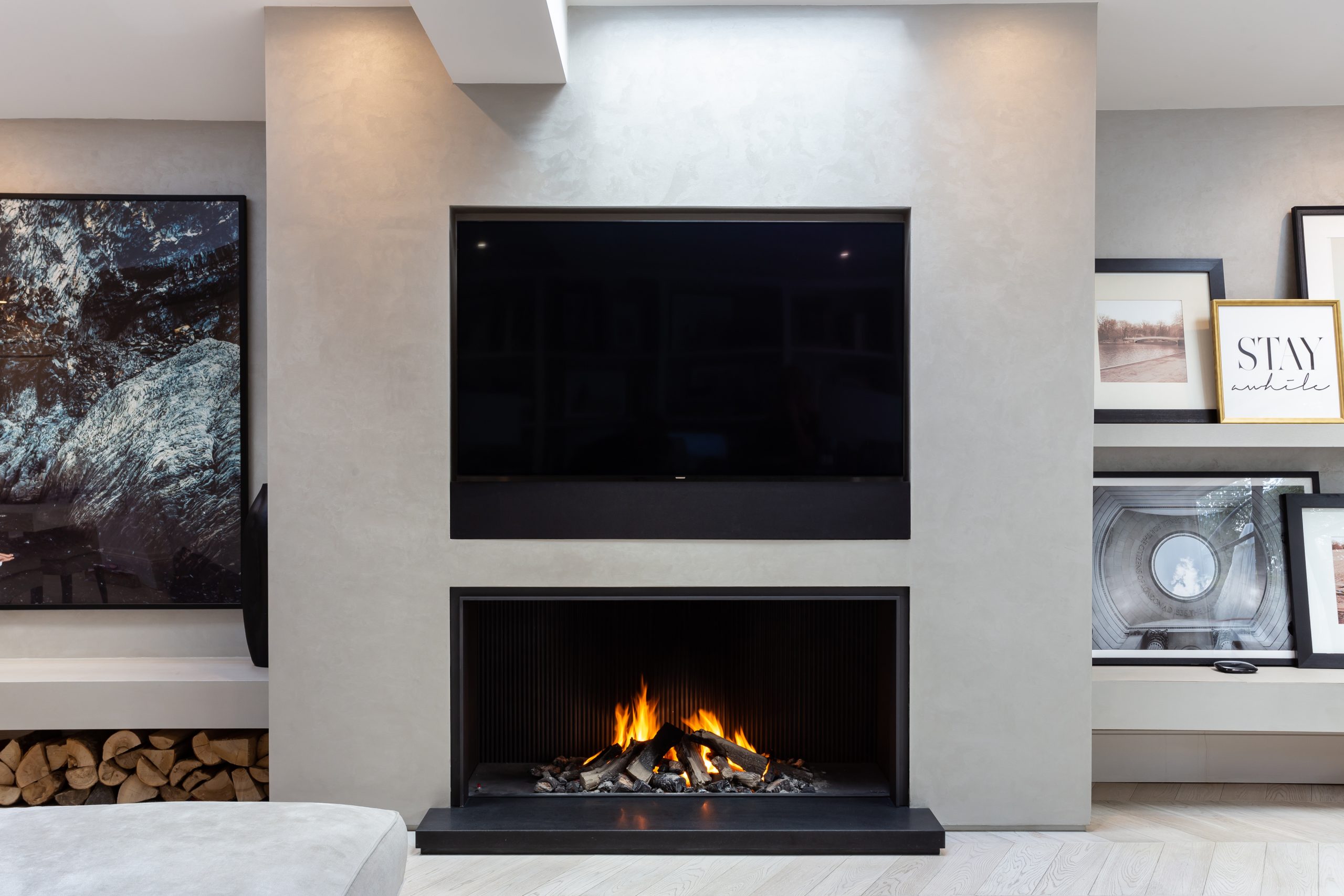
Custom built-in gas wall fireplace in a wall niche
A black frame draws the eye before the flames do. Set into a pale plaster wall, the built-in gas wall fireplace sits inside a deep niche, with the opening kept clean and rectangular. The contrast is simple: white wall, dark surround, orange flame. That direct reading suits the custom built-in gas wall fireplace well, because the fire is treated as part of the wall rather than an added object.
A wall opening defined by line and contrast
The surround is doing more than holding the opening. Its dark edge sharpens the outline of the fireplace and gives the wall niche a clear geometry. Above and around it, the plaster surface stays quiet, so the eye returns to the firebox and the line of the frame. In a room with ceiling recesses and built-in lighting, that restraint keeps the built-in wall fireplace anchored instead of scattered across the space.
What stands out most is the way the opening is cut into the wall. It reads as a custom wall fireplace design rather than a freestanding insert, with the surround built to follow the niche closely. The fire sits low in the composition, while the upper void and the dark band around it create a stacked effect. In the photographs, the wall itself becomes part of the composition, not just a background for the flame.
Inside the firebox, the details stay visible
The interior back wall is not hidden. Vertical ribs or slats appear behind the flames, adding texture where many fireplaces would stop at a flat surface. That firebox back design gives the opening depth, especially in the close-up view where the burning flames lift in front of the darker inner lining. The result is a clear reading of the fire chamber, with the material shift from plaster to metal-like surfaces visible at a glance.
The close-up also shows how the lower opening is framed. A dark ledge or base line sits under the fire, and the flames rise from a compact rectangular chamber. The scale is controlled. Nothing spills beyond the niche. Because the fire sits within a black framed wall niche fireplace, the composition feels deliberate without becoming heavy, and the flame remains the active point in the room.
From modern gas fire to wood-burning option
The source makes one useful point: this same wall fireplace can be shaped in different ways. It may be designed as a modern gas fireplace like the version shown here, or as a traditional wood-burning fireplace. That flexibility matters less as a technical claim and more as a spatial one. The opening, the frame, and the wall recess can support either reading, depending on how the fireplace is finished and used.
In the wider room view, the fireplace is set against a calm envelope of light plaster and built-in ceiling details. Recessed spots and stepped ceiling openings sit above the wall, while the fireplace holds the lower part of the composition. Large windows and vertical curtains appear to the side, but they do not compete with the fire. The niche keeps its own territory, which is what makes the built-in gas wall fireplace feel integrated rather than imposed.
What the finish does at eye level
The finish trim and the inner chamber design are the quietest parts of the project, but they do the most work. The trim marks the edge where the wall ends and the fire begins, while the interior lining gives the opening texture once the flames are lit. Together they turn a straightforward opening into a more composed built-in wall fireplace. Nothing is ornamental for its own sake; each line serves the rectangle of the niche.
Seen from another angle, the black surround becomes a graphic element against the white wall. A shelf-like wall section and framed artworks appear in the background, which helps show the fireplace as part of a lived interior rather than a standalone feature. Even so, the fire keeps the focus. The warm light from the flames pulls attention back to the center, especially in the image where the opening is seen from slightly farther away.
How the niche settles into the room
The room around the fireplace uses a restrained palette: plaster, dark framing, glass, and a few metal details in the lighting. That limited range lets the opening read clearly. The modern wall fireplace niche does not need extra layers to stand out; it relies on proportion, surface, and the brightness of the flames. The black outline is enough to separate the fire from the pale wall and give the recess a sharper edge.
There is also a clear contrast between the hard rectangle of the fireplace and the softer daylight coming through the windows. Curtains fall in narrow vertical lines, echoing the slats visible inside the firebox. That echo is subtle, but it helps the room feel ordered without turning rigid. The built-in gas wall fireplace sits at the center of that exchange between light, shadow, and the dark opening.
A design advisor can help test how this fireplace might sit within another interior, because the same idea can be adjusted to different wall proportions and room layouts. The key is the relationship between the opening, the frame, and the surrounding plaster. Once those three elements are aligned, the fireplace stops reading as an insert and becomes part of the wall itself. That is the strength of this built-in gas wall fireplace: it holds attention through line, depth, and fire.
Want to see more of Modus Fireplaces? View the page of Modus Fireplaces for even more great projects and company information.


NEW 2026 Jubileum Edition The Best Interior Designers Benelux
Order Now €125


