







Garden with Pond and Terraces by the Water
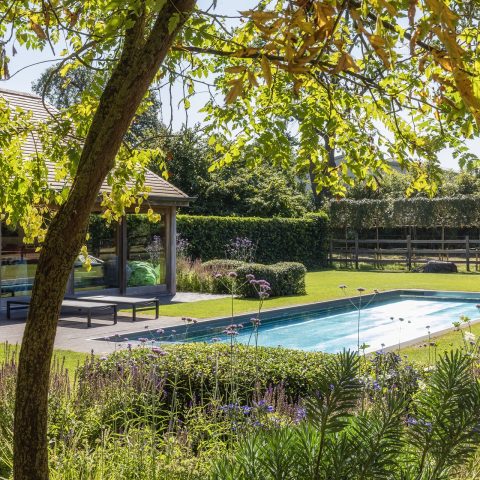
A terrace edge in timber, a reflective pond, and a long lawn plane set the tone before the house even comes into view. The setting needed more than a straight line to the water. Levels had to be absorbed, circulation had to stay clear, and the garage had to disappear into a green rise. In that framework, the garden with pond becomes a landscape rather than a simple water feature.
Terrace, water and the first descent
The terrace sits directly beside the water, so the route from the house to the edge is short and legible. Timber steps lead down in broad treads, and the same material returns elsewhere in the garden as a low platform and seating edge. The move feels measured rather than decorative. From the terrace, the water reads as part of the composition, with the bank pulled into a soft curve instead of ending in a hard line. That is where the project begins to show its restraint: every transition is visible, but none of it is loud.
The garden with pond also works from the side, where the slope is cut and held by hidden concrete retaining walls. They sit inside a shaped mass of yew, so the structural work never dominates the view. This is where the sloped garden retaining wall idea becomes useful as a spatial tool rather than a product solution. A solid garden wall separates the plot from a nearby parking area, while new green volumes replace an older boundary hedge. The result is not enclosure for its own sake, but a wider reading of the site.
How the height differences are absorbed
From roof level to ditch level, the site drops more than five metres. That difference could easily have turned the garden into a series of awkward platforms. Instead, the ground folds gently, with rounded cuts and planted banks that make the change in level look deliberate. The garage is integrated into a green hill, which keeps the built mass low in the landscape and leaves the planting to carry the eye. In a narrow plot, that kind of shaping matters more than ornament. It gives the garden a clear edge without making it feel tight.
Gravel border edging appears in the more serviceable parts of the scheme, where planting meets paths and terraces with a crisp finish. The material keeps the lines clean and lets the planting do the work of softening the perimeter. Through this mix of stone, timber and gravel, the garden avoids a heavy look despite the retaining elements. The eye moves from the lawn to the border, then to the planted mound and back to the water. The sequence is simple, but the ground treatment does a lot of quiet work.
Stone, yew and the hidden structure
The most technical parts of the design are also the least visible. Concrete walls are tucked behind the yew volume, so the planting takes the lead even where the slope needs support. That choice keeps the middle distance calm. It also allows the terrace to sit naturally against the land, rather than appearing dropped onto it. The sloped garden retaining wall is therefore not a visual statement; it is the support system that lets the rest of the composition stay open, planted and legible from inside the house.
A strong stone wall marks the edge near the parking area, giving the garden a firm boundary where it needs one. Elsewhere, rounded planting masses take over. The contrast between the hard wall and the soft mounded planting gives the narrow site more depth than its width suggests. Seen across the lawn, the layered planting design creates a sequence of foreground, middle ground and back edge. That depth is what makes the space feel larger than the footprint would suggest.
A water edge with planted depth
The pond is not treated as a separate object. It is pulled into the terrace, the bank and the surrounding landscape. To make the lower water visible from the house, a shallow bowl was formed in the ground, so the eye drops into the scene instead of skimming past it. On the softened shore, a marsh zone brings together Darmera peltata, Carex muskingumensis, Iris siberica and a swamp cypress. The names are specific, but the effect is even simpler: fine stems, broad leaves and vertical notes set against the still surface of the water.
Massive trees were added to give the seating area some enclosure, and a smaller terrace sits within dense greenery near the pond edge. That place feels more intimate because the planting closes in around it without blocking the view. The terrace by the water is not an isolated deck; it is a pause point between the house, the water and the surrounding ground forms. Here the garden with pond becomes quiet in a very physical way, through level changes, shade and a close edge of leaves.
White bloom, leaf texture and the old willow
One old willow was kept from the original planting because of its strong presence in the composition. Around it, the new planting follows the character of the open landscape without copying it literally. White flowers set the seasonal tone, but the planting never depends on bloom alone. Leaf shapes carry much of the image: broad, narrow, feathery and glossy surfaces sit next to one another so the garden keeps moving even when the flowers are absent. That layered planting design keeps the borders readable across the seasons.
Bamboo deck boards appear again in the stair up to the terrace, which doubles as a place to sit and look back across the garden. The material links several parts of the scheme, but it does so quietly. It gives the steps a dry, tactile surface and keeps the transition between house and garden light in tone. Against the stone wall, the timber reads as a warm line; against the pond, it helps the water remain the focal point. The repeated material use makes the project feel deliberate without turning it into a material display.
Land art in a narrow plot
The strongest gesture in this land art garden is the way the ground itself is drawn. Gently rounded landforms, excavated pockets and sloping lines organise a site that could have felt rigid and narrow. Instead of trying to hide the shape of the plot, the design works with it. The curves interrupt the straight boundaries, while a small peninsula planted with a willow gives the water edge a clearer figure. It is a small move, but it changes the reading of the whole garden.
Seen as a whole, the garden with pond relies on shaped ground, layered planting and material transitions rather than on a single focal object. The terrace by the water, the hidden structural walls, the gravel border edging and the timber steps all support that reading. Nothing is pushed forward too hard. The water, the lawn, the bank and the planting each hold their own line, and together they form a landscape that is calm to look at and precise in the way it is made.
Garden design · Pond garden · Terrace design · Retaining wall design · Planting design
Want to see more of Peter van der Velden Exclusieve Buitenruimtes? View the page of Peter van der Velden Exclusieve Buitenruimtes for even more great projects and company information.




NEW 2026 Jubileum Edition The Best Interior Designers Benelux
Order Now €125


NEW 2026 Jubileum Edition The Best Interior Designers Benelux
Order Now €125


NEW 2026 Jubileum Edition The Best Interior Designers Benelux
Order Now €125


NEW 2026 Jubileum Edition The Best Interior Designers Benelux
Order Now €125