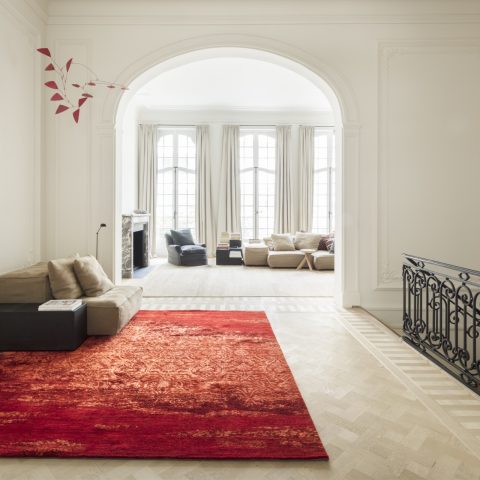








Luxury living room with a textured statement rug
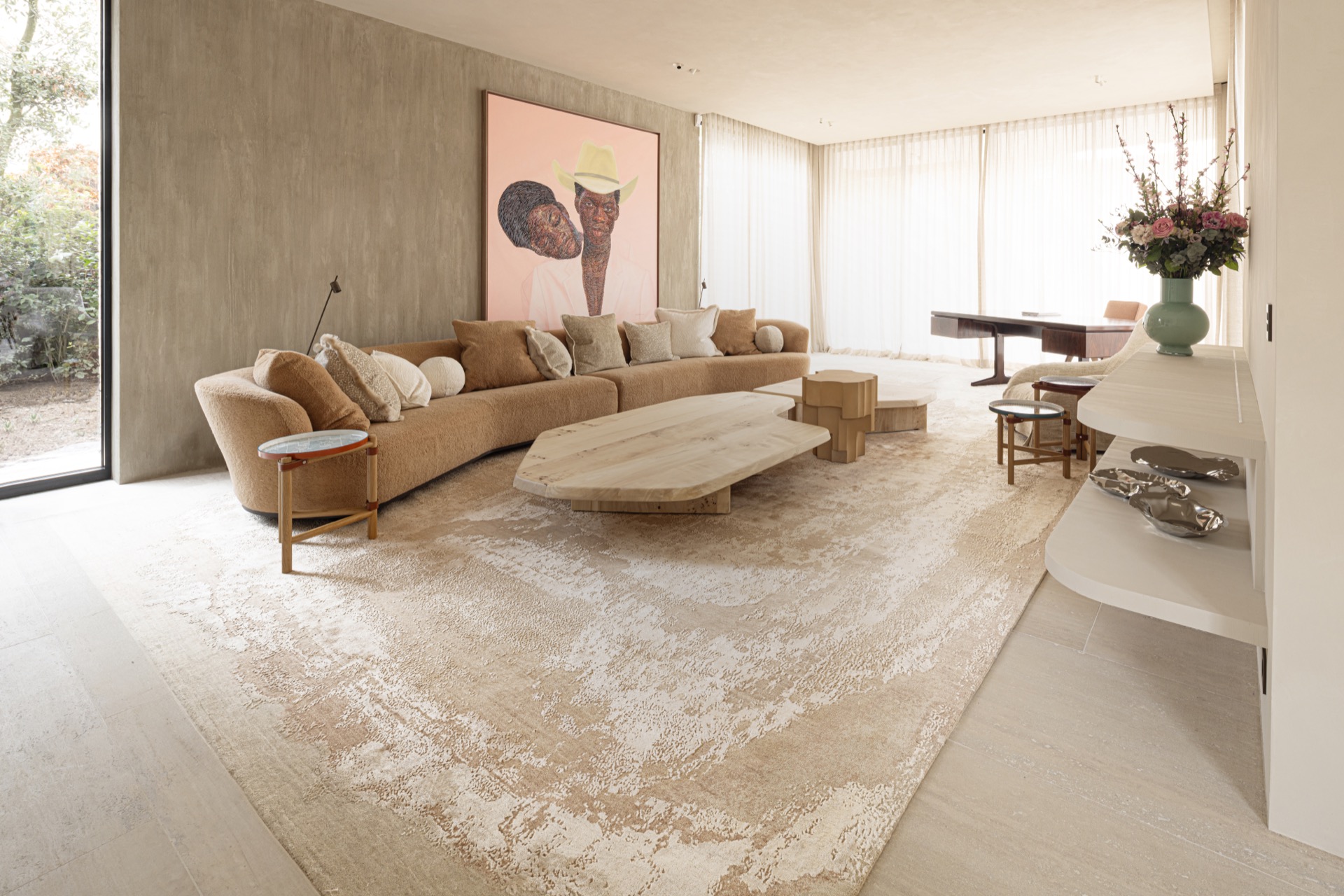
The rug settles the room before anything else does. Laid out in a generous 7 x 4 metre format, it covers the living area with a soft beige surface that catches the light and holds it in the pile. Its texture is the first thing you notice when you look past the sofa and toward the windows, where sheer curtains dilute the daylight. The result is not quiet by accident; the pattern, relief and scale are doing real work in the space.
A statement rug that draws the eye without shouting
The brief behind the living room was clear: the rug had to become the eye catcher, but it also had to sit naturally with the rest of the interior. That meant reading the room as a whole rather than treating the textile as a separate object. The warm beige rug sits against the tones of the floor, the walls and the upholstery, so the contrast stays controlled. It reads as a statement rug, but one that belongs to the seating arrangement instead of competing with it.
From the sofa side, the large rectangular rug anchors the room and gives the beige corner seat a clear edge. The cushions pick up related shades, while the stone-like floor and matte wall finish keep the palette grounded. Nothing here depends on strong colour. Instead, the room uses proportion and surface to create presence. The rug’s surface carries enough variation to register from across the living room, yet it never breaks the calm rhythm of the furniture around it.
Texture and relief at floor level
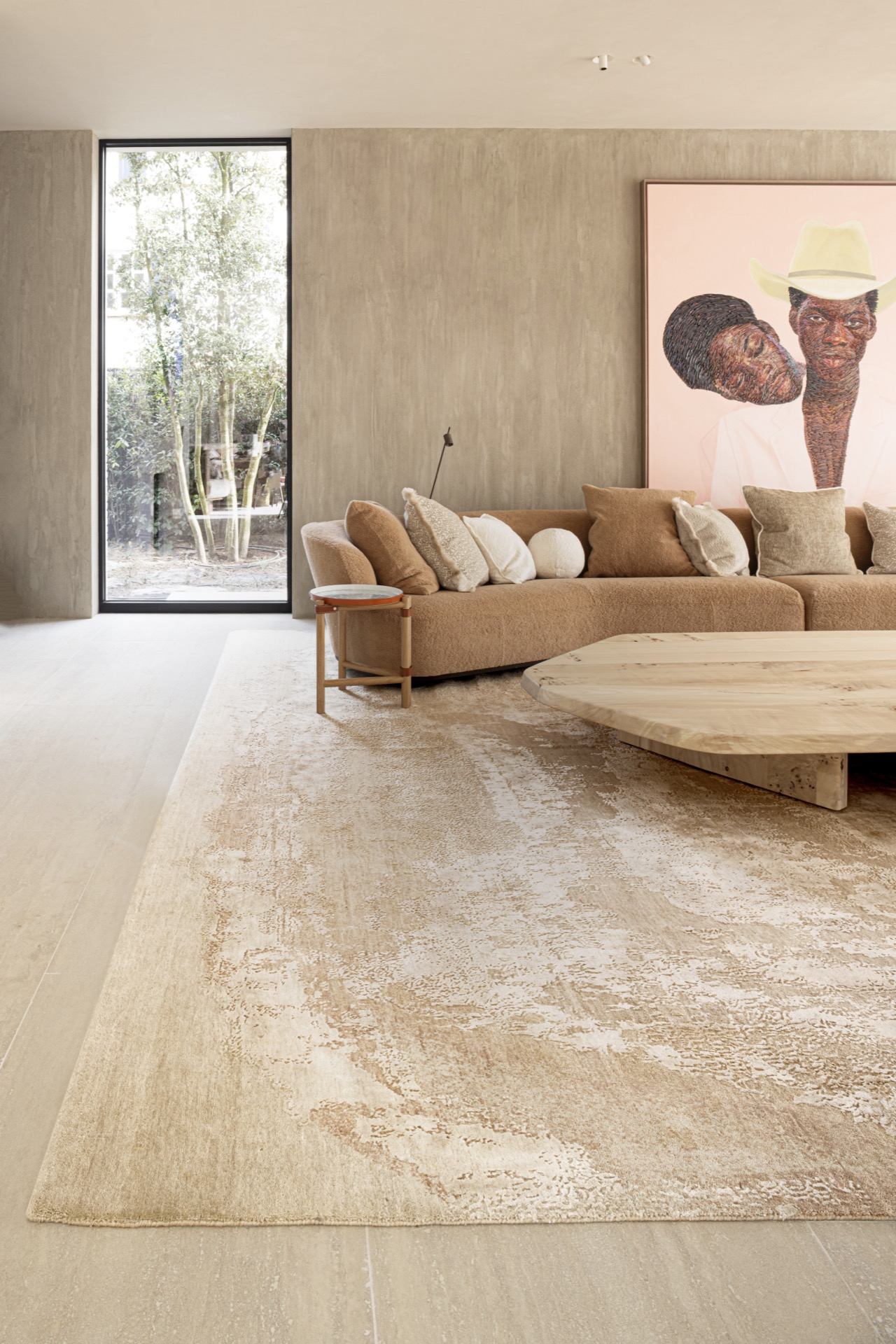
Up close, the carpet changes character. Its texture and relief are what make the piece memorable, especially in a room that otherwise relies on muted tones and broad planes. The surface has depth rather than gloss, so light lands differently across the weave depending on where you stand. That change is subtle, but it gives the floor a tactile quality that a flat textile would miss. In a room with large windows, those small shifts matter.
The project text describes the texture as distinctive to this type of rug, and the image supports that reading. The pile is not smooth or uniform; it creates a surface you can read visually from a distance. That matters in a living room where the seating, curtains and walls all stay restrained. The rug carries the visual interest low in the room, which keeps the eye moving across the floor instead of concentrating only on the furniture line.
Materials chosen for depth, not shine
According to the project information, the rug was made in India using Bikaner wool and natural silk. The wool was hand carded and hand spun, while the silk was hand spun as well. Those material notes explain why the surface has such a layered look. The fibres do not reflect light in a uniform way, so the beige reads as richer than a single flat tone. In the room, that variation softens the transition between the seating area and the surrounding finishes.
The material story also matches the atmosphere of the room itself. A leatherless, fabric-led interior can easily become visually thin if the floor treatment disappears. Here, the rug does the opposite. Its combination of wool and silk gives the living room a grounded centre, and the generous size lets that material presence extend beyond the sofa’s footprint. It is a large rectangular rug, but it never feels heavy because the colour sits so close to the walls and upholstery.
Neutral tones, but not a neutral effect
The palette stays within sand, cream and beige, yet the room avoids looking flat. That is partly because the rug’s surface has relief, and partly because the surrounding materials are different in grain and finish. The upholstered sofa, the smooth wall coating and the stone-like floor each catch light in their own way. Against them, the warm beige rug acts as a linking layer. It doesn’t repeat every surface; it connects them by tone and scale.
This is where the neutral living room rug earns its place. It does not rely on colour to make itself visible. Instead, it uses dimension, size and texture. The living room remains open and legible, with the rug framing the seating area rather than cutting it off. Even the windows contribute to that reading: daylight moves across the pile, and the sheer curtains keep the effect soft rather than stark. A lighter room could have flattened the textile; here, the light helps the structure of the weave come forward.
Protection built into the textile
The project notes mention a nanocoating applied to help protect the rug from dirt and stains. That detail sits in the background of the design, but it matters in a living room where the rug occupies a large surface area. The treatment is described as protection, not as a guarantee, so it should be read that way. What it adds here is practical reassurance without changing the appearance of the textile. The surface still reads as wool and silk, with texture visible across the full span.
Because the rug is so large, even small marks would be noticeable. The protective treatment therefore supports the way the room is used, while leaving the visual language intact. That balance is visible in the project itself: a light beige textured area rug that sits under a sofa, a table and the open circulation of the room, but still keeps its material character intact. It is designed to be seen, and to be lived with.
Why the scale matters in this living room
A smaller textile would have disappeared under the furniture. This one defines the room’s footprint instead. At 7 x 4 metres, the rug stretches far enough to connect the different parts of the seating arrangement and to hold the composition together without hard lines. The size gives the room a measured calm, but the word most people will notice first is presence. The rug is present because it fills the floor with a deliberate surface, not because it is loud.
That scale also explains why the piece works so well as a statement rug. It gives the room a focal point that is broad rather than abrupt, visible in long view and more detailed at close range. The surrounding furniture stays low and softly coloured, so the textile can carry the visual weight. In this interior, the floor is not background. It is part of the composition, and the rug turns that idea into something you can actually read in the room.
Photography – Annick Vernimmen
Suppliers
Thibault Van Renne produced this rug in India using Bikaner wool and natural silk. The wool was hand carded and hand spun, and the silk was hand spun. The rug is treated with a nanocoating intended to help protect it from dirt and stains.
Want to see more of Thibault van Renne? View the page of Thibault van Renne for even more great projects and company information.